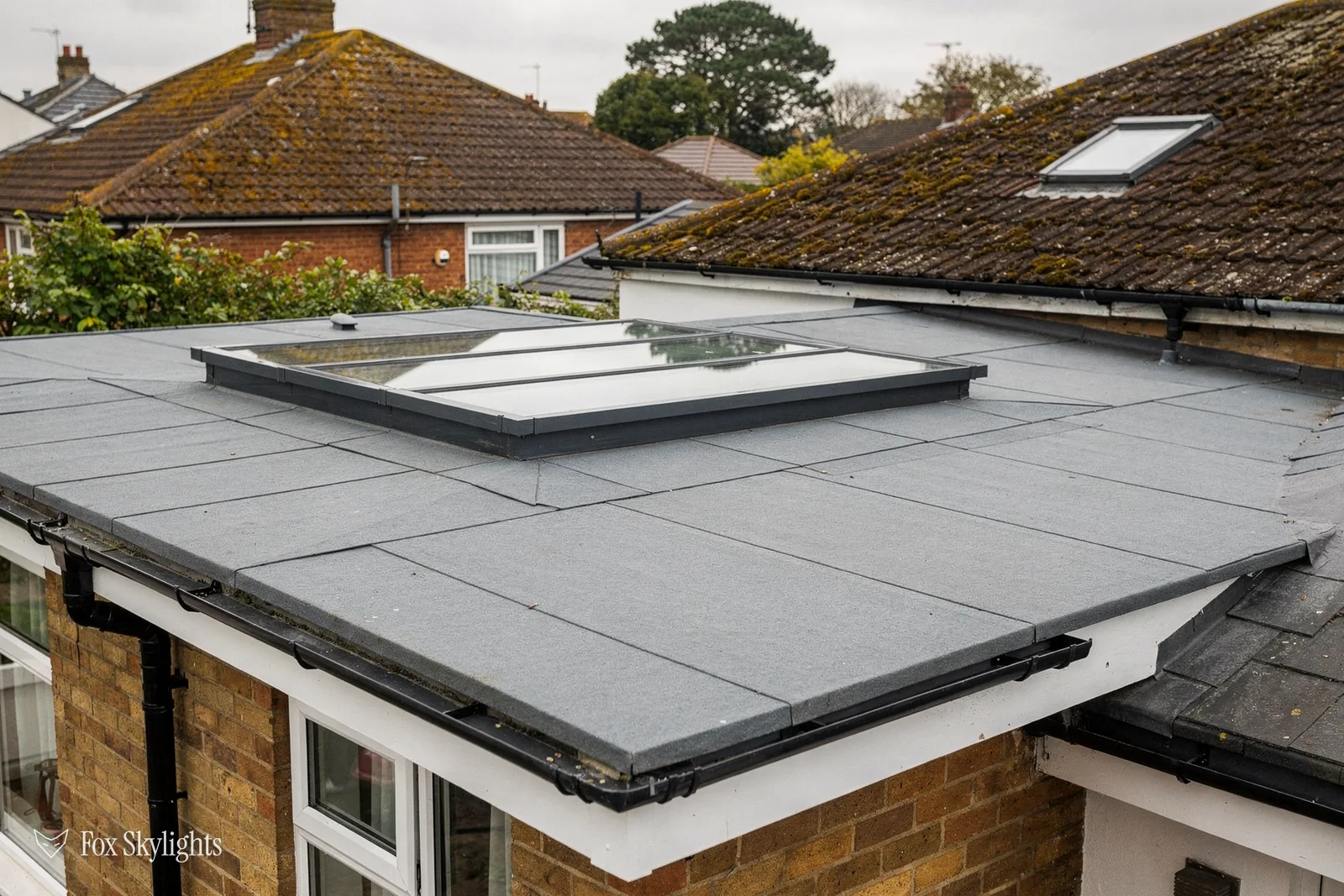
Why the roof covering is not the problem
A rooflight on a flat roof is carried by the structure, not by the waterproof layer. The opening is cut through the deck and the joists. A timber kerb, the raised frame, is fixed around it, and the glazed unit sits on top of the kerb. The roof covering finishes the job: it runs across the roof, turns up the side of the kerb, and is sealed there. Nothing about the glass relies on the membrane being any particular material.
That is why the answer to the question in the title is yes for both. A manufacturer of flat rooflights describes the last stage as flashing the rooflight with the roof membrane once it is at the correct angle, and calls it the final stage of weatherproofing. The membrane is the last thing to go on, and the skill is in the detail.
What changes between materials is the method for that detail. Felt and EPDM are very different products, and each has its own way of being turned up a vertical surface.
Felt roofs
Felt, in the roofing sense, is a bitumen-based sheet, laid in layers and bonded to the roof. The older kind was laid with hot bitumen. The common modern kind is torch-on: the sheet is warmed with a gas flame so the underside softens and fuses to the surface below. Both give a membrane that is joined to itself in layers.
Around a rooflight, felt is dressed up the kerb in extra layers: a first layer that turns up the side, then a cap layer over it. The upturn is the weakest part of any felt roof, so it is done in more than one layer and finished with a cap or a metal trim at the top. The kerb has to be one that the torch can be used near, which means the correct detail on the timber and no insulation or lining in the flame's path.
A felt roof is a good candidate for a new opening. The material is forgiving at the edge of a cut and easy to extend. The practical question is the age. Felt wears, and a covering that is near the end of its life should be in the plan from the start. The survey tells us whether it will outlast the new rooflight, and that is worth knowing before the hole is cut.
EPDM roofs
EPDM is a synthetic rubber. It is supplied as a single large sheet, often cut to cover a roof with few or no joins, and it is stuck to the deck with adhesive. Its strength is exactly that: a surface with very few joins to fail.
Around a rooflight, an EPDM roof is dressed up the kerb with the same sheet, or with a purpose-made flashing piece, bonded to the timber with the adhesive the system calls for, and finished at the top edge. The corners are the tricky part. Rubber does not fold like card, so the corners are formed with pre-shaped pieces or carefully cut and sealed patches, and the sealing tape or adhesive has to match the sheet.
The point worth remembering is that EPDM and bitumen do not mix. Bitumen-based products can harm an EPDM sheet that touches them, so the materials that go on or near the kerb have to be chosen with that in mind. It is one reason the person who opens an EPDM roof should be someone who works with it, not someone adapting a felt method.
Because EPDM is a sheet, fitting a rooflight into an existing EPDM roof usually means working with the sheet already there. How that is done depends on the age and condition of the sheet, which is a thing the survey looks at with the roof in front of us.
Other coverings, and the question of age
Felt and EPDM are two of several. Single-ply membranes of other kinds, fibreglass (GRP) coverings, liquid-applied coatings and lead or zinc sheet all turn up on flat roofs. Each has its own detail at a kerb, and the rule is the same for all of them: the covering is carried up the upstand and sealed in the way that suits that product.
Whichever you have, three questions matter more than the name.
- Is the covering sound? A rooflight is a long-lived thing. A roof with a short life ahead of it is better dealt with as part of the same plan, not left to fail round a new unit.
- Is there a guarantee on it? A roof covering sometimes carries a guarantee from its installer or maker, and that guarantee can depend on who does work to it. If you have the paperwork, show it at the survey.
- Is the roof's fall adequate? The covering cannot make up for a deck that holds water. The fall around the opening is checked as part of the survey, and our guide to fitting a rooflight to a flat roof with no fall covers that case.
The fitting, and what to tell us
The sequence is the same, whatever the membrane. The roof covering is cut back from the opening and the deck opened. The joists around the hole are trimmed and carried on new timbers. The kerb goes up, level or to the angle the unit needs, and is insulated. The covering is then dressed up the kerb and sealed, and the glazed unit is set on top. The kerb and the covering are the two things that decide whether the roof stays dry, and the kerb is covered in detail in rooflight kerbs and upstands.
Two more points. First, the height of the kerb above the roof surface matters. Water settles on a flat roof from time to time, and the covering has to turn up high enough to stay above it. Second, openings that are cut close to a wall or a parapet need the covering to run into the wall detail as well, and that is often where the time goes.
The planning and Building Regulations side of a rooflight is short, and it sits in one place: skylight planning permission and building regulations. Where the work is notifiable to Building Control, we make the notification.
A few facts make the visit more useful. Tell us what the roof is covered in, if you know. If you do not, a photo is enough, because the two materials look different once you have seen both: felt is dark and often has a slightly granular or mineral surface, while EPDM is a smooth, matt, rubbery black sheet. Tell us roughly when the covering went on, and whether anyone gave you a guarantee for it. Say whether the room below has ever shown a stain.
Then we do the rest in person: measure the roof, find the fall, check the structure under the covering and decide how the covering will meet the kerb. The fixed written quote names the detail. The flat roof rooflights page puts the whole job in order, and if you would like us to look at yours, ask for a quote or send a few photos on WhatsApp.