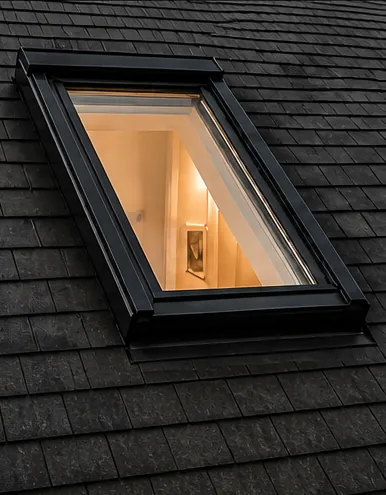
- 01Fog sealed between two panes
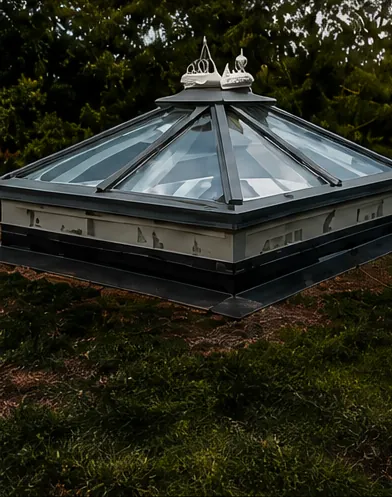
- 02A dome gone yellow and chalky
- 03Frame sound, glass finished
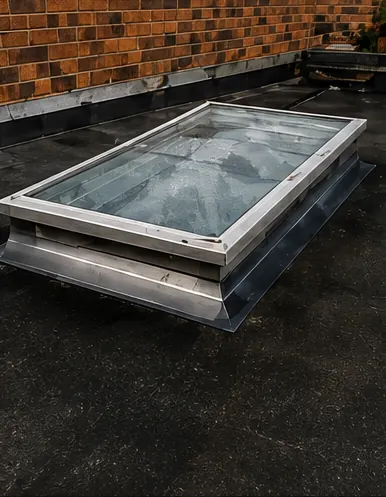
- 04Old kerb, new unit
Replace misted rooflights in Leicester
A rooflight that has fogged between the panes, or gone yellow and brittle, comes out and a new one goes in, measured to the opening you already have.
Or call 0116 430 0516
- Fixed written quote
- 10-year workmanship guarantee
THE FOX BROADSHEET · MISTED AND FAILED ROOFLIGHTS
Misted rooflights in Leicester: what has failed and what goes in
How to tell a failed sealed unit from ordinary condensation, when the glass alone comes out and when the whole rooflight does, and how the swap is made without the roof or the ceiling paying for it.
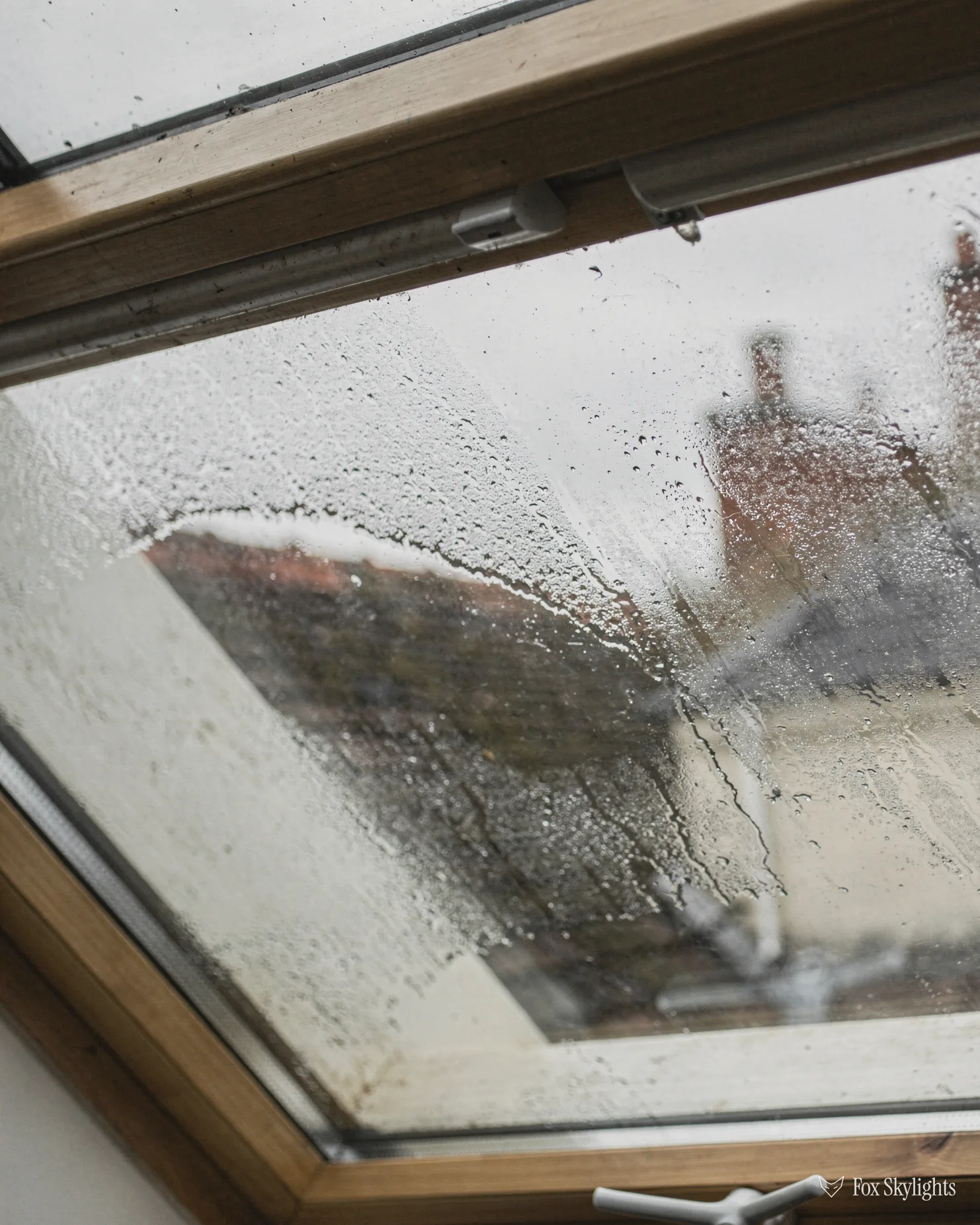
You look up at the skylight and the glass has gone cloudy. Not dirty: you can wipe the outside and the inside and the fog stays exactly where it was, trapped in the gap between two panes. A faint grey haze at first, then a milky patch in one corner, then water droplets that run down the inside face of the outer pane on a warm day and vanish on a cold one. The rooflight is still there, still keeping the rain out. It has stopped doing the job you bought it for, which was letting light into the room.
This page is about replacing it. The trade word for the part that has failed is the sealed unit, the factory-built pair of glass panes with a spacer and a sealed edge between them. Sometimes only that unit has to come out and a new one goes into the frame you already have. Sometimes the frame, the dome or the kerb has aged out too, and the whole rooflight is the better swap. Telling the two apart takes a survey and a tape measure, not a guess from the floor.
Our crews work in Leicester itself and out to a 30 mile radius by road, taking on misted and failed glazing over flat roofs, pitched roofs, extensions and small commercial buildings. A rooflight is the trade's word for glazing set into a roof, and skylight is what the householder calls the same thing, so you will see both here. The survey costs nothing, and the figure you get after it is written down and fixed. If you already know what you are looking at, book the survey. If you would like to know first, read on in the order the job runs.
What a misted rooflight is telling you
A double-glazed rooflight is two panes of glass held a few millimetres apart by a metal or plastic spacer, with a sealant around the edge. The gap is filled with dry air or a heavier gas, and the spacer holds a drying agent that soaks up the small amount of moisture present when the unit was made. That is the whole trick. The still, dry gap is what slows heat moving through the glass, and it is also why you can see straight through it.
Misting means the edge seal has let go. Moist air from outside has crept into the gap, the drying agent has taken all it can hold, and the next lot of moisture condenses on the cold inner face of the outer pane. From then on the gap breathes, damp in and damp out as the weather changes. You cannot clean it away, because it was never on a surface you can reach. It is the sealed unit telling you it has finished.
A reader asks
How can I tell misting from ordinary condensation?
Wipe it. Condensation sits on a face of the glass, usually the room side, and a cloth takes it off. It comes and goes with a steamy kitchen or a cold morning and it is gone by lunchtime. Misting sits between the panes, so the cloth does nothing, and it often leaves a tide mark or a hazy film where the water has dried and left its dust behind. If a patch of fog is still there on a dry afternoon after you have wiped both outer faces, the seal has failed. Our guide to why rooflights mist between the panes goes into the physics, and the page on why rooflights get condensation covers the surface kind, which is a separate matter.
Age and sun speed it along. Glass in a roof takes more weather than glass in a wall. It heats in the afternoon, cools hard at night and sits under rain and frost, and every cycle flexes the edge seal by a hair. A unit that was fitted square and sealed well lasts a long time, but nobody can say how long. When it goes, it goes quietly, and the first sign is often a clear day when the sun finds the haze.
Is it letting water in?
People worry that a misted rooflight means a leaking one. They are two different failures in two different places. The fog is inside a sealed gap that was never meant to be reachable from outside. A leak is water getting past the flashing, the kerb or the outer seal into the room. A misted unit can sit in a perfectly dry rooflight for a long while, and a leak can happen with crystal-clear glass. The two can turn up together on an old rooflight, because the same ageing sealant is doing both jobs. If you see a drip, a brown stain on the ceiling or a damp reveal, that is the question to settle first, and our answer to whether a misted rooflight is letting water in sets out how to check.
What fogged glass does cost you is light and warmth. The room under it gets dimmer and greyer, and the unit no longer insulates as designed, because the dry gap that made it a good insulator has become a damp one. It is a slow loss rather than a sudden one, which is exactly why people live with it for a year or two before they ring someone.
New glass, or a whole new rooflight?
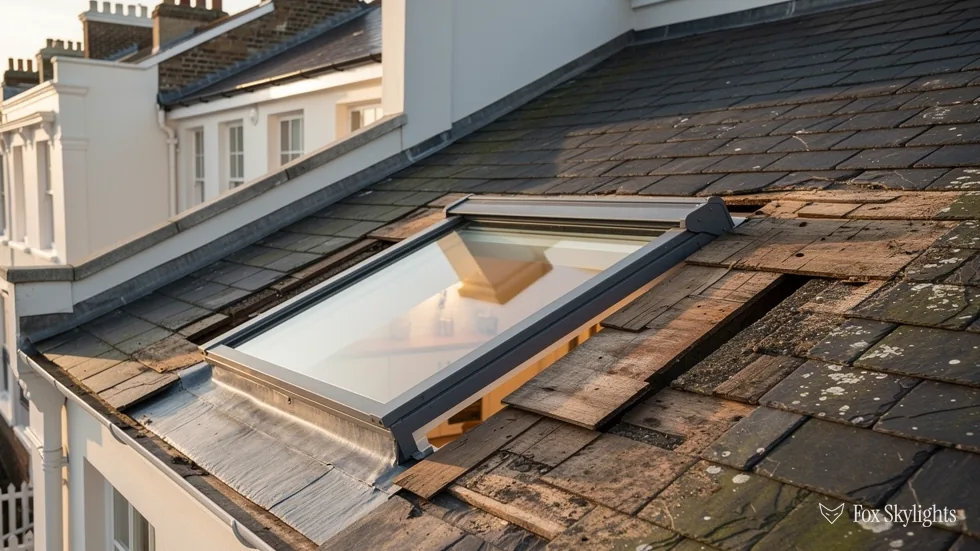
The fog is in the glass, but the question is what holds the glass. A sealed unit is a loose part. It sits in a frame, in a groove called the rebate, held with gaskets or sealant and often a pressure plate on the outside. If the frame is sound and the unit is a standard type, a new unit can be made to the exact size of the old one and fitted into it. The rooflight stays, the glass changes, and the visible work is small.
That is the swap people hope for, and on the right rooflight it is the sensible one. The right rooflight is one where nothing else has aged. A frame that has been painted over several times, a kerb that has softened, a flashing that has lifted at one corner: any of these turns a neat glass swap into the first stage of a bigger job. It is better to find that out at the survey than from a ladder with the old glass already out.
When only the sealed unit comes out
The glass-only swap suits a rooflight with a sound frame, a dry kerb and a unit that can be matched. The old unit is measured on site, to the millimetre, for overall size, glass thickness and the depth of the rebate, because a new unit that is a few millimetres too thin will rattle and one that is too thick will not seat. The new unit is made to that measurement and comes back to site as a ready-sealed pane. Our answer to whether you can replace just the glass in a rooflight explains what has to be true for it to work.
The new unit can be better than the one it replaces. Glass coatings and spacers have improved, so a unit made today will usually insulate better than one made when the rooflight went in. That is a gain you get for free, as long as the frame can carry the new unit's weight and thickness.
When the whole rooflight goes
The whole rooflight comes out when the frame has failed along with the glass: cracked or twisted aluminium, rotted timber, a plastic frame that has gone brittle, a kerb with a soft edge, or flashing that cannot be re-dressed. It also comes out when the opening is an awkward fit for what is there. A fresh unit in a worn-out frame is money spent on the wrong part. You swap the lot, set it on a kerb that has been checked or rebuilt, and the new rooflight carries its own guarantee from the first day.
A whole rooflight swap also lets you change the type. The old pane might be fixed, and an opening one with a rain sensor would suit the room better. The dome might be plastic, and flat glass would look cleaner. Those are choices, not requirements, and we put them in the written quote alongside the like-for-like option so you can see the difference in front of you.
| Point | New sealed unit | Whole rooflight |
|---|---|---|
| Frame | Stays | Replaced |
| Kerb or upstand | Checked, kept | Checked or rebuilt |
| Time on site | Short | Longer |
| Change of type | Not possible | Open to choice |
| Best when | Frame is sound | Frame has aged too |
If you are weighing the two, the page on what decides the cost of replacing a rooflight sets out what moves the price, from the size and the glass to access and the state of the kerb. The free survey is where the number comes from, once the roof has been seen.
Domes gone yellow, chalky or cracked
Not every failed rooflight is a double-glazed unit. A lot of older flat roofs carry a plastic dome: a single or double skin of acrylic or polycarbonate, moulded into a bubble and fixed to a kerb. These do not mist so much as age. The surface turns yellow or brown in the sun. It goes chalky to the touch, the skin crazes into fine cracks, and eventually a corner splits. Brittle plastic is also a safety matter. A dome that has been in sunlight for decades has lost its toughness, and a fall, a branch or a careless boot can put a hole in it.
With a dome there is no neat part to swap. The skin and its fixings are one assembly, and the usual job is to take the dome off the kerb and put a new rooflight on, either another dome or something that suits the room better. Our guide on replacing an old plastic dome rooflight follows the whole job in detail.
The but
The old dome sits on a thin kerb that was never insulated, and the dome is the only thing holding the roof edge together, so lifting it can show soft felt, a split upstand or a kerb that no longer matches any new rooflight on the shelf.
The way in
We survey the kerb before the dome is touched. If it is sound, the new rooflight is made to sit on it. If it is not, the quote includes rebuilding it, in the same visit, so the roof is never left open between the old rooflight coming off and the new one going on.
Glass is not the only upgrade. A plastic dome can be replaced with a new dome, with a flat double-glazed rooflight or with a glazed lantern, and each suits a different roof. The page on glass or polycarbonate rooflights compares them on light, noise and wear, and our flat roof rooflights page covers the flat glass option properly. For a tall room that wants height as well as daylight, roof lanterns are the third choice.
Why the colour change matters
A yellow dome is cosmetic at first. The room has a warm cast that you stop noticing, and the dome still keeps rain out. The trouble is what the colour stands for. Plastic that has yellowed has been broken down by ultraviolet light, and the same process that shifted its colour has made it stiffer and weaker. When it has also started to craze, water can reach the fixings and the kerb, and the room underneath takes the damp. Replacing a dome at the yellow stage is a tidy job. Replacing it after it has cracked, with the kerb wet and the ceiling stained, is a bigger one.
Nobody should step onto an old dome to measure it. Weight on aged plastic is how people go through a roof. We measure from the inside, from a ladder at the edge or with the kerb exposed, and treat any rooflight as unsafe to stand on unless it is a walk-on type made for the purpose.
The swap, step by step
The job begins with the survey, which costs nothing. We measure the opening, the glass, the frame and the kerb, check the flashing and the roof covering around it, look at the ceiling reveal inside, and note where a ladder, a scaffold tower or a hoist is needed. We also look at what is nearby: a gutter that tips onto the rooflight, an overhanging branch, a flat roof that ponds around the kerb. Those are the things that finish a rooflight early, and a new one in the same spot will go the same way unless we deal with them.
What reaches you afterwards is one written quote, fixed, that names the type of swap, the new unit or rooflight, the work to the kerb and the flashing, the finish inside and the removal of what comes out. It is a single number, and it holds once we are on the roof. If the swap falls under the Building Regulations as notifiable work, the Building Control paperwork is ours to deal with.
A sealed unit, start to finish
On the day, the area below is covered and the room is protected from dust and from anything that drops. The pressure plate or the retaining beads come off the outside, the gaskets or old sealant are cut back, and the failed unit lifts out of the rebate. It is heavier than it looks, since a double-glazed pane in a rooflight can be a two-person lift, so it goes down by hand rope or suction lifter and not by a lean-over from the roof edge. The rebate is cleaned and checked, new setting blocks go in to hold the unit at the right height, and the new unit seats on them.
The retaining plate or beads go back, with fresh gaskets or sealant, and the outer joint is sealed and tooled. We then check that water runs off the glass and the frame rather than sitting on any ledge, and that the drainage channels at the foot of the frame are clear. Last of all the inside is wiped and the room is left as we found it.
A whole rooflight follows the same path with more in it. The old rooflight comes off the kerb. The kerb is checked, and rebuilt or reflashed if it needs to be. The new rooflight is set on the kerb with the correct seal, fixed down, flashed into the roof covering and tested for weather tightness. Inside, the reveal is made good, which means the lining between the ceiling and the opening is plastered or boarded and painted-ready so the join looks finished. If the new opening is a different size from the old one, the roof structure is trimmed to suit, with a new frame of timber around the hole to carry the load.
A reader asks
Will it take more than a day?
A glass-only swap on a single rooflight is a short visit, because the frame stays and the unit goes straight in. A whole rooflight with a rebuilt kerb takes longer, and a large commercial rooflight, or several in one building, takes longer again. We give you the time in the written quote after the survey, and the weather sets the one thing nobody can promise, so a roof is opened only when the forecast is dry. For the stages of a fit in more detail, see the timing guide.
The part nobody sees is the day-end routine. Whatever stage the work has reached, the roof is made weathertight before we leave. If a new unit is not due until tomorrow, the opening is covered and sealed, not left under a sheet. Water coming into a room is the one thing a replacement must never cause.
The new glass, and the rules around it
The new unit does not have to be a copy of the old one. Whatever the replacement is, it is a chance to buy the glass better than the last time. Three things set how well a rooflight performs: how many panes it has, what coating is on them, and what sits between them. A modern double-glazed unit usually has a low-emissivity coating, a thin metal film on one pane that reflects warmth back inwards, plus a spacer made of a material that carries less cold to the glass edge than the old aluminium kind. Triple glazing adds a third pane for a lower figure still, at more weight and cost, and our page on triple or double glazed rooflights compares the two.
U-values in plain words
A U-value is the figure for how much heat passes through a material. The lower it is, the better it holds the heat in. It is measured in watts per square metre per degree of temperature difference, written W/m²K. Two figures matter for rooflights in an existing home set by Part L, the energy section of the Building Regulations, for an existing dwelling: a rooflight has a ceiling of 2.2 W/m²K, and a roof window has to hit 1.4 W/m²K (or Window Energy Rating band B). They are different products. The roof window lies in a sloping roof and opens on hinges, while the rooflight is glass on a raised kerb over a flat roof. Which of the two you have decides which limit your new one has to meet, and the page on rooflight U-values and Part L goes through it in full.
A reader asks
Do I need permission to replace a rooflight?
Swapping a rooflight for one in the same opening is usually permitted development, which means it does not need a planning application. The short version: the new unit must stay within 150mm of the roof slope's surface and must not rise above the roof's highest point. Three situations change the answer. A listed building needs its own consent, a flat or maisonette is outside the householder rights altogether, and a local Article 4 direction can take the right away. The Building Regulations sit on top, so the glazing must meet the figures above, and Building Control paperwork comes with the job where it applies. The statutory detail is in the planning and Building Regulations guide.
One more rule belongs to loft rooms. Loft rooms add one more rule. Where the fogged skylight is a roof window that a bedroom counts on as its way out, the new one has to do that job as well. Approved Document B only allows an escape window for floors up to 4.5m off the ground, and a loft conversion in a two-storey house needs a protected stair rather than any window. A genuine escape gets a matching replacement, and the roof window fire escape answer explains how the sizes and heights work.
| Choice | What it does |
|---|---|
| Low-emissivity coating | Holds heat in the room |
| Warm-edge spacer | Cuts cold at the glass edge |
| Solar control coating | Eases summer glare and heat |
| Laminated inner pane | Holds together if it breaks |
| Triple glazing | Lowest heat loss, heaviest |
If the old rooflight made the room too hot in summer, a solar control coating is the fix to ask about, and we cover it on the page about solar control glass for rooflights. For overhead glass the inner pane is usually laminated, which means two layers of glass bonded round a plastic interlayer so that a break leaves the pieces in place rather than falling into the room. Laminated glass is a safety matter and is the sensible default for anything overhead.
Can I get a government grant for new glazing in a roof? Government energy schemes change, so check gov.uk for the help on offer now. The written price we give you stands on its own, whatever schemes are open.
Flat roofs, pitched roofs and commercial units
Flat roofs and extensions
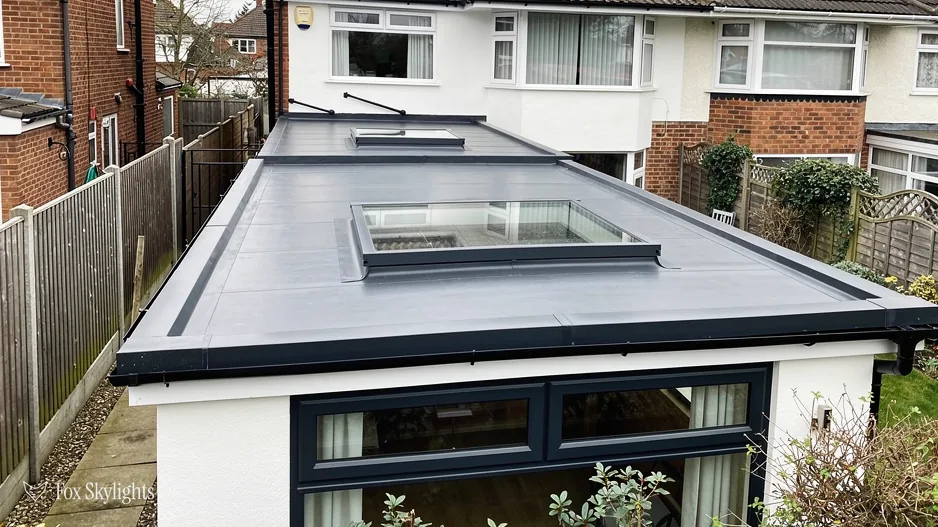
Flat roofs carry the biggest share of misted rooflights, because a flat rooflight is a large pane of glass facing the sky with nothing to shed the weather and nothing to shade it. The kitchen extension on the back of a Victorian terrace, the garden room, the flat-roofed rear addition from the 1970s: each has its own sealed unit or dome, and each ages at its own pace. The roof covering matters here. GRP, which is glass-reinforced plastic laid as a continuous skin, felt, EPDM rubber and single-ply membranes all meet the kerb differently, and the flashing for each is different. Our page on rooflight kerbs and upstands shows why the height of the kerb above the finished roof is the thing to get right.
The shapes are worth knowing by name. A flat rooflight is a single pane on a low kerb. A pyramid or plateau rooflight has sloping glass on every side and a small flat top, and a dome is a bubble of plastic. A lantern is the tall, pitched version. A like-for-like replacement keeps the shape. A change of shape is a decision for the survey, because it alters the kerb and sometimes the height.
Pitched roofs and roof windows
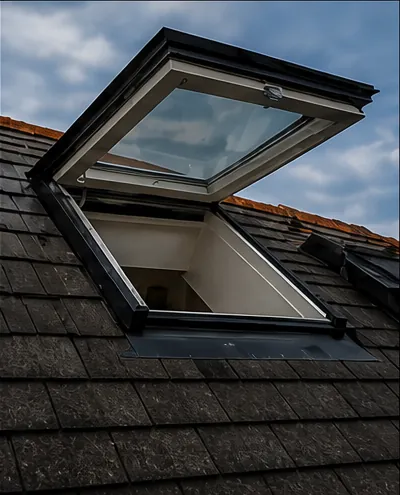
On a pitched roof the misted pane is usually in a roof window, a rooflight set in the slope in line with the tiles or slates. The same logic applies, with a sharper edge: the unit is the part that failed, but the flashing around the frame is the part that keeps the weather out, and the two have to be thought of together. Some roof windows can be re-glazed from inside, which is explained on the page about replacing a VELUX from the inside, and some are better replaced whole, with a new frame and a new flashing kit. Knowing when a VELUX is due for replacement helps with the call. The size code matters when you order: on a VELUX the letter is the width and the digits are the height, so an MK04 is not an MK06, and a survey takes the measurement off the frame, not from memory. Our roof windows page covers the product itself.
Commercial and industrial rooflights
Houses come first, but a small commercial roof is welcome too: a workshop, a shop unit, a small warehouse bay, a school extension, an office over a yard. The rooflights are bigger, the roofs are different, and the safety questions weigh heavier. Older commercial rooflights are often plastic or fibre-reinforced sheets that turn brittle with age. They fail by cracking, not by fogging, and a cracked sheet on a roof people walk on is a fall hazard. Fall protection is the first thing we look at on those roofs: edge protection, a safe route, covers for open holes. Nobody stands on a rooflight that is not made to be stood on.
The replacement can be GRP or polycarbonate sheet, a glazed unit, or a walk-on rooflight where the roof is used for access. Light is the point for these buildings, because a dark workshop costs real money in lighting and in mood. Insulation matters too, since a large rooflight is a large hole in a warm building. See walk-on rooflights for the load-bearing option.
Leicester roofs, and looking after the new one
Leicester has roofs of every age, and each age fails rooflights in its own way. Victorian and Edwardian terraces have rear outriggers and flat-roofed kitchen additions whose rooflights have been in place for decades, set on kerbs that were never built for modern glass. Interwar and postwar semis often carry a flat-roofed extension at the back, a dormer or a lean-to over a side passage, and those roofs were made for a dome, not a sealed unit. Newer estates have roof windows in the slope and flat rooflights in garage conversions and rear extensions, installed with the standard of their day and now old enough to mist.
Each type has its own access. A terrace may have a narrow rear yard, a shared passage or no side access, so materials come in through the house or up from the street and the survey plans for it. The city and the surrounding county get the same method, so the one goes into a Leicester terrace and a country house on the edge of the county.
Conservation areas and older buildings
Parts of Leicester and the county sit in conservation areas, and some buildings are listed. A like-for-like swap of a rooflight that is already there is a different thing from adding a new one, but the answer depends on the building and on the council, so we check first rather than assume. A listed building needs listed building consent for work that changes its character, and an Article 4 direction can remove permitted development rights in an area. Our pages on conservation rooflights and on rooflights in Leicestershire conservation areas set out the detail, and Historic England has published guidance at historicengland.org.uk.
Awkward roofs are our wedge, and a misted skylight is often found on one: a valley between two pitches, a roof with a chimney at one side, a very shallow slope, a roof so tall that the ladder needs a scaffold. We work these out at the survey. Our guide to awkward roofs and where a skylight can go is the place to start if yours is one.
Aftercare and maintenance
A new rooflight asks for very little, and what it asks for is easy. Clean the glass once or twice a year with water and a soft cloth, from the inside and from a safe place outside, and not by walking on it. Keep the gutters and the roof around it clear of leaves, since standing water at the kerb is what ages seals first. Look at the sealant at the edges from time to time and tell us if it has lifted or cracked. If the rooflight opens, operate it now and again so the mechanism stays free. If it has a rain sensor, wipe the sensor.
We guarantee our workmanship for a decade, and the guarantee page says exactly what that covers. The glass carries the manufacturer's own terms as well, which we pass on in writing with the quote. If anything looks wrong after the job, tell us at once. WhatsApp is the quickest way to reach us, on 07880 284133 or through the WhatsApp link.
What will a misted rooflight cost to replace? It depends on the size, the type of glass, whether the frame stays, the state of the kerb and how hard the roof is to reach. A small like-for-like unit and a large rebuilt lantern sit a long way apart, so the number comes after we have seen the roof. The survey is free and the price after it is fixed, on paper. The costs page shows what moves a price, and our answer on price goes through it item by item.
If the rooflight over your kitchen, hallway or workshop has turned to fog or to yellow plastic, the next step is small. Book the free survey, and we will tell you in plain terms whether it is a new unit or a new rooflight, and what each would involve.
Further reading
Guides
-
Why rooflights mist between the panes
How a sealed unit fails, why the fog sits where a cloth cannot reach, and what makes it happen sooner.
9 min read
-
Replacing an old plastic dome rooflight
The job of taking an aged dome off its kerb and putting a new rooflight in its place.
9 min read