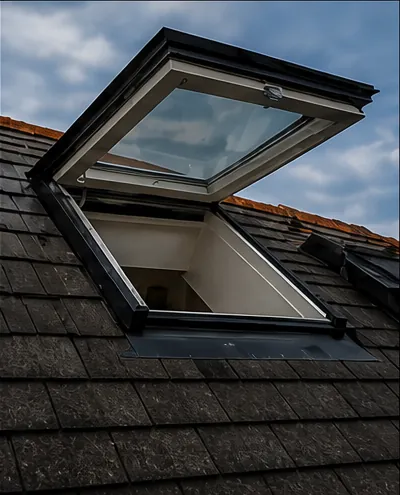
- 01Low pitch?
There is still a way in - 02A purlin in the way
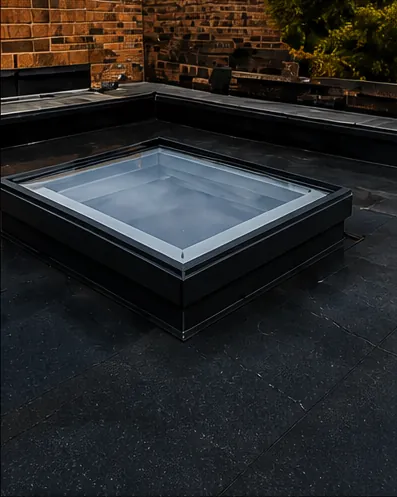
- 03Flat roof, no fall
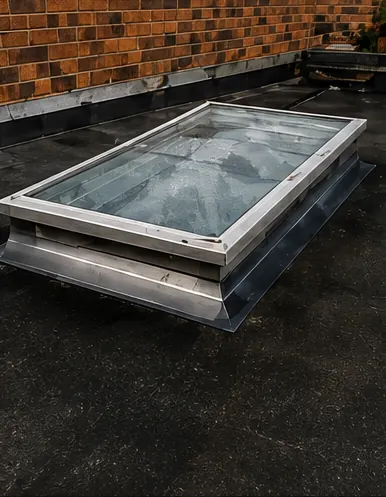
- 04Misted units replaced
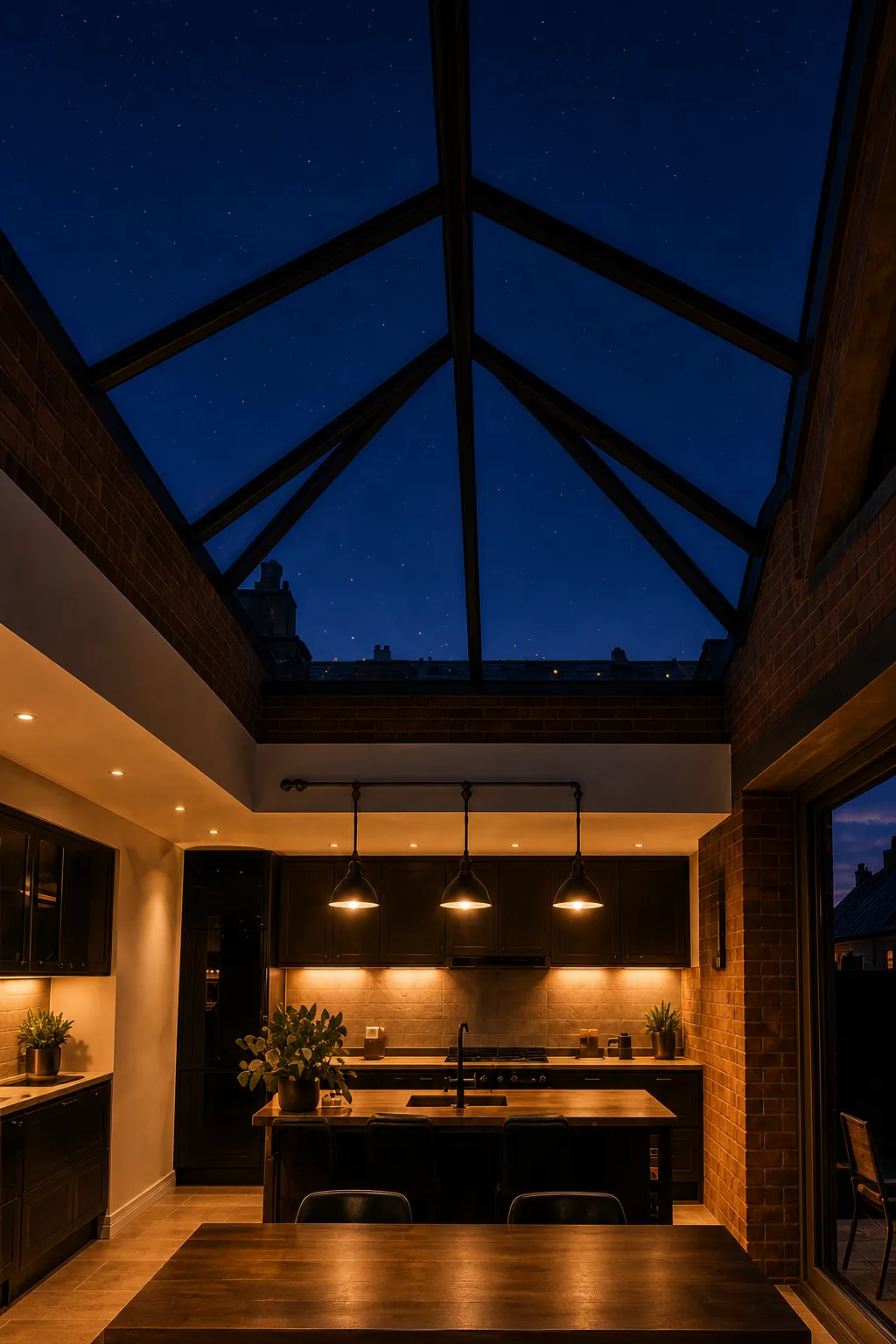
Leicester and 30 miles around
Skylight and rooflight installation, Leicester We find the way in.
Skylights and rooflights for awkward roofs.
Or call 0116 430 0516
- Fixed written quote
- 10-year workmanship guarantee
The awkward ones
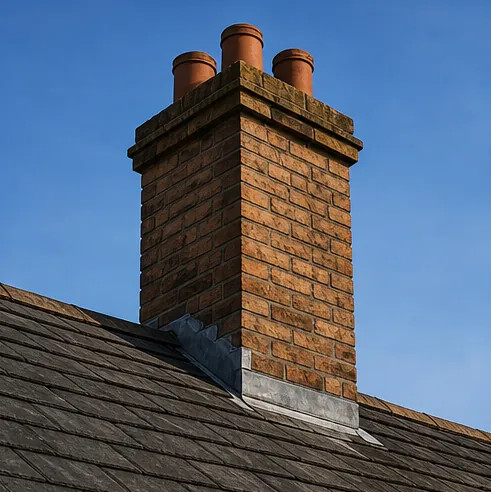
Not every roof is straightforward. Chimneys, valleys, purlins and services all get in the way. That’s where we start looking.
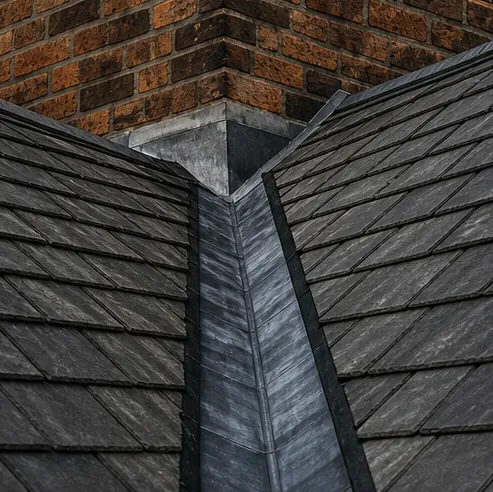
Valleys, hips and changes in pitch need careful detailing. We do that every day.
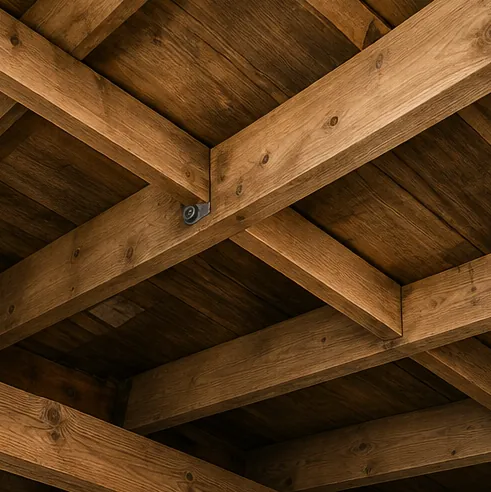
A purlin right where the light needs to go? We work around it, not through it.
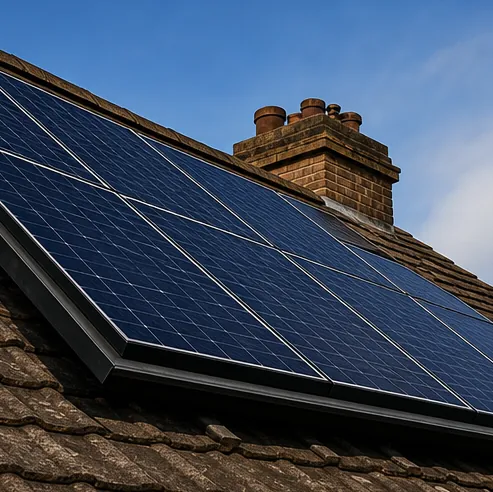
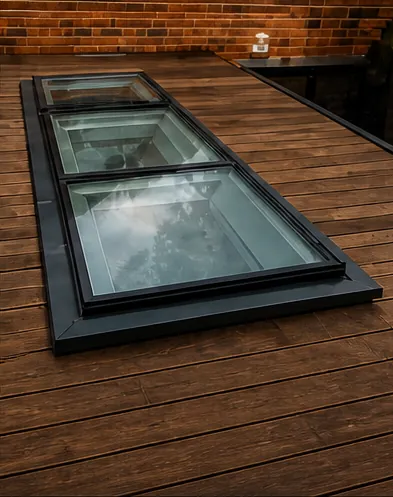
Panels, pipes, plant and odd layouts. We solve the puzzle and make it watertight.

Straight answers
- What if something goes wrong?
- Our workmanship is guaranteed for ten years, in writing.
- Who deals with Building Control?
- We do. We handle the notification where the work is notifiable.
- Will the price change on the day?
- No. You get a fixed written quote after the survey.

In this job
Photo or call
Send a photo or call us. We’ll ask a few quick questions.
Survey on the roof
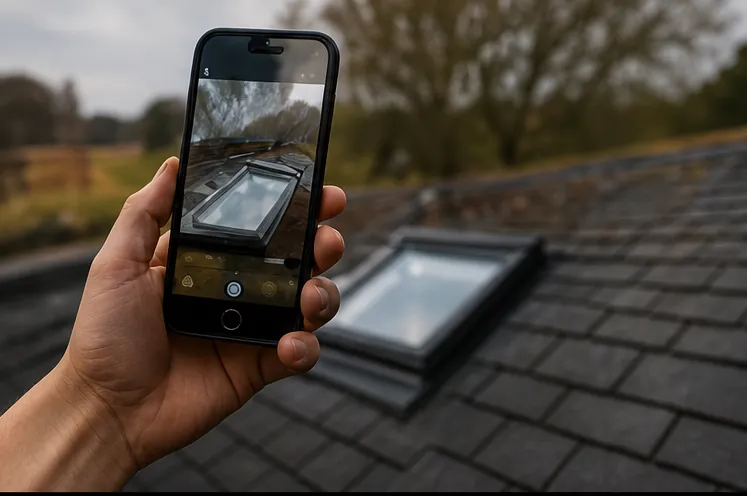
We visit, measure up and check access from the roof.
Fixed written quote
You get a clear quote by email. No surprises, no pressure.
Fitted and signed off
We fit it properly and get it signed off where required.

Leicester and 30 miles around
See every area
THE FOX BROADSHEET · SKYLIGHTS AND ROOFLIGHTS IN LEICESTER
Skylight and rooflight installation in Leicester, worked out roof by roof
A plain account of how daylight gets into a roof that was never built for it, from the first look in the loft to the sign-off.
Every roof has its own logic. The pitch, the structure, the covering and the way water leaves it all decide which light will sit well and keep working for years. This read sets out how Fox Skylights matches a skylight or rooflight to the roof you already have, in homes across Leicester and the towns within 30 road miles of it.
We start with the roof, not the catalogue. A survey comes first, it is free, and it ends with a fixed written quote that names the product, the size, the position of the opening and the finish. Skylight installation in Leicester tends to mean old roofs with new demands: a Victorian back addition, an interwar hip, a loft that wants to become a bedroom. Rooflight installation on a flat-roofed extension is a trade of its own, with kerbs, falls and coverings to get right.
Some roofs are straightforward. Some are not, and those are the ones we like to see. A purlin moves the opening; it rarely ends the idea. A low pitch rules out some products, not all of them. And when there is no sensible way in, you hear that plainly, before anything is cut.
If you want more natural light without the guesswork, read on, or ask for a survey now.
Which light for which roof
Not every light suits every roof. The words get used loosely, so first a translation. A roof window sits in a pitched roof, follows the slope and opens, so you can reach it and clean it from inside. A rooflight, in the trade sense, is a fixed or opening glazed unit on a flat roof, set on a kerb. Skylight is the everyday word and covers both. We use all three, and the quote always says exactly which one you are getting.
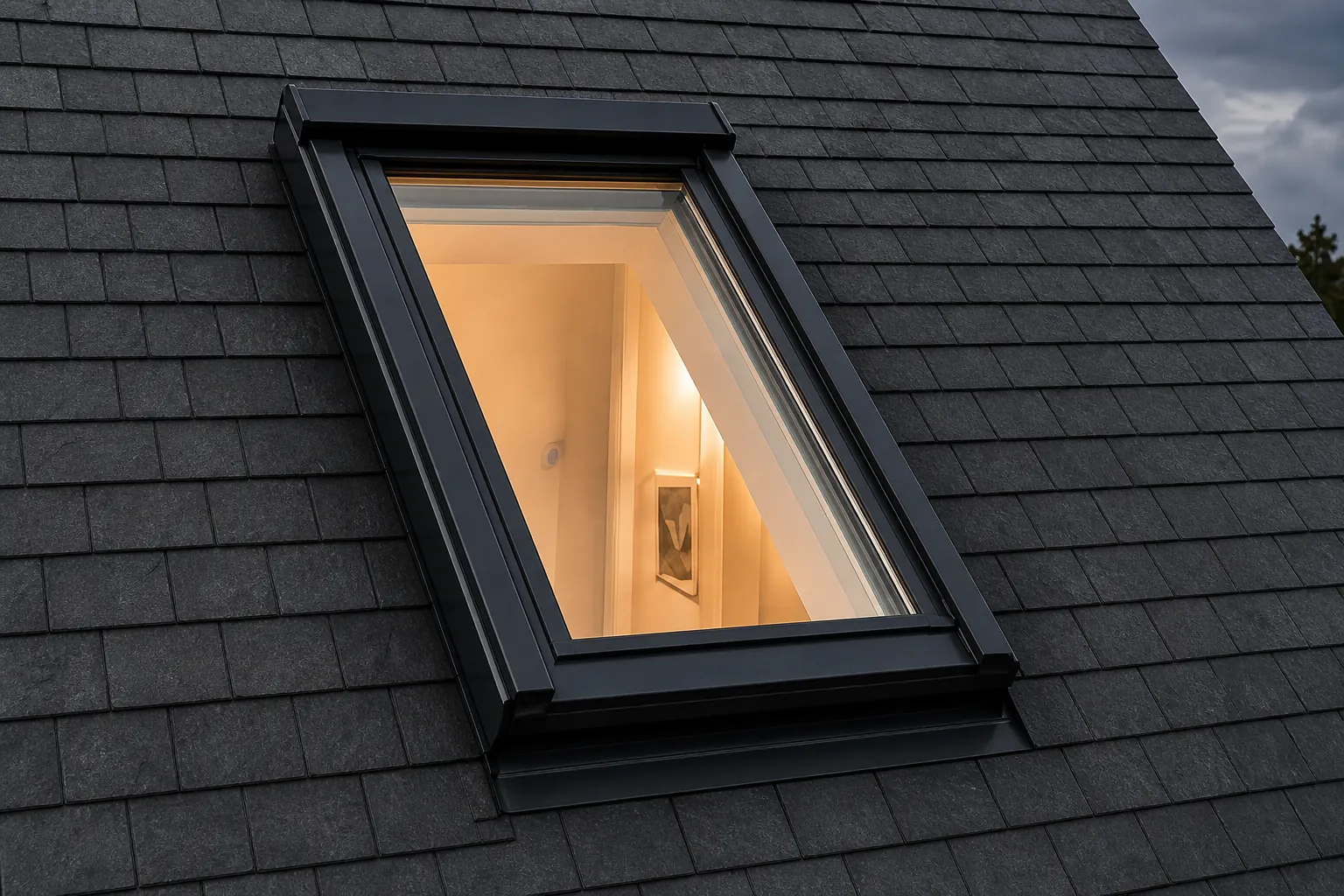
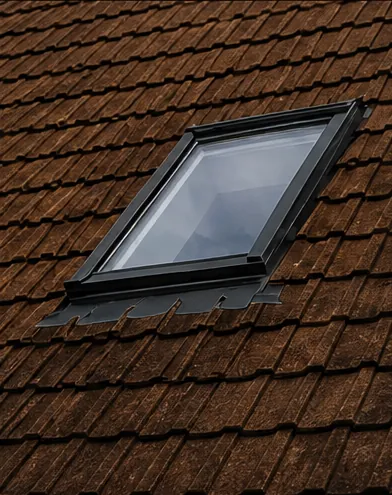
On a tiled or slated pitched roof, a roof window with the right flashing kit is the natural choice. The flashing is the shaped metal collar that ties the window into the covering, and it is made for that covering: a deep profiled tile and a flat slate take different kits. On a period house in a conservation area, a conservation rooflight sits low among the slates with a slimmer, darker frame. For the best-known maker, our VELUX windows page covers the range, the flashings and the size codes.
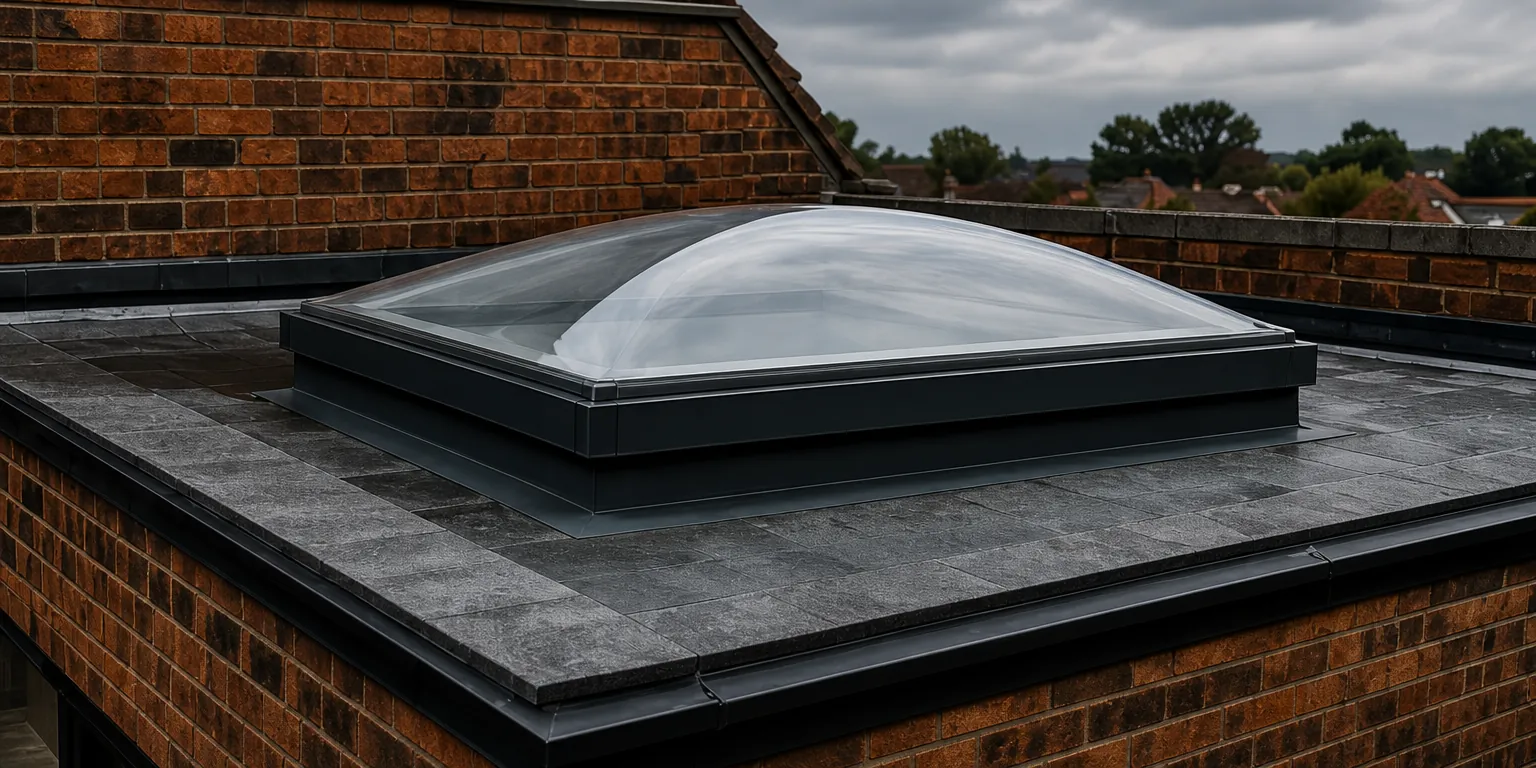
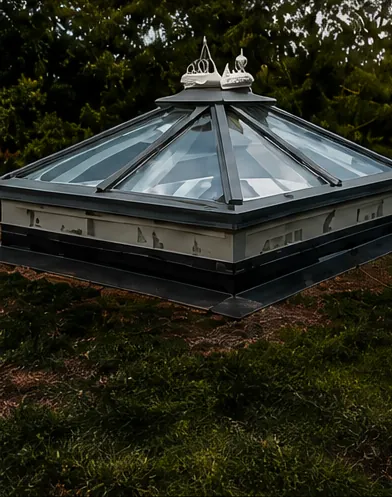
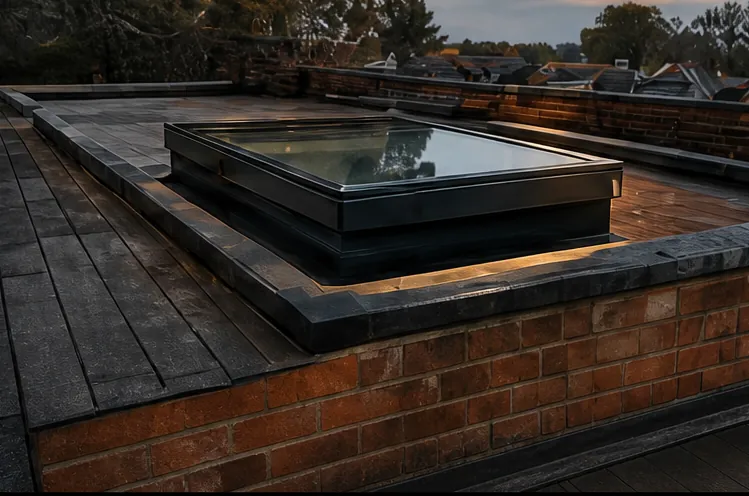
A flat roof needs a different answer. The glass has to sit clear of standing water, so a flat roof rooflight goes on a kerb: a raised frame, either timber built on site or a factory-made insulated upstand in uPVC or GRP, with the roof covering dressed up and over it. Where the room wants a centrepiece rather than a slot of sky, a roof lantern lifts a small pitched glass roof above the flat one. Where people will stand on the glass, over a basement or on a terrace, a walk-on rooflight takes the load. Older flat roofs still carry polycarbonate domes, light and cheap in their day, which yellow and craze as they age.
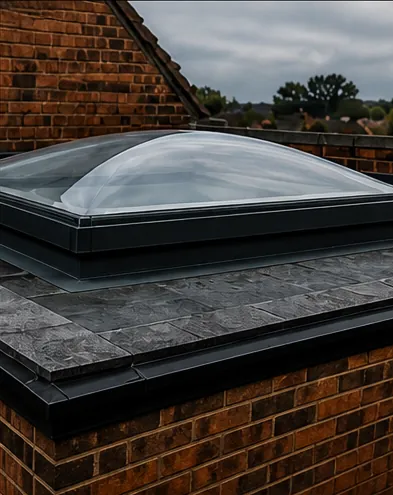
Sizing is about the room, not the moment. There is no Building Regulations daylight requirement for houses in England, so the size is your choice, guided by the depth of the room, the way the slope faces and what stands outside. Too much glass on a south slope can overheat a bedroom in July. Too little on a north slope can leave a kitchen feeling flat. Every opening is measured for its own roof, and the light is made to measure or chosen from a size range to suit that opening, never the other way round.
| Roof | What fits | The awkward bit |
|---|---|---|
| Pitched, tiled | Roof window | A purlin in the way |
| Pitched, slate | Roof window or conservation rooflight | Flashing for flat slates |
| Flat, felt, EPDM or GRP | Flat rooflight or lantern | No fall to the outlet |
| Low pitch | Low-pitch roof window or kerb rooflight | Below the product's minimum |
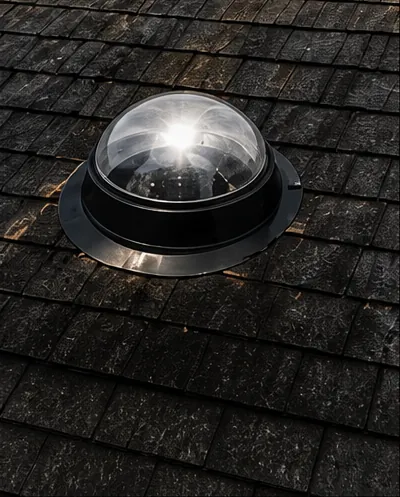
| Deep inner room | Sun tunnel | Distance from roof to ceiling |
The survey, step by step
The survey is free, and it is where the job is won or lost. We look at the roof from outside, then from the loft or the room below, because the structure inside decides the opening as much as the covering outside. Whatever makes the roof awkward is looked at first, not left as a surprise for the day of the fit.
The but
A purlin sits exactly where the light needs to go.
The way in
We move the opening up or down the slope to clear it, or trim the rafters around it and keep the purlin whole. It is a structural timber, so it stays.
From survey to sign-off
- The survey. We measure the roof, check the pitch, find the rafters or trusses, and note the covering, the falls and anything in the way. Access and fall protection are settled here too: whether the work needs a scaffold, a tower or edge protection.
- The written quote. A fixed price in writing, naming the product, the size, the opening position and the inside finish. It says what we found on the roof and how we deal with it.
- The notification. Where the work is notifiable, we handle the Building Control notification, with the local authority or a registered building control approver.
- Opening the roof. Tiles or slates come off around the position, the felt or membrane is cut back, and the rafters are trimmed. The cut rafters are carried on trimmers, new timbers fixed across the top and bottom of the opening, and the rafters either side are doubled up so the load still reaches the wall plate.
- Fitting and weathering. The frame is fixed, the flashing kit is dressed into the covering, the underlay is lapped into the collar and the tiles go back. On a flat roof, the covering is dressed up the kerb and sealed.
- Inside. Insulation is packed tight round the frame so there is no cold gap, then the lining goes in: plasterboard reveals or a factory lining kit, ready for decorating.
A single roof window in a straightforward pitched roof is the quickest job we fit. Lanterns, larger flat rooflights and anything involving extra structure take longer, and the quote says how long. Our guide to how long it takes to fit a skylight sets out the timings job by job. Safety runs through all of it: an open roof is a hole people can fall through, so it is covered or guarded whenever nobody is working at it.
A reader asks
Do roofers fit skylights?
Some do, as part of a wider roofing job. Here the rooflight is the whole job, and the hard roof is the one we want to see. The difference shows in the details: the trimming, the flashing chosen for that covering, the insulation round the frame and the finish of the lining. Our answer on whether roofers fit skylights covers the questions worth asking whoever quotes.
Planning and Building Regulations
Two separate systems apply, and they are easy to mix up. Planning is about how the house looks from outside. Building Regulations are about how the work is built: the structure, the insulation and fire safety. A skylight can need one, both or neither, and the survey tells you which before any money is spent.
A reader asks
Do I need planning permission to put a skylight in my roof?
Not if it falls within permitted development, which rooflights and roof windows on a house usually do. The rules sit in Class C of Part 1, Schedule 2 of the General Permitted Development Order 2015. The light must not stick out more than 150mm beyond the plane of the roof slope, and it must not sit higher than the highest part of the roof. A window on a slope that forms a side elevation must be obscure-glazed, and non-opening unless the part that opens is more than 1.7m above the floor.
The exceptions matter. A listed building needs listed building consent. Flats and maisonettes have no householder permitted development rights, so they need planning permission. And a council can remove these rights for an area with an Article 4 direction, which is why the planning authority for your street is checked before anything is ordered. Our planning and Building Regulations guide goes through each case.
| Question | Rule | Source |
|---|---|---|
| Planning needed? | Not if within Class C | GPDO 2015 |
| Projection | 150mm beyond the slope at most | GPDO 2015 |
| Side-slope window | Obscure glass; fixed unless it opens over 1.7m up | GPDO 2015 |
| Roof window U-value | 1.4 W/m²K or WER band B | Part L 2021 |
| Rooflight U-value | 2.2 W/m²K | Part L 2021 |
| Escape window | Storeys within 4.5m of ground | Approved Document B |
Building Regulations come in because cutting a new opening alters the roof structure and the insulated shell of the house. Part L 2021 sets limits on heat loss for new and replacement windows in existing homes: 1.4 W/m²K for a roof window, or a Window Energy Rating of band B, and 2.2 W/m²K for a rooflight. The U-value is the rate heat escapes through the unit, so lower is better. Energy efficiency is not only a box to tick: a well-insulated unit keeps the room warmer in winter and stops cold glass running with condensation. Our energy efficient rooflights page explains the glazing and insulation choices that go beyond those limits.
Replacing a misted or failed rooflight
Skylight replacement in Leicester is its own job, and a narrower one than a new opening. The hole already exists, the structure is already trimmed, and the question is what goes back in. A rooflight misted between the panes has a failed seal: the double-glazed unit has let moist air into the gap, and no amount of wiping will clear it. An old polycarbonate dome may have yellowed or turned brittle. A roof window may no longer close square, or the flashing around it may have tired.
Rooflight replacement in Leicester starts with the same survey as a new fit. Where the frame and kerb are sound, replacing the glazing or the unit alone can be the right answer, and our page on replacing just the glass in a rooflight sets out when that works. Where the kerb has rotted or the covering around it is failing, the unit and upstand come out together and go back new. Our misted rooflight replacement service covers both routes.
A reader asks
How much does it cost to replace a rooflight?
It depends on what has failed. New glazing in a sound frame, a like-for-like roof window, and a new rooflight on a rebuilt kerb are three different jobs. The size, the glazing, the access and whether the covering has to be dressed in again all move the figure. The survey tells you which job you have, and the written quote fixes the price. See what decides the cost of replacing a rooflight.
Roof windows are simpler to match. A VELUX size code is a letter and digits: the letter gives the width and the digits give the height, so the code on the old frame tells us what fits the opening. Other makers use their own codes, and those can be matched too. A replacement roof window counts as a new fitting under Part L, so it has to meet the same 1.4 W/m²K limit as a new one, and the Building Control notification is handled where the work is notifiable. Our page on when to replace a VELUX window covers the signs in more detail.
The but
The old dome is fixed to a timber kerb that is past its best.
The way in
The kerb comes out with it. A new insulated upstand goes in, the covering is dressed up it, and the new rooflight sits on a sound, dry base.
The awkward ones
Leicestershire roofs come in every age and shape: shallow back additions behind older terraces, hipped roofs on interwar semis, trussed rafters on later estates, flat-roofed extensions on houses of every era. Each one has a "but". Our awkward roofs page lists them as an obstacle sheet, one feature at a time. Here is the short version.
Purlins and trusses
A purlin is a horizontal beam that carries the rafters partway up the slope. The opening is planned around it rather than through it. Trussed rafters are factory-made triangles, and cutting one weakens the whole frame, so a wider opening needs an engineered trimming detail, or a light sized to fit between two trusses. A narrow roof window between the trusses is often the neat answer, and a pair of them side by side can light a room as well as one wide one.
Low pitch
Every roof window has a minimum pitch in its fitting instructions. Below it, water can sit and drive back under the flashing. Some makers produce windows rated for lower pitches; below those, a rooflight on a built-up kerb turns a low slope into a flat-roof detail. Our guide to a skylight on a shallow-pitched roof covers the choice, and roof windows for low-pitch roofs names the options.
Flat roofs with no fall
A flat roof should fall towards its outlet. Some do not, and water ponds. A rooflight sitting in a pond is a problem waiting for a wet week. The kerb is built up so the glass and its seals sit well above any standing water, and the glazing is set with a slight pitch so rain runs off rather than lying on it. Our page on a rooflight on a flat roof with no fall shows the detail.
Hips and dormers
A hipped roof slopes on every side, so the rafters shorten as they near each corner, and the clear run for a light shrinks with them. The opening goes where the full-length rafters are, away from the hip line and its ridge tiles. A dormer cheek or a small dormer roof can take a light too, but the slope is short and the flashing has more junctions to meet, so the survey measures the run before anything is promised.
Valleys, stacks and solar panels
A valley carries water from two slopes at once, so a light needs to stand clear of it. A chimney stack needs room for its own flashing. Solar panels may already take the best slope; then the light goes on another slope, or into a gap in the array if the layout allows. Our guide to where a skylight can go on an awkward roof works through each case.
What moves the price, and aftercare
Our figures come after the survey, because a price without the roof is a guess. What can be set out here is what moves it, so the quote you get makes sense line by line.
How much does it cost to install a skylight? It depends on the roof, and the written quote after the survey fixes it. The things that move it are the product and its size; the glazing, whether double, triple, solar control or laminated; whether it opens and how; the roof covering; any structural trimming; access and scaffold; the inside finish; and any Building Control charge. The same light in an easy tiled roof and in a slate roof with a purlin in the way are two different jobs. Our costs page sets each factor out, and what affects the cost of fitting a VELUX does the same for roof windows.
Opening lights add cost and comfort. A manual roof window is opened with a handle, or with a pole when it is out of reach. An electric opening rooflight runs from a wall switch or a remote, and a rain sensor closes it when the first drops land. On a flat roof three metres up, that is the difference between fresh air every evening and a light that never opens at all.
What is a cheaper alternative to Velux? VELUX is the name people know, but it is one maker among several. FAKRO and Keylite make roof windows in comparable sizes, with their own flashings and linings, and either can come in at less for the same opening. The right choice is the one that suits the pitch, the covering and the room, and the quote names it. Our comparison of FAKRO, Keylite or VELUX sets them side by side, and our roof windows page covers the wider range.
Aftercare is light work. Glass rooflights want an occasional clean and a look at the kerb and covering after a stormy winter. Roof windows want their seals wiped, their hinges kept clear of grit and their vent filter cleaned now and then. Electric units ask for little beyond keeping the sensor free of leaves and moss. That routine maintenance is the owner's side of the bargain.
Ours is the guarantee. Everything we fit carries a 10-year workmanship guarantee, set out in full on our guarantee page, and the product itself comes with its maker's warranty. If something we installed is not right, you call us and we come back to it.
Commercial and small business jobs
Homes come first, and small commercial jobs are welcome. A shop with a dark back store, an office over a showroom, a café kitchen under a flat roof, a workshop unit with tired domes: the questions are the same as at home, at a slightly bigger scale. What fits the roof, and how is it weathered so it stays dry?
Commercial work is planned around the business. The quote names the product, the access arrangement and any limit on working hours, so a shop can stay open while the roof above it is worked on. Dust sheets go down, the opening is cut from outside where the roof allows, and the inside finish is done in as few visits as the job permits.Flat rooflights and lanterns on commercial extensions follow the same kerb and covering details as at home. Larger openings need structural input, and Building Regulations apply to commercial buildings too, with the notification handled where the work is notifiable.
Where an industrial unit has rooflight sheets in GRP or polycarbonate, the survey checks their condition and what should replace them, and the light that results is measured against the same energy efficiency limits as any other. The aim is daylight across the floor without glare on the screens or the bench. To talk through a commercial job, ask for a survey.
Leicester and 30 miles around
Fox Skylights works across Leicester and the towns within 30 road miles of it. Leicester has been a city since 1919, and we work in every part of it: Clarendon Park, whose streets were laid out from the 1870s, Westcotes, Highfields, Belgrave, Knighton, Aylestone, Evington, Humberstone, Beaumont Leys and New Parks. Rooflight installation in Leicester's older districts and on the newer estates at its edge brings the full range of roofs, from shallow slate back additions to flat-roofed kitchen extensions.
Close in, Birstall lies north of the city, with Thurmaston and Syston to the north-north-east. Oadby is south-east and Wigston south-south-east, and Glenfield sits west-north-west. Further out, Loughborough is 11.6 road miles to the north-north-west, Coalville lies west-north-west and Hinckley west-south-west. To the south-east is Market Harborough, to the south-south-west Lutterworth, and to the north-east Melton Mowbray. At its edges the radius reaches Coventry to the south-west and Nottingham to the north.
Each district has its own planning authority, and that matters for the exceptions, because Article 4 directions and conservation areas are set locally. Around the city that means Charnwood, Blaby, Harborough, Oadby and Wigston, Hinckley and Bosworth, North West Leicestershire and Melton, with Leicester City Council for the city itself. The right one for your address is checked at the survey. Our guide to rooflights in Leicestershire conservation areas covers the county.
The but
Your street sits in a conservation area with an Article 4 direction.
The way in
We check what the direction covers before anything is ordered. A conservation rooflight that sits low with the slates is often the way in.
Skylight installation in Leicester, rooflight replacement in a Leicestershire village, a lantern on an extension at the far edge of the radius: each one starts the same way, with a free survey, a straight answer and a fixed written quote. Book the survey.