- 01Ninety-five listings in the centre
- 02Mill Street and the old waterways
- 03Roofs facing the river valley
- 04Loft rooms, one slope at a time

North-east of Leicester by 16.7 road miles, with a drive of roughly twenty-eight minutes
Skylights and rooflights in Melton Mowbray
Rooflights for a market town that grew around water and mills, from the listed streets near the centre to the mill-named courts and the roads that lead out along the Wreake.
Or call 0116 430 0516
A river town's listed roofs

The centre has 95 listed buildings, mostly Grade II, with five at II* and a single Grade I. A rooflight on any of them begins with consent, and the flush, thin-framed unit is the kind most likely to be accepted.
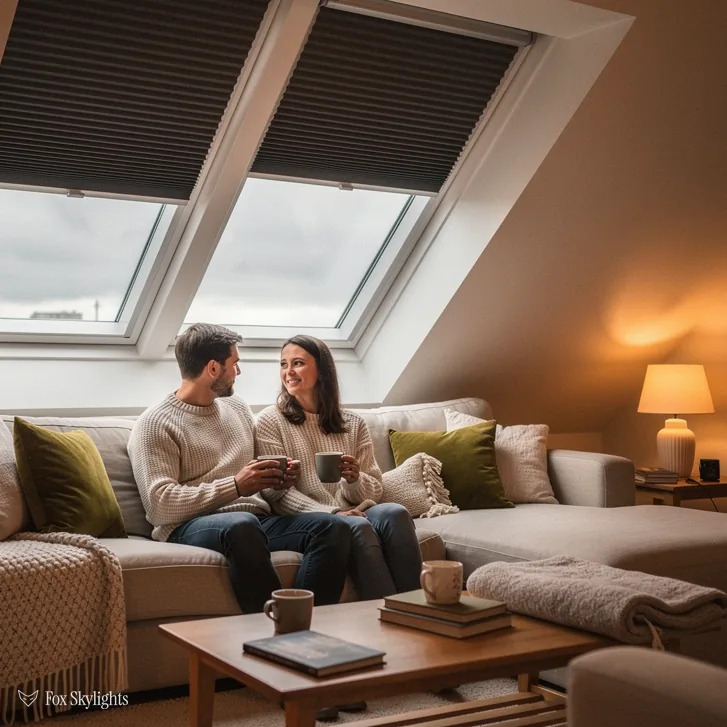
Streets named for the old mills, such as Mill Street and Beckmill Court, are a reminder that this was a working town. Older working-town terraces tend to have narrow lofts, so a compact roof window is usually the better size.
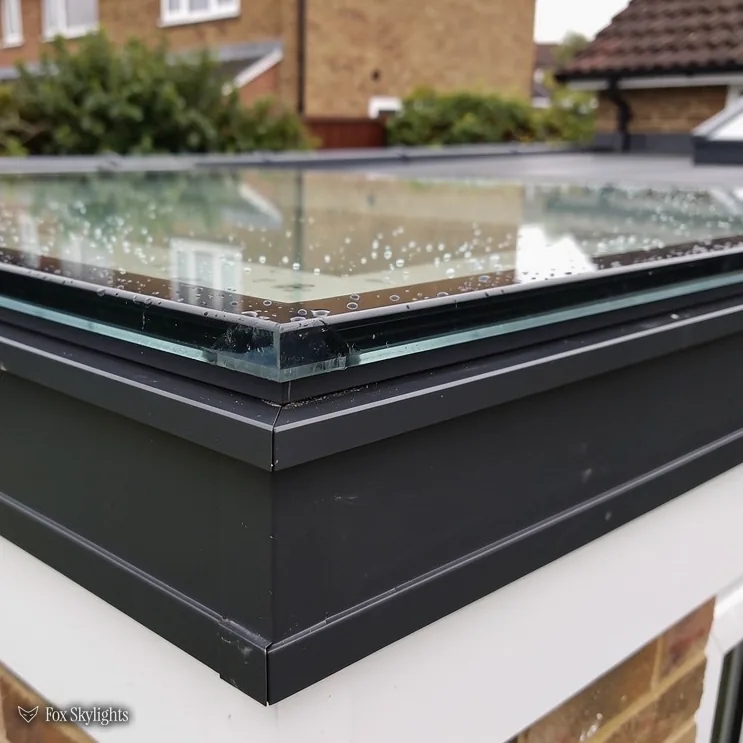
Houses spread along the roads out to Asfordby and Market Harborough have room at the back for extensions. A flat rooflight over the new kitchen brings the middle of that room into the light.
What the town's roofs ask for
-
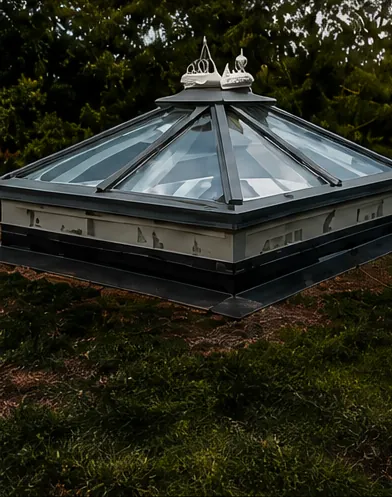 Conservation rooflights
For roofs in or beside the listed centre, where a low frame with a central glazing bar belongs on an old slope better than a modern box.
-
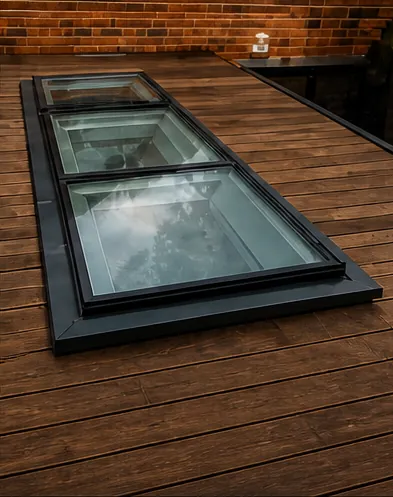 Walk-on rooflights
For courtyards, small extensions and rear passages where daylight has to travel down through a floor rather than a roof.
-
 Roof lanterns
For the larger rear extensions on the roads out of town, where one lantern can brighten a whole kitchen and dining room.
-
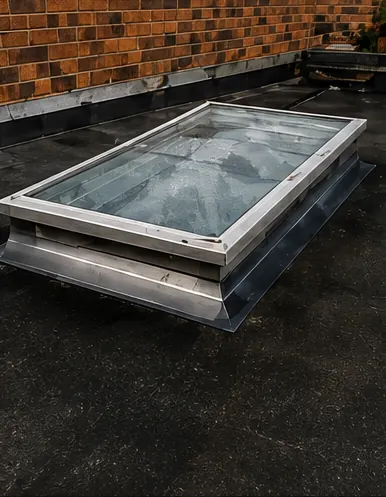 Misted rooflight replacement
For older units gone cloudy between the panes, swapped for a sealed double-glazed unit on the same opening.
Nearby
The neighbours along the same river and the same roads each have a page below, written about their own roofs.

THE FOX BROADSHEET · MELTON MOWBRAY
Ninety-five listings and one council
Melton Borough Council decides planning matters in the town. A new rooflight on an ordinary dwelling normally needs no application, since Class C of the 2015 order covers it, provided the glass stays within 150mm of the roof plane and never climbs above the roof's highest point. Side-elevation units carry their own glazing rule, which the guide below sets out.
The planning register holds one record named for the town, drawn round the centre point, and 95 listed buildings stand inside it. Counted by grade: 89 at II, five at II*, one at I. The data gives no designation date, so none appears here. For a town this size that is a long list, which is why the listing is the first thing checked for any roof near the middle.
A reader asks
Our house stands a street from the church. How can we tell whether it is listed?
The national list is searchable on the Historic England site, and the council can confirm the position for your address. We look it up ourselves during the survey, but it is worth having an answer first if you are choosing between a rooflight and a different project.
Where consent is needed, a precise drawing makes the application easier: the exact rooflight, the depth of its frame, and how it meets the slope. A conservation rooflight is made to be seen from the street without drawing the eye. Building Regulations are another matter. When the work has to be notified, we do the notifying, using the council or an approver registered for the purpose.
One practical point for the listed streets: the register describes the building but not what has happened to its roof since. Slates may have been relaid, a dormer added, a plastic dome fitted in some earlier decade. On survey day we photograph what is up there and match the new rooflight to the roof as it now stands, since consent officers judge the roof in front of them, not the listing text.
Water, mills and the roofs they left behind
The town lies on the River Eye, which carries the name Wreake below it. Mapping data names the Eye, the Wreake, an old canal line beside the Wreake and the Melton Mowbray Navigation, all within roughly a kilometre and a half of the centre, and the Grantham Canal belongs to the town's industrial story too. Mills worked this water up to the 18th century, and two street names keep them alive: Beckmill Court and Mill Street.
Proximity to water matters to a roof in small ways. Damp air and morning mist keep the outside of the glass dirty for longer, and a rooflight with a gentle slope sheds that grime better than a flat pane. A roof lantern on a rear extension that looks out over the valley has the extra job of keeping the light inside when the low sun comes across the water, which is why we talk about glass coatings at the survey, not after it.
The practical result is a town where the choice of unit depends on the street. Close to the river and the old mill sites, plots tend to be tight, with neighbours' windows looking straight down on the slope, so a rooflight that sits flush and keeps its frame thin looks right from every angle. Further out, where the plots are wider and the extensions larger, the question moves to span and structure: how big a lantern the opening and the roof beams can carry, and whether the room below needs the extra glass to come with solar control so it does not overheat in July.
What a working town leaves in the loft
The town also had a research and engineering side. Before 1960 the Production Engineering Research Association came to Nottingham Road and employed about 400 people, and the East Midlands Manufacturing Advisory Service is based here now. We mention it because it tells you the housing around the centre was not a single estate built in a single decade. Homes of different ages stand side by side, which is why we measure each loft separately and never size a window from a neighbour's.
The but
A narrow loft under a steep roof leaves almost no floor where a person could stand under a standard window.
The way in
We choose a roof window that sits high and tall in the slope, so the light reaches the middle of the room and the head height is found where the ceiling meets the glass.
| Roof | First look | Usual route |
|---|---|---|
| Listed town house | Consent and frame depth | Conservation rooflight |
| Older terrace loft | Floor width under the slope | Compact roof window |
| Rear extension | Span and structure | Roof lantern |
| Yard or passage | Load on the glass | Walk-on rooflight |
| Cloudy old unit | Kerb and opening size | Sealed replacement |
Mill sites carry their own habit of change. A building that once ground corn or powered a loom may now be flats, offices or a home, and the roof over it may have been rebuilt more than once. If your house stands on or beside an old mill site, say so when you ask for the survey. We then look for later alterations in the roof structure before settling on a position, and we ask whether the freeholder, if there is one, needs to agree to an opening in the roof.
Swapping an old window for a new one brings the Part L standard for existing homes into play. A roof window must hit 1.4 W/m²K or band B for Window Energy Rating, and a rooflight 2.2. Daylight and fire safety are separate questions. In a two-storey house the loft bedroom's escape is the stair, protected, never the roof window, because the rule stops counting escape windows beyond 4.5m. Building control owns that detail. Our roof window page explains the products.
Roads out, trains in, a van between
Melton Mowbray sits in the Melton district of Leicestershire. Leicester sends you 16.7 road miles north-east to reach it, and the van takes around 28 minutes. Within about a kilometre of the centre run the A6006 and A607, with the B6047 and B676 close behind. The B6047 starts here and heads for Market Harborough, and the A6006 runs on towards Asfordby. The railway station stands some 400 metres from the middle of town, and a disused one, Melton North, about the same distance away.
A Wreake Valley village such as Rearsby, Gaddesby or Frisby has the Danish "-by" ending common along Melton's river, and some of the villages around it are the nearest neighbours on our list. Burrough Hill and Belvoir were both fortified long before any slate roof existed, a reminder that people have been picking high ground and looking out for centuries. A rooflight is a smaller version of the same instinct, a way of looking out from a room that was never built to have a view.
The disused station deserves a word because it shows how the town changed: two stations within a few hundred metres of each other means rail once mattered here more than it does now, and the land and buildings around railway sites are often a patchwork of ages. If your street is near either station, expect houses that were built or altered at different times, and expect us to check each roof separately before giving a size or a price.
The town also has a small railway of its own: a 10¼-inch gauge track around Play Close Park, run by the Town Estates. It has nothing to do with rooflights, so we keep the job on the roof. Access in town is usually the real question, with parking near the centre limited and scaffold towers needing space, so we plan the visit around the street before we turn up.
Many of the extensions in a town like this are flat-roofed, and the flat roof is where a leaking old dome usually shows itself first. If you are not sure what you have, a photograph from the garden and one from inside is enough for us to tell a plastic dome from a glass unit, and to say whether a walk-on rooflight could replace a patch of roof that is already used as a path or a terrace.
A reader asks
Our old rooflight has misted between the panes. Can it be swapped without opening up the room below?
Normally, yes. The new sealed unit is lifted into the existing opening from above and fixed to the kerb, so the ceiling and decoration below are left alone. If the opening is a different size from standard, we source a unit to suit, and if the kerb is weak, we put it right first and write that into the quote. Details are on our misted rooflight page.
Villages up the valley are near enough to share a day: a morning survey in Melton, an afternoon one further up the Wreake, on the same A and B roads both times. If you live in one of those villages, the chips below lead to its page, with its own housing and planning record. Wherever you land, the visit is free and the quote is fixed and in writing, so you can set it beside any other.