- 01Knitters' cottages under old timber
- 02Suburbs from three decades, each loft read in turn
- 03Quarters split off by the railway
- 04Conservation streets in the middle of town

Half-way to Coventry, and 14.5 miles out of Leicester by road, west-south-west, a 24-minute run
Skylights and rooflights in Hinckley
Rooflights for the old knitting-trade streets, the quarters that grew up around them and the loft rooms that never got their daylight.
Or call 0116 430 0516
Hosiery lanes and later estates

The older streets grew around a hosiery trade that worked from the home, and the oldest of them are timber-framed. A low-profile unit laid close to the tiles keeps the line of the street intact.
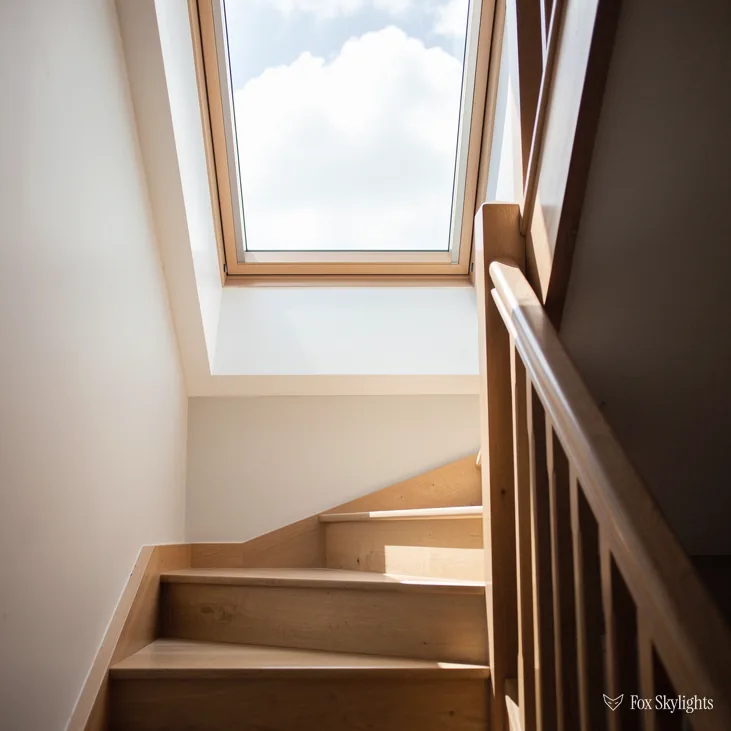
Housing arrived in the 1950s, the 1960s and the 1990s. We do not guess how any one loft was framed from its decade, so we look at the timbers first and the window size follows from what we find.
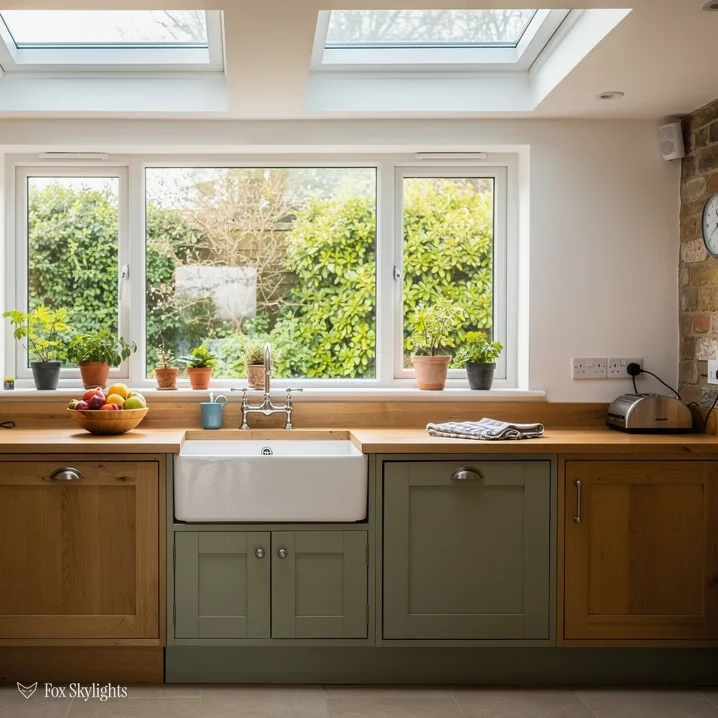
Back extensions with flat roofs turn up all over the town, and the ceiling in them sits a long way from any window. A flat rooflight puts a source of light straight overhead, where the room most wants one.
Which products tend to fit Hinckley best
-
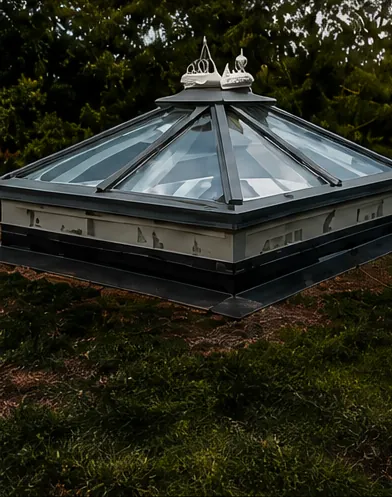 Conservation rooflights
Used where roofs are old, visible from the street or inside one of the conservation areas, since the thin frame sits flush with the covering.
-
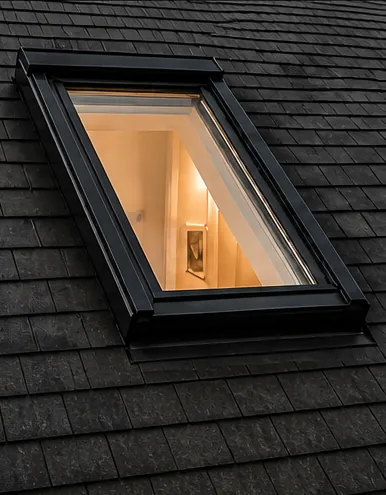 Roof windows
Used on the loft rooms of the post-war and 1990s houses, after we have looked at which way the rafters run.
-
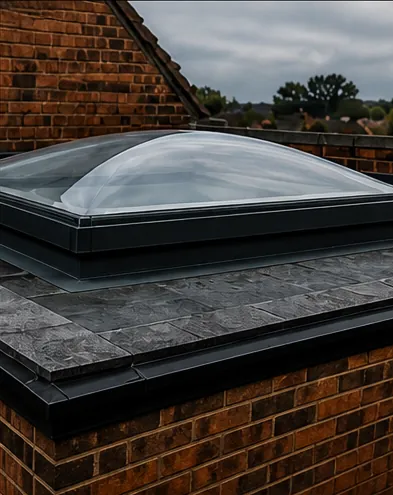 Flat roof rooflights
Used on the back extensions and kitchens, where a ceiling light well gives a dark middle of the room something to look up at.
-
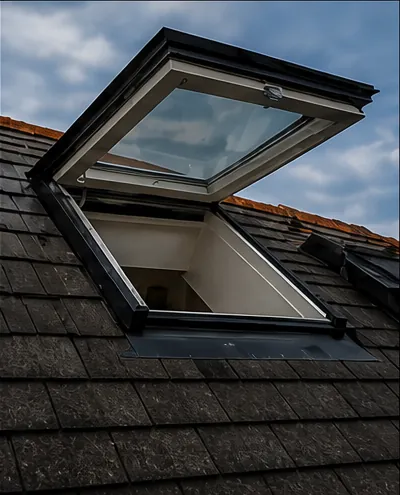 Electric and opening
Used for high ceilings and stairwells, so that warm air can be let out at the press of a button without climbing a ladder.
Nearby
Hinckley anchors a cluster of places we cover in this corner, and the chips below lead to the nearest, each with a page about the roofs that belong to it.
THE FOX BROADSHEET · HINCKLEY
Where the knitting frames stood
This is a market town in the south-west of Leicestershire, run for local purposes by Hinckley and Bosworth Borough Council. By size it comes third in the county, behind Leicester and Loughborough, and it sits about half-way between Leicester and Coventry, close to Nuneaton and to Watling Street on the Warwickshire border. Its past was in hosiery. By 1939 the Hinckley and District Hosiery Union alone counted 6,000 members, and although the industry has shrunk steadily since the Second World War, some textile firms are still around.
That history sits in the buildings. Hinckley and District Museum occupies a range of former framework knitters' cottages, 17th-century and timber-framed, and it tells the story of the trade with some of the knitting machines themselves. A visitor can see what a workshop-home looked like: a domestic building, shaped by the work done inside it. Where houses of that kind survive elsewhere in the town, their roofs are usually old, handmade in character and a little out of true. Nothing in them is square, which is the first thing to remember when anyone proposes a standard opening.
The but
Old rafters are never evenly spaced, as anyone who has crawled along a ridge knows, and a rooflight picked from a catalogue ends up sitting on a timber.
The way in
We measure the gaps in the loft first and choose a frame that fits the widest clear one, or order the glass to the space and not the other way round.
An old roof raises a question of looks as well. The conservation rooflight is built with a thin frame, one upright bar and glass that lies close to the covering instead of standing proud of it. On a roof that can be seen from the lane in front, that quiet profile is what lets the new opening look like it belongs. Nothing about the style makes it cheaper or dearer to survey, but it gives us more freedom with the position, because the unit does not draw the eye.
A reader asks
Will a new rooflight spoil a timber-framed roof?
It need not. The frame of the building is not touched; the opening is cut between existing rafters, and any timber that has to be trimmed is supported with a new header. On a listed or very old building the answer depends on what the listing covers, so we start with that question and not the measuring tape.
Roofs of this kind seldom have much insulation to start with, and a rooflight job is a chance to add some around the frame while the covering is lifted. We pack insulation into the gap between the unit and the roof structure, so the new glass is not the cold spot in the room. It is a small step, and the sort that gets forgotten when a skylight is fitted from the outside alone.
Quarters, decades and a railway line
Wikipedia lists the town's suburban districts: Hollycroft, Middlefield, Stoneygate, Wykin, Forest View, West Hinckley, Saxon Paddock and Druid Quarter. Burbage, Sketchley and Lash Hill sit on the other side of the railway line, which divides them from the rest of town. OpenStreetMap marks Lash Hill and Tilton as quarters, lying 1.2 and 1.4 km from the town point. The station is 0.7 km away, which means the line is rarely out of sight.
The area took new housing in the 1950s, the 1960s and the 1990s. The date of a house does not tell us how its roof was framed. Some lofts have cut rafters with room to work between them, and others have trusses set close together. We open the hatch and look before promising a window size, because a wide opening in a trussed roof can mean a structural change that a cut roof would not need.
Which loft, which window
| Period | What to expect | First look |
|---|---|---|
| Knitting-trade streets | Old, uneven timbers | Rafter gaps, listing |
| 1950s and 1960s | Check the framing | Rafter or truss spacing |
| 1990s estates | Check the framing | Width between trusses |
| Back extensions | Flat roof, dim ceiling | Fall and kerb height |
Burbage, across the line, has a page of its own, yet the same questions follow the van over the tracks. On both sides of the tracks the order of questions is the same: what the timbers are, which way the slope faces, how the room below is used, and only then the size and position of the glass. Picture a 1960s semi with a kitchen built on the back in a later decade. Over its worktops, a flat roof rooflight that stands on a kerb, the low timber frame that raises the unit off the roof, delivers light from straight above. The extra height also lifts the glass clear of the water that stands on a flat roof after rain.
High ceilings and open stairwells pose a different problem: heat gathers at the top. An electric opening rooflight at that height can be worked from a wall button or a handset, with an optional sensor to close it at the first drops of rain. For a room that is warm in the afternoon, it does a job that a window at ground level cannot.
Replacing an older unit brings in Part L, the thermal rule for existing homes. Hinckley replacements are measured against two numbers. For roof windows it is 1.4 W/m²K (or, on the energy rating scheme, band B); for rooflights it is 2.2 W/m²K. Manufacturers publish both figures, and we copy them onto your quote.
A reader asks
My loft room is above the first floor. Can a roof window be the escape route?
On a two-storey house, no. Under the fire guidance in Approved Document B, the escape-window rule stops at 4.5m above the ground outside, and a loft sits higher than that. A stair enclosed in fire-resisting construction is what the guidance wants there. Our quote spells out what the window does, which is light and fresh air, and what the staircase does, which is get people out.
Borough council, three conservation areas and the M69
Planning matters here are dealt with by Hinckley and Bosworth Borough Council. The national planning data holds three conservation areas with Hinckley in their names. Town Centre covers the middle of the town, with 24 listed buildings inside its line: two Grade II*, 21 Grade II and one with the grade left blank. Hollycroft lies 0.31 km from the centre and was designated on 27 January 1998, with a single Grade II building. Druid Street lies 0.38 km out and holds no listed buildings. No designation date is recorded for Town Centre or Druid Street. Further out, 1.58 km from the centre, a conservation area for the Ashby-de-la-Zouch Canal was designated in December 1990 and contains three Grade II buildings.
A conservation address does not, on its own, end the freedom to fit a rooflight. For a house that freedom is Class C, found in the 2015 Order but hedged with conditions: 150mm is the limit on how far the unit can protrude, the roof's high point is a limit on how far up it can go, and glass facing sideways has to be obscure and non-opening with a single exception for an opening section positioned higher than 1.7m up from the floorboards. A direction under Article 4 can withdraw it, and only the borough can say whether one applies on your road. Ask us about it at the free survey and we will check where your address stands.
Opening a roof is building work too, so a second set of rules, Building Regulations, sits on top of planning. Should the job be notifiable, we lodge the Building Control notification for you, to whichever of the two routes you prefer.
Getting here is straightforward. From Leicester the road is 14.5 miles and expect about 24 minutes in the van. Wikipedia names the M69 as Hinckley's motorway link to Coventry and Leicester, with the M1 and M6 beyond, and six B roads (the B590 is one, the B4109 another) run within a kilometre of the centre. When you message, tell us which road the house is on and which room you want lit, and we will arrange a free survey at a time that suits you and confirm it in writing.
A reader asks
My road is not in any of those conservation areas. Do I still need to check?
A short check is still worth it. A conservation area is only one reason a rooflight can need an application. A listing, an Article 4 direction or a flat conversion can each change the answer. You can send the address by WhatsApp, and we will look at the council's information before the visit, so nothing is a surprise when we turn up.
The next step is a free survey. We inspect the slopes from outside and the loft space from within, then set out a fixed quote naming the unit, its measurements and its position. To get a day in the diary, book the Hinckley survey.