- 01Church Gate and its 23 listed buildings
- 02Estates from the 1960s onward
- 03Grange Park, built from 2006
- 04Roofs that grew an extra room

Heading north-north-west out of Leicester for 11.6 road miles, a 21 minute drive
Skylights and rooflights in Loughborough
Eight conservation areas close to the centre, estate roofs from the 1970s outward, and a ring road whose last phase came just before Grange Park.
Or call 0116 430 0516
Eight conservation areas, then the estates
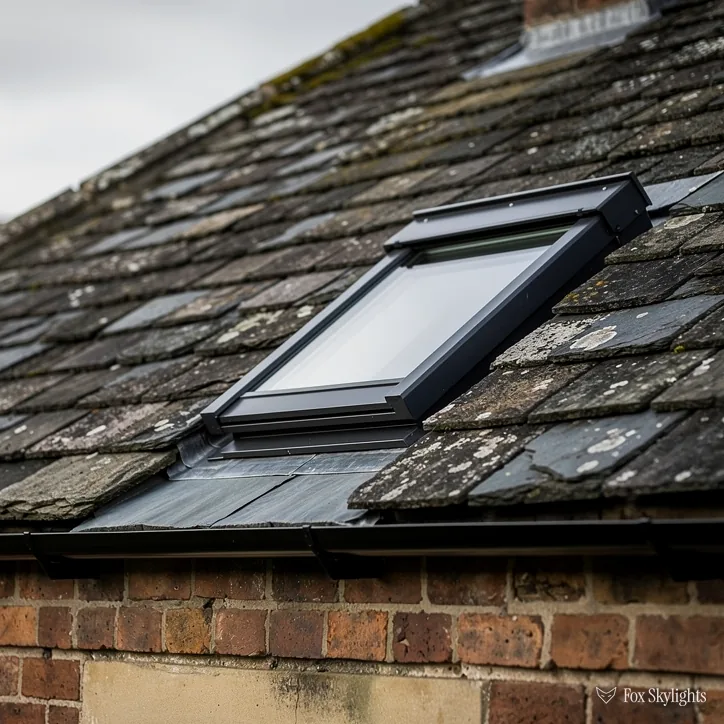
Church Gate holds the most listed buildings of the town's conservation areas on the record: 23. Any rooflight near the centre starts with the listing and the council's map, not with a tape measure.
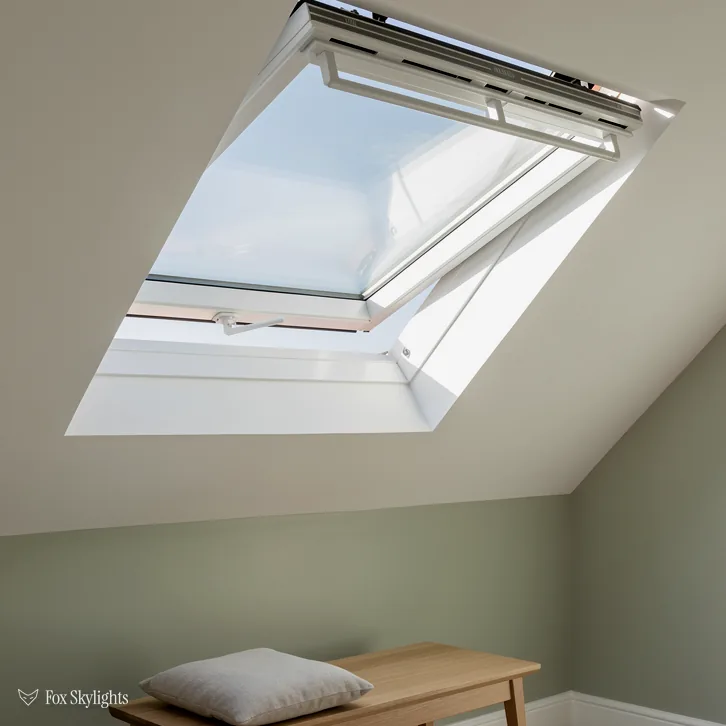
The Hazel Road and Fairmeadows Way estates date from the 1970s, and the Haddon Way estates followed them. Lofts of that age are often roomy enough for a conversion, and a roof window is the natural way to light one.
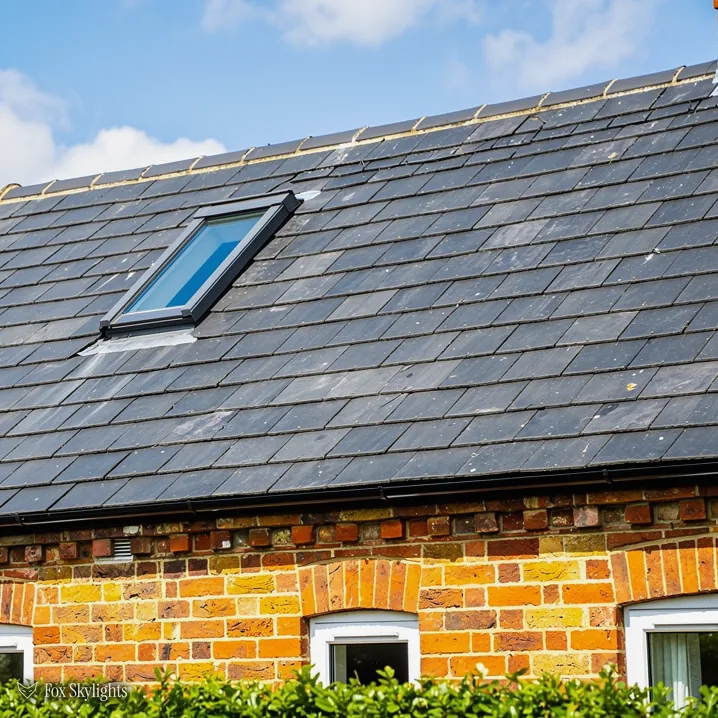
Grange Park began going up in 2006, after the last stretch of the ring road opened. Newer roofs like these are built to a tighter energy standard, so an extra opening has to be placed with the existing insulation in mind.
Which rooflights tend to fit this town
-
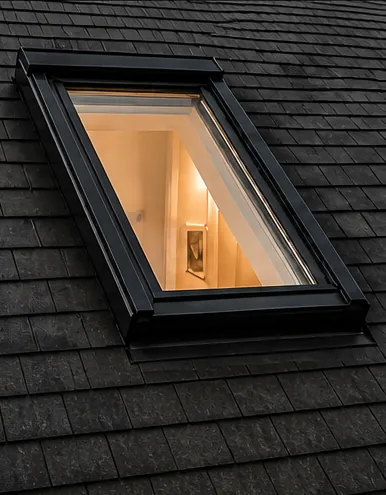
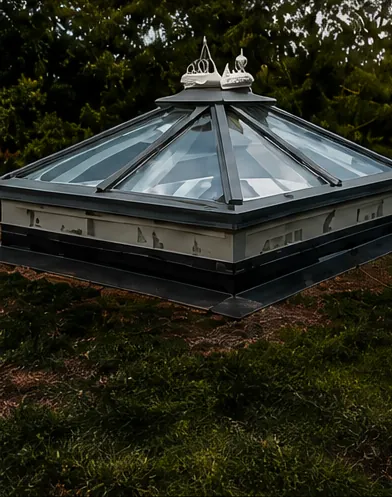 Conservation rooflights
For roofs around Church Gate, Ashby Road, Victoria Street and the other central areas, where a low frame with a slim bar keeps the slope's look.
-
 Roof windows
For lofts on the 1970s estates, where the roof has the height for a room and needs a window sized to the rafters.
-
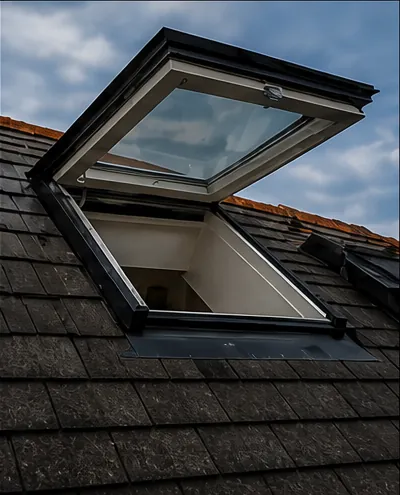 Electric and opening
For kitchens and stairwells with a ceiling too high to reach, where a rooflight that opens by remote clears the steam without a pole.
-
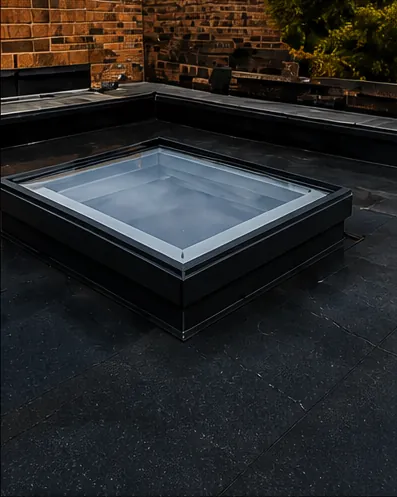 Energy efficient
For the newer houses at Grange Park and across the south, where choosing the glazing spec counts for as much as the opening.
Nearby
The villages and smaller towns that ring Loughborough stand on pages of their own, listed here.

THE FOX BROADSHEET · LOUGHBOROUGH
Charnwood Borough Council and a crowded map
Loughborough, a market town in the Charnwood borough, answers to Charnwood Borough Council on rooflight queries. It is the second largest settlement in Leicestershire after the city, sits close to the Nottinghamshire border and is within reach of Leicester, Nottingham and Derby. That position matters more to the shape of the town than to the planning rules, but it means the housing stock arrived in waves, each one for a different reason.
Rooflights on an ordinary dwellinghouse come within Class C of the 2015 order; for these, an application is normally unnecessary. Three limits sit inside it. The frame can stand 150mm proud of the slope and no more. Nothing may poke above the roof's own top point. A side-slope window needs obscured glass and a fixed sash; the only exception is an opening part placed over 1.7m from the floor beneath. A back-slope unit on a standard semi passes all three.
The conservation map is where Loughborough stands out. The planning register records eight conservation areas on or near the town centre, none with a designation date on file. Church Gate covers the centre point and contains 23 listed buildings: a Grade I building, a Grade II* and 21 Grade II. Ashby Road has six, Victoria Street seven, Queens Park three, and the Leicester Road, Emmanuel Church and Cemetery areas two each. Shelthorpe is on the list too, with no listed buildings recorded in it.
Listing is a different matter. On a listed house, no new rooflight goes in without listed building consent, whatever its size, and the consent comes first. Householder rights do not stretch to flats or maisonettes, so over a flat the process begins as an application to the planning authority, with the freeholder normally involved. Every rule is set out in our fuller write-up on permission and building control for skylights.
A reader asks
Our terrace backs onto Queens Park. Does that put the roof in a conservation area?
Not automatically. The Queens Park conservation area is recorded about 120 metres from the centre of the town and contains three Grade II listed buildings, but a boundary can stop at the edge of a park as easily as run through it. The council's map tells you which side your roof is on, and we check it before we measure anything. If you are inside, an unlisted house keeps the Class C allowance, and only an Article 4 direction could remove it.
Building Regulations run alongside planning. Each new roof opening is building work regardless of how the planning answer falls. For notifiable work we deal with the Building Control notification directly, using the council's own team or a private firm approved for the job, and the certificate is waiting at the end.
How the town grew, and what is in each loft
The record of Loughborough's growth reads like a series of rings. Through the sixties and the first years of the seventies, Thorpe Acre gained a new estate that subsumed the old village. The Hazel Road and Fairmeadows Way estates, west of Shelthorpe and south of the university, date from the 1970s. They were followed by the Haddon Way estates to the south of those, and then by Grange Park, just south of Shelthorpe and north-west of the hamlet of Woodthorpe, whose construction began in 2006 after completion of Terry Yardley Way to One Ash Roundabout, the last phase of the A6004 ring road.
For a roofer that is a useful sequence. A house from the 1970s estates is likely to have a roof and loft made one way, and a house at Grange Park another, because the way roofs are built and the insulation expected in them both moved on in thirty years. We do not guess which. We check the timbers on the day and the insulation depth in the loft, and the answer sets what we can do.
Older lofts and the room they leave
A 1970s house tends to have a loft with usable height along the ridge and low sides. That is exactly the shape a roof window likes, because the window can sit where a person stands upright and not where they would crack their head. The question is the framing. If the roof is rafters and purlins, the purlin, the heavy beam that props the rafters midway, can often be worked around. If it is a trussed frame, the openings have to fit between the trusses or be framed with a doubled timber on either side.
The but
The best spot for the window falls exactly where a diagonal brace crosses the loft.
The way in
We move the window up or down the slope until it clears the brace, or fit a slimmer unit to suit the gap, and we say which in the written quote.
| Roof | First check | Likely product |
|---|---|---|
| Church Gate area | Listing and council map | Slim conservation rooflight |
| 1970s estate loft | Rafter or truss frame | Roof window to the gap |
| Grange Park house | Insulation and glazing spec | Low U-value rooflight |
| Extended kitchen | Flat roof fall and kerb | Flat rooflight, kerb built up |
| High stairwell | Can you reach it? | Opening unit on a motor |
The newer houses bring a different issue. A recent roof is built to the energy rules of its day, so an added or replacement opening must clear Part L. Roof windows have to achieve 1.4 W/m²K (or an alternative route through Window Energy Rating, band B), while rooflights need 2.2 W/m²K. A low U-value, the measure of heat lost through the glass, is a catalogue choice. Detailing the insulation around the new opening so the roof's good work survives is where the thought goes. Glazing options are on our energy-efficient rooflights page.
Loft conversions on two-storey houses bring in Approved Document B. An escape window is accepted only for floors whose level is under 4.5m from the ground, so a loft bedroom above that wants a protected stair for its exit. The roof window serves daylight and air; the staircase serves the fire route. We design to that split because the regulations do.
Rail, canal and ring road: a town you can read from the van
On the road it is 11.6 miles from Leicester, heading north-north-west, and the trip takes around 21 minutes. Roads within roughly 1 km of the centre include the A6 and A60 plus the A512, the ring road and two B roads, and two railway stations lie inside two kilometres: Loughborough Central at 0.9 km and Loughborough at 1.1 km. That mix of routes lets a survey slot into a working day without the awkward gaps a more remote village leaves.
Industry left its mark on the map. John Heathcoat, an inventor from Derbyshire, patented an improvement to the warp loom in 1809, the twisted lace machine, which marked the first sign of industrialisation in the district. Brush Traction, a maker of railway locomotives, stands next to the Midland station. The Eastern Gateway, a scheme that developed the area around the railway station with a new road and new housing, was completed in 2013 for £20 million. Work like that changes the rooflines around it. If you live in one of the flats there, remember that flats fall outside householder rights.
Water runs through the picture too. The Grand Union Canal passes inside roughly 1.5 km, and the now-derelict Charnwood Forest Canal once linked Nanpantan on the west side of the town with Thringstone, with goods carried into Loughborough by a horse-drawn wagonway. Butler Court Nature Reserve is 1.2 km away. A house that faces water or open ground tends to want its light from the roof slope, because the walls on that side are already taken by the view.
Shelthorpe, Thorpe Acre and Dishley are the recorded suburbs, each between one and a half and just over two kilometres from the centre. Thorpe Acre gained its estate in the 1960s and early 1970s, and 1970s estates lie west of Shelthorpe; with the occasional garage conversion or rear extension under a flat roof. On those flat roofs a flat roof rooflight, carried on a purpose-made kerb, is the usual answer for a kitchen that has become the darkest room in the house.
Where the glass sits beyond arm's length, over a stairwell or in a high-ceilinged kitchen, an electric opening rooflight opens and closes by remote or wall switch, and can be fitted with a rain sensor. It suits a first-floor landing, where steam and warm air gather. It needs a power supply, which we plan for at survey.
A reader asks
Does a rooflight that opens count as a window for ventilation under the regulations?
It can contribute to ventilation, but the rules for a room depend on its use and on what other openings it has. We look at that at survey and say what the opening adds. A rooflight that opens is often the quickest route for warm air to leave a landing or kitchen because it sits at the highest point. There is more in our guide to opening rooflights for ventilation.