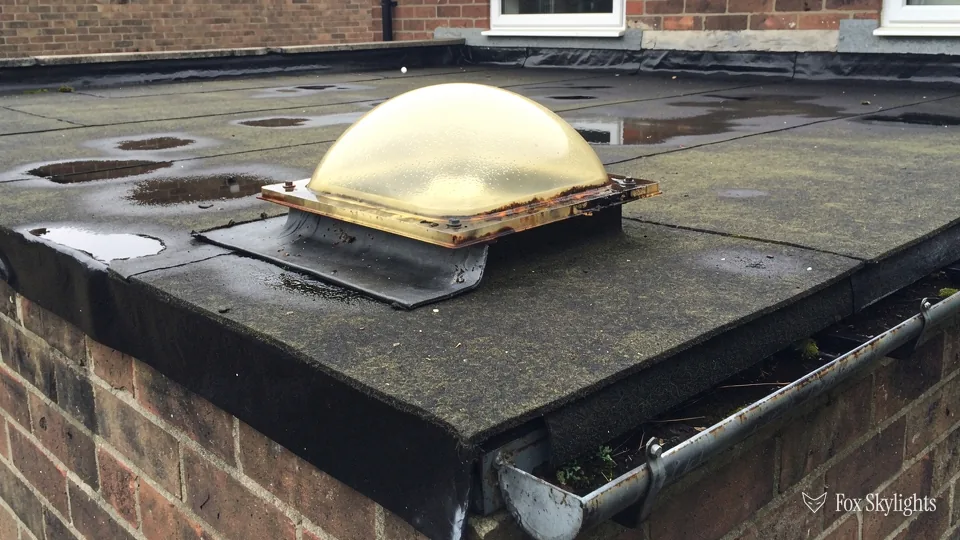
Every street with a flat-roofed extension has one: a pale, slightly cloudy plastic bubble sitting on the roof, put in when the extension was built. Look at it from the garden and you can see the years. The plastic has yellowed, the surface has a fine web of cracks, and a corner may have lifted where the fixing has loosened. Inside, the daylight it lets in has a brownish tint and the room below feels dimmer than it did. This guide is for the owner of that dome. It explains what it is made of, why it ages the way it does, what you can fit in its place, and what happens to the raised frame underneath. What suits your own roof is settled once someone has been up and looked, which is what the survey is for.
What a plastic dome is made of
A dome rooflight is a moulded plastic cap that sits over an opening in a flat or low-pitch roof. The cap is usually acrylic or polycarbonate, two clear plastics with different habits. Acrylic stays clear for longer and scratches easily. Polycarbonate is tougher against impact and tends to cloud and yellow sooner under sunshine unless it carries a protective layer. Cheaper domes are a single skin. Better ones are twin skin or triple skin, which means two or three layers of plastic with an air gap between them to cut heat loss.
The dome does not sit on the roof covering directly. It clamps onto a kerb, also called an upstand: a short raised frame round the opening, built in timber, GRP (glass-reinforced plastic) or a factory-made insulated section. The roof covering turns up the outside of the kerb so water runs off and cannot get under the dome's edge. Between the dome and the kerb is a seal, and often a bead of sealant too. A lot of the old ones also carry a plastic or metal ring that sits between them.
The dome is the part you see. The kerb is the part that decides the job.
Many older domes are built to let light in and keep rain out, and little more. They were not made to carry a person, to match today's insulation levels, or to look good from the room below. That is not a criticism of them. It is simply the standard they were designed to, and standards have moved on.
How old domes show their age
Plastic ages in the sun, and a dome gets more sun than almost anything on the house. Ultraviolet light breaks down the surface, and heat and cold stretch and shrink it every day. The signs come in a fairly regular order, and the table shows what each one tells you.
| Sign | What it means |
|---|---|
| Yellow or brown tint | UV has aged the plastic |
| Fine surface cracks | Crazing, the surface is failing |
| Brittle, snapping edges | Plastic has lost flexibility |
| Mist between the skins | The air gap has let moisture in |
| Sag or bowing | Heat has softened the shape |
| Rattle or movement | Fixings or seal have loosened |
Yellowing is the first and the commonest. It reduces the natural light in the room and puts a warm cast on everything below. Crazing comes next: a network of tiny cracks, mostly on the outer face. Once the plastic turns brittle, a hard hailstorm, a branch or a ladder placed in the wrong spot can crack it clean through. A cracked dome is a leak waiting for the next downpour.
A twin or triple skin dome can mist between its layers in the same way a sealed glass unit does, covered in more detail in our guide to why rooflights mist between the panes. The cause is a little different, because the skins are only held at the edge and the gap is not truly gas-tight, but the answer is the same: a new unit.
The sagging dome
On a dark-coloured roof in July, the surface temperature climbs far beyond air temperature, and an old plastic dome can slump slightly and pull away from its seal at the corners. It looks like a small dip and it works like a gutter, collecting leaf litter and a puddle. Sagging is a sign the plastic has had its day and a new dome or a different type of rooflight should be planned, not simply refitted.
What can go in its place
A dome rooflight does not have to be replaced by another dome. The opening is already there, the kerb is already there, and that gives you a few choices. Some are close to like-for-like. Others change the look of the room.
A new insulated dome
The simplest swap is a new dome, ideally a modern twin or triple skin with a good thermal break between the dome and the kerb. It suits a utility room, a hallway or a loft that wants daylight and little else. It is the quickest route and keeps the existing opening. The trade-off is that a plastic dome will age again, and it will not match the sharper look of glass.
A flat glass rooflight
This is the step up that you notice from the sofa. A flat glass rooflight on a kerb is a sealed glass unit in a slim frame. Inside the room it is a clean rectangle of sky, and outside it sits low on the roof. Glass stays clear for far longer than plastic, takes a coating for solar control or easy cleaning, and carries better insulation. It is a common choice for a kitchen extension or a bathroom with a bad dome. Flat rooflights on a low-pitch roof need the right fall for water to run off, which we cover in our minimum pitch guide.
A pyramid or lantern
A glass pyramid rooflight is raised in the middle, so it sheds rain better than a flat pane and throws daylight into the room from several directions. A roof lantern goes further, with a taller glazed form and a proper ridge. Both need a kerb of the right size and a roof structure that can carry the weight of the glass. The step from a dome to a lantern is bigger than it looks, and we decide it only after seeing the joists.
An opening unit
Many old domes were fixed. If the room below is a hot kitchen or a bathroom that collects steam, a hinged or electric opening rooflight, optionally with a rain sensor, lets the room breathe. Wiring for a motor has to be planned, so it is worth deciding early.
The kerb: where the real work sits
The dome is only the lid. Whether the new rooflight can sit on the old kerb is the most important question in the job, and it is answered by inspection. A sound, level kerb of the right height and size can take a new unit with little disturbance. One that has rotted, tilted or been built too low will not hold a modern rooflight properly.
The but
The old kerb is the wrong size or in poor condition for the new rooflight.
The way in
We build a new insulated kerb to the dimensions of the new unit, weathered into the roof covering, so the rooflight sits on a sound base and the water has a clean line to follow.
Height matters on a flat roof. A kerb that is too low lets standing water reach the seal. A kerb that is higher than necessary may be harder to weather neatly. We set it according to the roof covering and the falls, rather than by habit. Insulation inside the kerb also matters, because an uninsulated kerb lets heat escape around the edge of an otherwise good rooflight.
Then there is the covering. Flat roofs in Leicester are felt, single-ply membrane, GRP or, on some older extensions, asphalt. The new kerb has to be tied into whichever one you have, in a way that suits it. A mismatch here is how a new rooflight ends up with a leak at the corner. When the roof covering is also near the end of its life, it often makes sense to talk about doing both together, which we raise at the survey.
A good rooflight on a poor kerb is just a more expensive way to get a damp corner.
Plastic domes and the Building Regulations
A like-for-like replacement of the glazing is normally simple on the planning side, but it still falls under the Building Regulations, because the new rooflight has to meet current energy standards. Existing homes are held to a ceiling of 2.2 W/m²K on the U-value, the measure of how quickly heat passes through a unit, where lower is better. A new rooflight is chosen to sit inside that ceiling, and a dome from the extension's first years was never chosen with it in mind.
If the replacement is notifiable, the Building Control paperwork is part of our job. If you want to change the size of the opening, add a lantern or raise the height of the rooflight above the roof plane, the situation changes a little, and you should read the planning permission and Building Regulations guide before deciding. Flats and listed buildings follow different rules from houses.
Safety on a fragile roof
An old plastic dome can look strong and fail without warning. Brittle plastic does not bend under weight. It snaps. Falling through a rooflight is one of the best-known ways of coming to harm on a roof, and a yellowed dome is exactly what a person would step on without thinking. Treat every old rooflight, and the roof round it, as fragile. Do not stand on one, do not lean a ladder against one and do not climb up to look at it yourself. Bring the question to us and we will go up with the right access, edge protection and fall prevention for the roof.
The same applies on small commercial and industrial buildings, where a run of old domes or roof lights set in a flat roof is common. Those jobs are as welcome as a house extension. They call for a plan for working at height, covers over open holes and a clear way to keep the building weatherproof while the units change.
How the replacement runs
From first message to finished roof
- You send a photo of the dome and the room, by WhatsApp or the form
- A free survey: we measure the opening and the kerb, check the covering, and look at the room below
- A fixed written quote naming the new rooflight, the glass or plastic, the kerb work and the finish
- An agreed date; the old dome is lifted out and the opening is covered if the weather turns
- The kerb is built or prepared, the new rooflight is set and sealed, and the roof covering is dressed up to it
- A tidy finish inside, with the lining or plaster brought back to a clean edge, and a final check of the weathering
The work is done in stages so the room below is never left open to the sky. The workmanship carries our 10-year guarantee.
The dome that took the years is not a problem to keep. It is a chance to put a better rooflight in the same opening and get more of the daylight the room was meant to have. That is part of our wider work on replacing misted rooflights. When you are ready, book the free survey and the fixed written quote, or send a photo of the dome by WhatsApp.