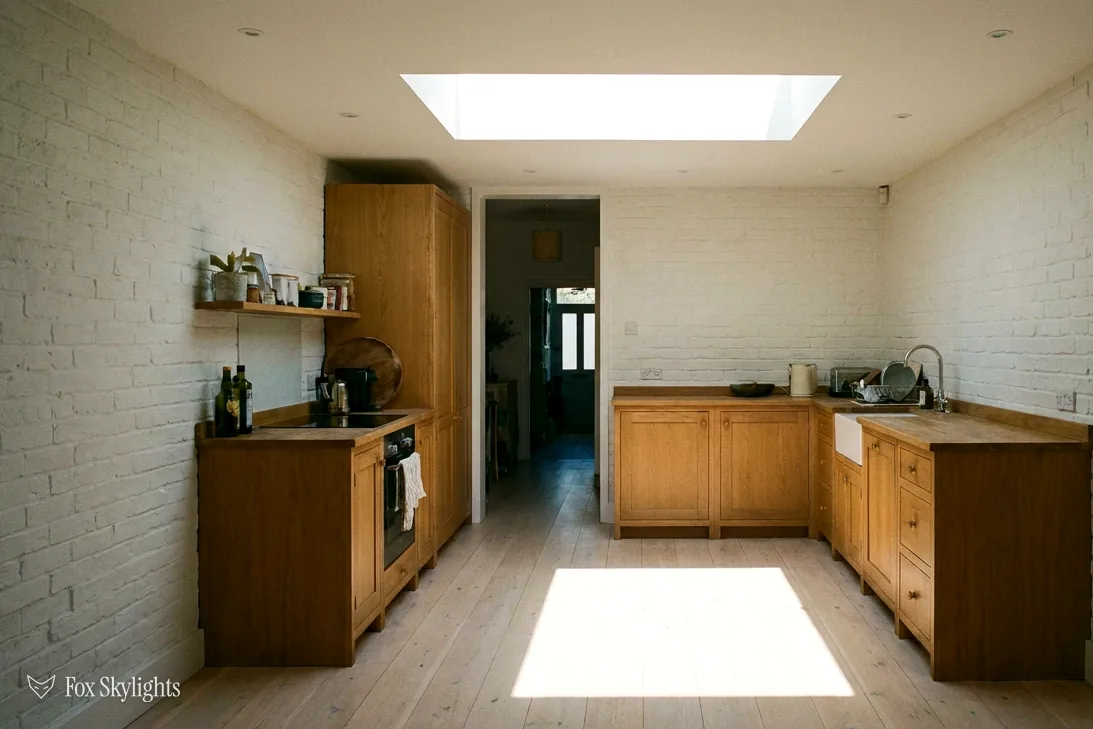
What a roofer brings to a skylight
A skylight is a roofing job with glass in it. It is also a carpentry job, a lining job and a finishing job. The hole goes through the roof, the roof covering has to be cut and made good round the frame, and the weathering is the thing that decides whether the room below stays dry. Those are roofing skills. A good roofer understands tiles, slates, flashings, felt, membranes and the way water travels over a roof, and that is most of the battle.
So the honest answer to the question is yes. Roofers fit skylights, and many do it well. A standard roof window is the sort of job a good one takes in stride. Where the window is a standard roof window going into a standard pitched roof with a known covering, an experienced roofer working to the manufacturer's fitting instructions is a perfectly reasonable person to hire.
What a roofer may not do every week is everything around it. A skylight job also touches the carpentry of the roof, the insulation, the inside finish and sometimes the electrics. How much of that the firm covers, and how often, is the useful thing to find out.
When a specialist is worth having
Some skylight jobs are more than a tile-and-flashing exercise. A firm that works on rooflights day in, day out brings habit and the right parts. These are the jobs where that counts.
- Structural openings. A wide opening through rafters, a purlin in the way, trussed rafters, a steel beam. The load has to be carried round the hole, and the trimming wants planning, not improvising.
- Flat-roof rooflights and roof lanterns. These stand on a kerb with its own insulation and weathering. Kerb height, upstand detail and the fall of the roof around it all matter. The roof lantern work is a good example.
- Electric and opening units. Wiring, controls, rain sensors and safe isolation sit alongside the roofing, and the two have to be coordinated.
- Shallow slopes and awkward geometry. Low pitches, hips, valleys, dormer cheeks and back additions. A firm that has met the problem before knows the options.
- Made-to-measure glass. Sized to an opening, with a specified U-value, solar control or a conservation profile. Ordering the right unit the first time depends on getting the survey right.
- Replacing an old rooflight. Taking out a failed unit and fitting a better one into the same opening, with the upstand and flashing reviewed rather than copied.
- Regulated work. Part L figures for the glazing, Building Control for notifiable work, and planning for a listed building, a conservation area or a flat.
Questions that tell the two apart
The title on the van matters less than the answers. Whoever you ask, put these to them.
- What have you fitted on a roof like mine? Same covering, same pitch, same kind of unit. A concrete answer beats a general reassurance.
- Who does the structural trimming, and who designs it? If a rafter or a truss has to be cut, there should be a plan for carrying the load.
- Which fitting instructions are you following? The manufacturer's instructions set the pitch range, the flashing and the underlay. A firm should be able to name them.
- Will you survey the roof first, inside and out? Looking at the loft or ceiling void, as well as the covering, finds the things a photograph hides.
- What is included in the quote? Scaffold, flashing kit, lining and finishing, clearing away. Written down.
- Who deals with Building Control? A firm should know if the job is notifiable and whose task the notification is.
- What guarantee is there, and in what form? A written workmanship guarantee with its term stated is a better sign than a verbal one.
Price is the other thing people weigh, and it is fair to compare quotes. Compare like with like: the same unit, the same scope, the same finish inside. A cheaper figure that leaves out the lining, the flashing kit or the clearing away is a different job on paper.
A general roofer who answers those well is a fine choice for a simple job. A specialist who answers them well is the safer choice for a complicated one. A firm that cannot answer them is one to cross off the list. Ask for the answers in writing, as an email or a line on the quote, so there is something to point to later.
How we work
Fitting and replacement is the whole business. The range runs from roof windows through flat-roof rooflights, roof lanterns, walk-on rooflights, sun tunnels and electric opening units to conservation rooflights. We work on homes first, and small commercial jobs are welcome.
The way in is a free survey. We look at the roof from outside and from inside, take the pitch and the structure into account, and check the covering and the access. Then you get a fixed written quote that describes the work. The workmanship carries a 10-year guarantee, and when a job needs notifying to Building Control, that paperwork is ours to send.
If your job is a plain one, you will hear that it is a plain one. If it is not, you will hear what makes it awkward and the way we would get round it, and our awkward roofs guide sets out the usual obstacles. Everything we fit, across Leicester and 30 miles around, is laid out on the home page.
Whoever you choose, ask the questions above. When you are ready for a survey of your own roof, ask for a quote, or send photos on WhatsApp.