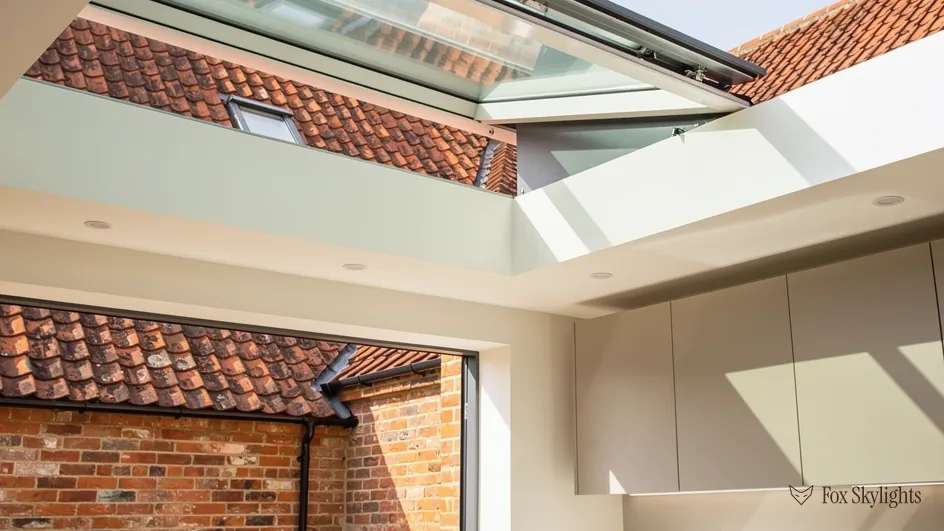
The glass gets the attention. The cable decides whether the thing works. An electric opening rooflight, the sort that lifts at the touch of a switch, is a roof window or flat-roof skylight with a small motor fitted to the sash, and a motor needs power, a control and a sensible place to put both. On a plain loft room that is a short run of cable. On a finished extension with a vaulted ceiling and no void, it is a problem to be solved before anyone orders glass. This guide is for homeowners in Leicester and Leicestershire who are weighing up an electric rooflight and want to know what the wiring involves, what the control choices are, and what a rain sensor really does. It is general trade knowledge. The specifics of your roof come from the free survey.
What makes a rooflight electric
Two things open a rooflight: a hand, or a motor. A manual one has a pole, a handle or a catch. An electric one has an actuator, which is the motor and the arm that pushes the sash open and pulls it shut. Some actuators are a chain that winds out of a housing. Others are a spindle or a rack. The trade term does not matter much. What matters is that the actuator is a small electrical appliance bolted into the frame of your roof, and it has to be fed.
Electric rooflights come in the same families as the manual ones. You can have an electric roof window on a pitched roof, an electric flat-roof skylight on a kerb, and an opening panel in a roof lantern. The parent page, electric opening rooflights, covers what each is good for. Here we stay with the wiring and the controls that sit behind all of them.
The first decision is access. A manual rooflight placed out of reach is a rooflight that never gets opened. That is the usual reason people choose electric: the unit sits over a stairwell, a kitchen island or a double-height room, and a pole would be a joke. The second reason is that the room needs ventilation and the person in it should not have to think about it. Both reasons point at the same set of questions, which the rest of this guide takes in order.
A motor on a roof needs three things before it needs a catalogue: power, a route for the cable, and a place for the switch.
Where the power comes from
There are two broad ways an actuator is powered. Some run directly from the house supply. Others run from a transformer or driver that steps the supply down to a low voltage, and the low-voltage cable then runs to the motor. Which one you have depends on the product the maker designed. The data sheet for the unit says which, and the installer follows it. You do not need to choose between them, but you should know that the answer changes what has to be run to the roof.
Either way, the power starts at the consumer unit or a nearby spur and has to arrive at the rooflight. On a new extension, the electrician who is already first-fixing the lights and sockets can add a feed for the rooflight while the walls and ceilings are open. That is the best moment by far. The cable goes in behind plasterboard, nobody sees it, and nothing is chased out afterwards.
On an existing house it takes more thought. The cable has to get from the nearest practical source to the opening, and what lies between the two decides the difficulty. A loft with a floor void above the room is simple. A flat roof with a plastered ceiling underneath means working along joist bays, and a room that has been decorated and carpeted means someone is going to be careful with a drill. We look at all of this at the survey and say what is likely before you commit.
Who makes the connection
A qualified electrician makes the electrical connection. That covers the feed from the supply, the control and any transformer, and the test that proves it is safe. We fit the rooflight, the frame and the weathering on the roof. The mains side belongs to the electrician, whether that is one you already use or one arranged for the job.
Part P of the Building Regulations covers electrical safety in dwellings, and it may apply to this work, depending on what is being added or altered. The government's page for the document says it "explains when notification of work is required". Which side of that line your job falls on is a question for the electrician, and a Building Control body can confirm it. If the rooflight installation itself is notifiable, the Building Control notification for that part is ours to deal with. The official document is on gov.uk: Approved Document P, electrical safety in dwellings.
Getting the cable to the roof
The route is the part nobody enjoys planning and everybody notices if it is wrong. A cable has to travel from a source to the rooflight without crossing the weatherproofing, and without turning a clean ceiling into a patchwork.
Pitched roofs and loft rooms
A roof window in a loft conversion usually has a deep reveal around it, the angled lining that finishes the opening inside. That space is useful. The cable can come down behind the lining or run along the rafter and enter the room neatly beside the window. Roof windows are built with this in mind, and a neat run is the normal result.
Flat roofs and kerbs
A flat-roof skylight stands on a kerb, an upstand that carries the glass above the roof covering. The cable should never pass through the waterproofing. It goes in from underneath, up through the kerb's inner face or the structure below, and reaches the actuator inside the frame. Anything that pierces a flat roof covering is a place for water to find a way in later, so the principle is to avoid it. Rooflight kerbs and upstands explains how a kerb is built and why the inside is the right place for services.
Vaulted ceilings and finished rooms
This is where it gets awkward, and where the wedge of this business lives. With no void above the ceiling, a hidden cable means cutting into the finish. Sometimes the answer is a surface-mounted trunking painted to match. Sometimes it is a short chase in plaster that a decorator makes good. Sometimes the right call is to take the feed from the opposite side and put the control where the cable naturally lands. It is a better conversation to have on the survey, with the room in front of us, than after the glass has been ordered.
A cable that passes through the weatherproofing is a future leak. Keep services on the inside of the kerb.
Controls: switch, remote or app
Once there is power, the next question is how you tell the rooflight to move. The options are broadly the same whoever makes the unit.
| Control | Good for | Watch for |
|---|---|---|
| Wall switch | Fixed, reliable, always there | Needs a cable run |
| Handheld remote | Rooms you cannot easily rewire | Gets lost in drawers |
| Wall-mounted remote | Stick-on, no chasing | Battery to remember |
| Smart-home hub or app | Many units, one scene | Only as good as the Wi-Fi |
| Rain or timer automation | Closing without you | Needs its own setup |
A wall switch is the oldest idea and still the most dependable. It looks like any other switch plate, it works every time, and a guest can use it without being shown. Its only drawback is the cable to the switch.
A remote removes the cable. The remote talks to a receiver at the rooflight by radio, so you can fit one into a finished room without chasing a wall. Some people keep a remote in a dock by the door, which solves the lost-in-a-drawer problem. A wall-mounted remote is a small battery panel that sticks or screws to the wall and acts as a switch with no wire.
A smart-home link lets the rooflight take part in the wider house. You open it from a phone, include it in a scene, or let it respond to a timer. This depends on the product you choose having an interface for it, and on your own hub. We will say plainly what the particular unit supports. If you already run a smart-home system and want the rooflight on it, mention it at the survey so the right product goes on the quote.
One practical point: more than one rooflight in one room. If you have a pair over a kitchen, do you want one control for both, or each on its own? The answer changes the wiring and the receiver, and it is cheap to get right on day one and fussy to change later.
How a rain sensor works
A rain sensor is a small device that detects moisture and tells the rooflight to close. It is the feature people ask about most, because the fear is simple: I go out, the window is open, it rains. The sensor is the answer to that fear. A short separate page deals with the question directly: do electric rooflights close when it rains.
In principle the sensor has a surface that wet makes conductive, or a small heated plate that detects drops. When water lands, the circuit changes, and the control unit sends the close command to the actuator. Once the surface dries, the sensor resets. Whether the rooflight then reopens by itself or waits for you depends on how the particular control is set up, and you should ask which behaviour you are buying.
Where the sensor sits
The sensor has to get wet before the room does. On some units it is built into the rooflight's frame, on the outside edge. On others it is a separate piece mounted nearby on the roof, with a cable that comes back to the control. Either way it needs a clear view of the sky, so a position under an overhanging eave or in the shadow of a parapet defeats the purpose. We choose the spot with that in mind.
What it cannot do
A rain sensor reacts to rain that arrives. It cannot forecast, and it cannot help if the power is off or the sensor is dirty. A sensor plate covered in leaves or bird mess will be slow to react. Treat it as a good safety net with a bit of upkeep, and not as a reason to leave every window open all day while the house is empty. The aftercare section below covers what to do about it.
A rain sensor is a safety net. Keep it clean and keep it in view of the sky.
Power cuts and manual override
People ask what happens when the lights go out. A fair question for a motor on a roof. With the power off, a standard actuator holds whatever position it was in. It does not drift shut, and it does not fall open. What you want to know is whether you can move it by hand.
Some products include a means of manual operation, a release or a tool that lets you wind or push the sash. Others rely on a battery back-up that sits with the control unit and keeps the rooflight working for a period. These are product features, and the maker's data sheet tells you which one a given unit has. We give you the answer for the exact product on your quote, in writing, and you can decide whether it matters to you. For a rooflight over a stairwell where you want to be able to air the house on a hot night, it may well matter.
If the rooflight is closed when the power fails, the weathering does the work. A closed rooflight is a sealed roof component, as watertight as a fixed one. The motor is only there to move it.
Smoke ventilation and other special uses
You will see some opening rooflights described as suitable for smoke ventilation. That is a separate subject from a domestic comfort vent, and it is settled by a fire designer or the Building Control body for a specific building, not by choosing a motor from a list. If a stair or a corridor in your property needs automatic smoke venting, the requirement will come from that route and the product must be specified to meet it. Mention it at the survey if it applies, and we will work from the written requirement.
For ordinary home use, an electric rooflight is a ventilation and daylight device, and the question to ask is how it will be used. Does it open a little each morning, or fully on hot afternoons? Does it need to open into a position where nobody can reach through it easily? Those habits shape the choice of stroke and the choice of control. The companion guide, opening rooflights for ventilation and purge air, takes the ventilation side in more detail.
Planning the install and looking after it
A sensible order of work for an electric rooflight in a new build or extension is straightforward. Decide the control and the position of any switch. Agree where the feed will come from. Let the electrician first-fix while the ceilings are open. Fit the rooflight and weather it. Return for second fix, connection and testing. Commission it, which is the moment someone checks the stroke, the close position, and the rain sensor, and shows you how to use it.
Questions to settle before ordering
- Where does the power come from, and who is connecting it?
- Where does the cable run, and does it avoid the roof covering?
- Switch, remote or app, and is there more than one unit?
- Where does the rain sensor sit, and can it see the sky?
- What happens in a power cut, by hand or by battery?
- Is the rooflight within reach of a child, and how far does it open?
Once it is working, the upkeep is modest. Wipe the sensor surface when you clean the glass. Check the seals now and again for grit. Use the rooflight, because a motor left idle for a long time is more likely to stick than one that moves regularly. If anything about its behaviour changes, tell us. We are the people who built it into your roof.
Electrics and the roof are two trades meeting in one small space. Our part is the opening, the frame, the weathering and the Building Control notification for the roof work, all covered by our 10-year workmanship guarantee. The electrician's part is the connection. The planning side, if the rooflight changes the roof's outline or the property is listed, is covered in skylight planning permission and building regulations.
If you are weighing an electric skylight for a room where the awkward bit is the ceiling or the cable route, book the free survey. We will look at the roof and the room together and give you a fixed written quote naming the unit, the control and the work involved. You can also send a photo of the ceiling on WhatsApp to start.