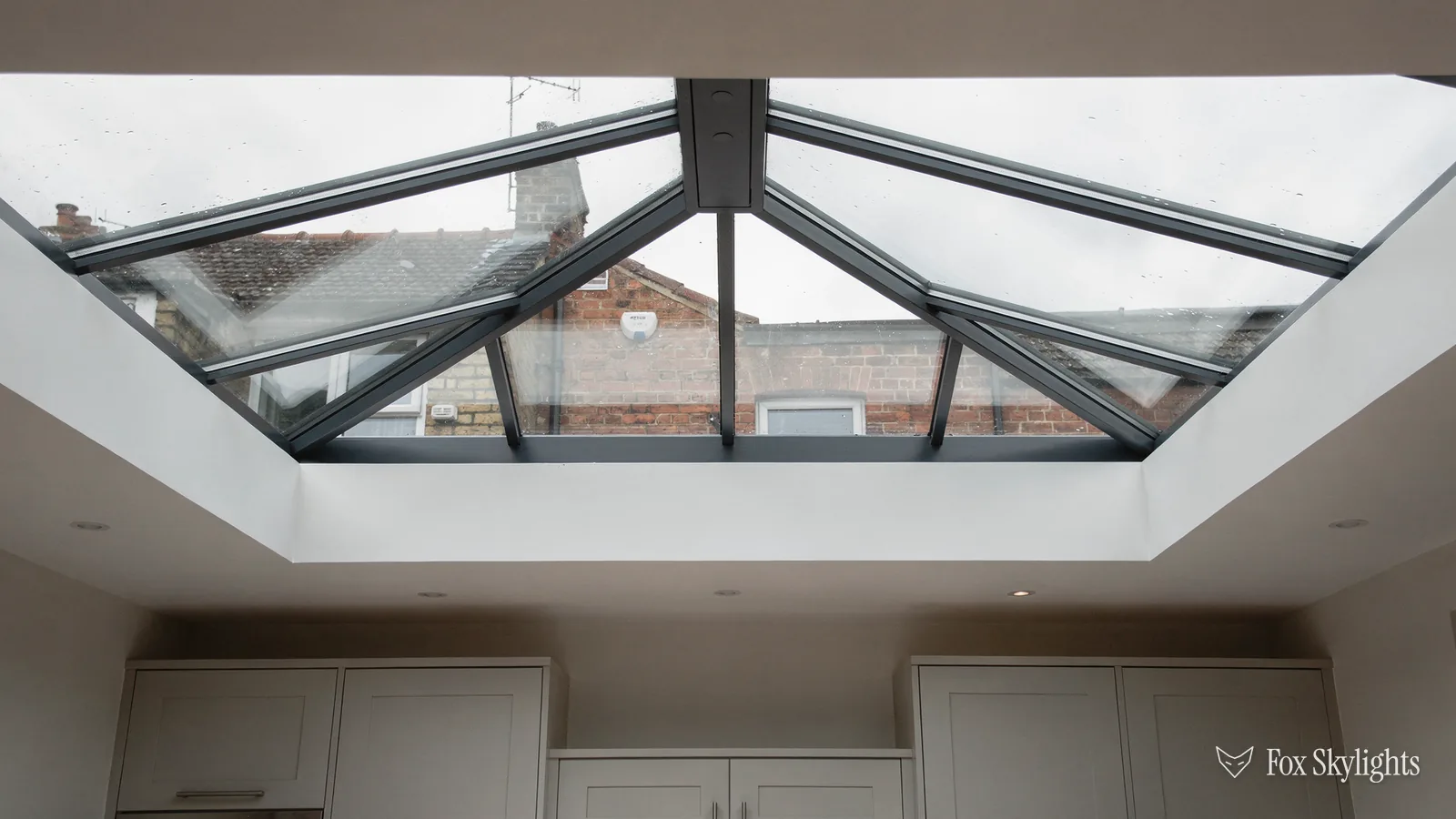
An extension with a flat roof has a problem built in. The new room is deep, the old house stands between it and the sun, and the middle of the floor is the dimmest part. A skylight in the roof fixes that, and the usual shortlist has two entries: a roof lantern, which is a small glazed roof with sloping sides standing on the main roof, and a flat rooflight, which is a pane or a pair of panes set low on a kerb. People often come to the choice already attached to one, because they saw it in a friend's kitchen. This guide puts them side by side on the things that actually differ, so the decision rests on your room and not on a photograph.
It sits under our roof lantern service, and it assumes you have a flat roof, new or existing, and an interior you want to light. Neither product is the right one by default. Each is the right one for some rooms.
What each one is
A flat rooflight is glazing set in a frame on a raised base called a kerb, which is a short upstand built up from the roof deck. The glass is flat or very gently domed, and the whole unit stands only a little above the roof. Rooflights come as fixed units or as opening ones, and as one pane or as several in a row. The trade also calls them flat glass rooflights. Our page on flat roof rooflights covers the range.
A roof lantern is a glazed structure of its own. It has a frame, usually with a ridge down the middle, and sloping glass panels on all sides, so it reads as a small pitched roof sitting on top of the flat one. It stands on a kerb too, and the kerb is where the two products start to look alike in the roof build. Above that, the shapes part company.
A flat rooflight is a window in the roof. A lantern is a small roof of its own.
How the light behaves
Light from a flat rooflight comes straight down, in a patch roughly the size of the opening. At midday, in summer, that is a strong beam; in winter, the low sun reaches less of it. It is bright directly beneath and falls off quickly. For a kitchen island or a dining table it can be exactly what you want, because the light is on the work surface and not in your eyes.
A lantern takes light from several directions at once. Its sloping sides face different ways, so as the sun moves round, a different pane is lit, and the room is lit more softly and for more of the day. The glazing is also taller, which means light reaches further across the room and picks out the walls. That is much of why lanterns are favoured in a big, open kitchen and living room, where a single patch of light would feel lost.
What you see from inside
Looking up through a flat rooflight, you see sky and the occasional bird. Looking up through a lantern, you see a ceiling shaped like a roof, with a visible frame and an apex. In a big room that is a feature. In a small room it can feel like a lid. The relationship between the opening and the room is set out in the guide to roof lantern sizes and proportions, and it matters for flat rooflights too: a light that is too small for the room looks like an afterthought, whichever type it is.
Height, the ceiling and the outside
Height is the difference you will notice first from the garden. A flat rooflight sits close to the roof and is barely visible from the ground, unless you are looking from an upstairs window. A lantern rises above the roofline. That is the point of it, and it is also why it needs thought on a house where neighbours look down on the extension, or where the roof line is already high.
Inside, the lantern adds volume above the ceiling. Where a flat rooflight leaves the ceiling at one level, a lantern's inside edge can be carried up into a pitched shape, so the room has a peak at its centre. If you have a low ceiling and the roof build-up is already deep, a lantern's extra height is a way of adding some sense of space. If you want a plain, clean ceiling, a flat rooflight is quieter.
The look from the street
A lantern is visible and designed to be. Frame colour, glazing bar pattern and roof pitch are all things you will see. If the extension is at the back and out of sight, that does not matter. If the extension is at the side and visible from the road, the lantern joins the street scene and the shape needs to sit well with the house. A flat rooflight is the lower-profile choice.
Sun, warmth and the glass specification
Roof glazing takes in heat in summer and gives it up in winter, and a lantern has more glass than a flat rooflight of the same footprint, because its sides slope up from the opening. More glass means more light, and more of both gains and losses. The answer is in the glass specification: coatings that reflect part of the sun's heat, a sealed double or triple unit, and frames with a thermal break, which is a strip of insulating material that stops the frame itself from conducting heat straight through. Our pages on solar control glass and whether rooflights lose heat explain what each does.
Ask for the U-value of the unit you are being offered, the measure of how much heat it lets through, where lower is better. Building Regulations set energy limits for new work, and the planning guide linked in this page's last section lists the Part L figures for existing homes. An extension is new work and meets the current standards for the whole building, so your designer or building control body will say what the roof glazing has to achieve.
Summer
A south-facing lantern in a conservatory-like extension can get hot if the glass does nothing to manage the sun. Opening vents help, and so do blinds under the glass. A flat rooflight facing up has the same problem, over a smaller area. In both cases the cure is specified in the glass and the ventilation. It is not an afterthought.
Structure and the build
Both types stand on a kerb, and the kerb stands on the roof deck, so both depend on joists in the right places. The difference is the weight and the span. A lantern is heavier than a flat rooflight of similar footprint, because of its frame and its sloping glass, and it is wider at the base for the same area of light. The joists round the opening are trimmed and doubled to carry the load, and the opening size is the lantern's footprint plus the kerb.
If the extension is new, the lantern's weight and size are designed into the structure from the start, which is easy. If the roof already exists, the joists decide what is possible, and that is a question for the survey. We look at the deck, the joists and the fall of the roof before we quote either type, and we tell you if a different position or a different type works better. The page on rooflights on a flat roof with no fall covers one common awkward case.
Fitting time
A lantern is a more involved fit. The kerb is built, the lantern is lifted on and fixed, and the glazing is checked. A flat rooflight is a quicker job once the opening is formed. How long each takes on your roof is set out at survey. On the day, both are weathered before we leave, so the roof is sealed when we go.
Opening, safety and security
Either type can be made to open for ventilation, with a manual or an electric opener. Opening is more useful than it first seems, because warm air rises, and a vent at the top of a tall room lets it escape. A lantern can carry vents in its sides or at the ridge. A flat rooflight opens as a whole pane, usually on a hinge. Our page on opening rooflights for ventilation says more.
Security and breakage follow the glass. Laminated glass on the inside holds together if broken. Ask what the inner pane is, in either type. If anyone might walk on a flat roof for any reason, ask about the strength of the glass as well.
Keeping them clean
Any glass in a roof collects leaves, dust and bird droppings, and rain does only part of the cleaning. A flat rooflight lies almost level, so debris sits on it and water can pool on the glass for a while. A lantern sheds more, because its panes slope, but it has more glass and more joints between panes and bars to clean. The work is the same in kind: a soft brush or cloth, plain water, and a gentle product for stubborn marks. Check that anyone cleaning from the roof can do it safely, and that the roof can take their weight. If you cannot reach the glass without leaning out over an edge, leave it for a day when someone can set up properly.
Inside, glass can show condensation on cold mornings, especially on a large pane above a warm kitchen. Ventilation and a well-specified unit reduce it. Our page on why rooflights get condensation explains the cause.
Planning, in brief
A rooflight in an existing roof is commonly permitted development, with limits on how far it can protrude and how high it can rise. A lantern stands higher above the roof than most flat rooflights, so the limits are the first thing to check. If the extension itself needs permission, the lantern is part of that application and the drawings show it. Listed buildings, conservation areas and flats have their own rules. All of that is set out, with the legislation, in our guide to skylight planning permission and Building Regulations.
Choosing between them
| Question | Lantern | Flat rooflight |
|---|---|---|
| Light | From several sides | Straight down |
| Ceiling | Adds a peak | Stays flat |
| Outside | Rises above roof | Low profile |
| Glass area | Larger | Smaller |
| Structure | Heavier, wider kerb | Lighter kerb |
| Best in | Large open rooms | Smaller rooms, plain ceilings |
Leans towards a lantern if
- The room is large and open, and a single patch of light would feel lost.
- You want a feature in the ceiling, and the ceiling height allows it.
- The extension is at the back, where height will not trouble anyone.
- You are happy to specify the glass and ventilation properly.
Leans towards a flat rooflight if
- The room is small, or you want a plain ceiling.
- You want the lowest profile from the garden and from neighbouring windows.
- Light is wanted over one task area, such as a worktop or a stair.
- The roof structure favours a lighter kerb.
If you are still undecided, the survey settles it. We stand in the room, look at the roof and tell you which suits the space, with a fixed written quote for the one you choose. Ask for a free survey here. Some rooms take both: a lantern over the dining end and a flat rooflight over the kitchen end, for example.