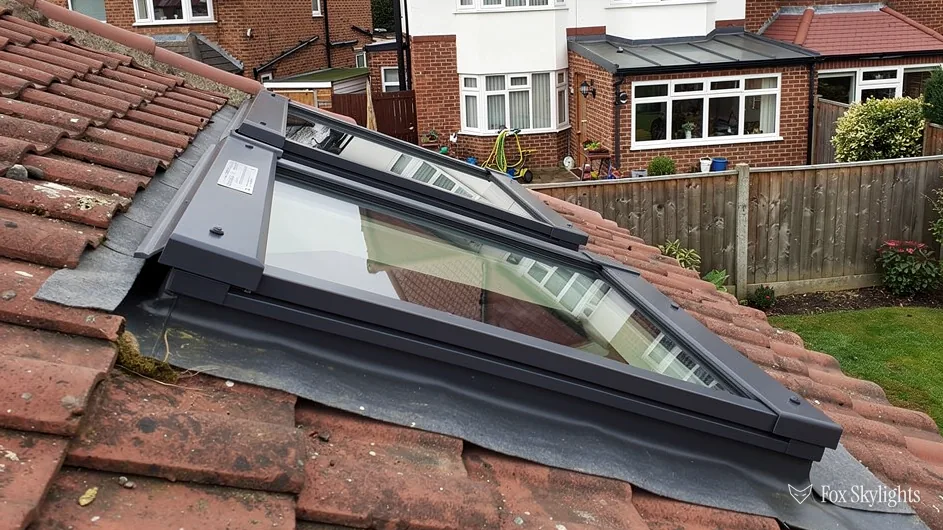
Someone has said the window is an MK04, or a quote has arrived with SK06 on it, and nobody has explained what the letters mean. They are not a secret. VELUX, the roof window maker, names its pitched-roof windows with a letter and two digits, and once you know the pattern you can read any of them in a few seconds. This guide goes through the pattern, shows a table of the common codes with the sizes VELUX publishes, explains where to find the code on a window already in your roof, and covers what the code leaves out, because a size code is a starting point for a replacement, not the whole story. It is written for homeowners in Leicester and Leicestershire who are comparing quotes, planning a loft or extension, or looking at an old window and wondering what to order. We fit VELUX windows, and the code is the first thing we ask for.
The pattern: a letter for width, digits for height
Take MK04. The first letter gives the width. The two digits at the end give the height. The letter in the middle, the K, appears in every pitched-roof code on the VELUX sizes page, and the page does not break it down, so we leave it alone and read the other two parts. M is the width. 04 is the height.
On the VELUX UK sizes page, the widths that go with the letters are these: F is 66 cm, M is 78 cm, P is 94 cm, S is 114 cm and U is 134 cm. The heights that go with the digits are: 04 is 98 cm, 06 is 118 cm and 08 is 140 cm. Put them together and MK04 is 78 cm wide and 98 cm high. PK08 is 94 cm wide and 140 cm high. The page lists these as the sizes of the windows, in centimetres, and it says the list is a selection, with more options available.
Letter first for width, digits last for height. Read it left to right and the shape is in your head.
Width and height as you look at the window
Width runs across the roof, from one side of the window to the other. Height runs up the slope. So a code with a late letter and a low number, such as UK04, is a wide, short window. A code like FK06 is narrow and tall. When you stand in the room and look up, the tall narrow windows sit between rafters and suit a stair or a landing, and the wide short ones sit well over a bed or a desk where you want a broad sweep of daylight.
A table of common codes
These are the sizes shown on VELUX's own sizes page for pitched-roof windows. We give them so you can sanity-check a quote against a catalogue. The sizes in the table come from the manufacturer's published list.
| Code | Width | Height |
|---|---|---|
| FK06 | 66 cm | 118 cm |
| MK04 | 78 cm | 98 cm |
| MK06 | 78 cm | 118 cm |
| MK08 | 78 cm | 140 cm |
| PK06 | 94 cm | 118 cm |
| PK08 | 94 cm | 140 cm |
| SK06 | 114 cm | 118 cm |
| SK08 | 114 cm | 140 cm |
| UK04 | 134 cm | 98 cm |
| UK08 | 134 cm | 140 cm |
The pattern holds across the whole table. Every M window is 78 cm wide and every 06 is 118 cm high, so MK06 sits where the M column and the 06 row cross. That is also how to spot a typo on a quote: if a code says MK06 and the stated size is 94 by 118, one of the two is wrong.
The sizes are the manufacturer's catalogue sizes for the window. The opening in your roof, the gap cut through the rafters and covering, is a different measurement, and it is set by the frame, the flashing and the rafters. The installation instructions for the model give the opening dimensions. We take those from the instructions for the product we fit, never from the catalogue size.
Flat-roof codes work differently
VELUX also makes windows for flat roofs, and its code for those has a different shape. On the VELUX sizes page, the flat-roof codes are six digits. The first three give the width and the last three give the height, in centimetres. So 090120 is 90 cm by 120 cm, and 100100 is a metre square. There is no letter at all.
The sizes page adds a detail for the glass rooflights that open on a motor: the long side is written first, to show where the motor is mounted. For those, the first set of digits may refer to the motor side rather than strictly the width. If you are working from a flat-roof code and the measurement matters, check the full code against the VELUX size guide rather than trusting a quick read. The window on the sash carries a model prefix in front of the numbers, such as CFP or CVU, followed by the size.
Flat-roof windows sit on a raised upstand rather than in the plane of the roof, so their sizing is partly about the kerb. We cover how that works in kerbs and upstands, and for the large fixed units that come from other makers entirely, in our guide to roof lanterns.
Where to find the code on your window
You do not need a ladder. On a pitched-roof window, open the sash and look for a small metal plate, called the type sign. VELUX says it sits in the right corner of the top sash, behind the ventilation flap, and that the windows it has made since 1968 carry one. Lift the flap and the plate is there. On a flat-roof window the type sign is on the sash, and the code on it starts with the model letters.
The type sign has four parts, according to VELUX: the type, the size, the variant and the production code. The size part is the one you want for a size check. The type tells you the model family, which matters just as much, and the variant covers the glazing and finish. A photograph of the whole plate, taken with your phone, is the best thing you can send us. Send it on WhatsApp to 07880 284133 along with a photo of the window from inside, and we can work from there.
Photos that help a survey
- The whole type sign, sharp and readable
- The window from inside, sash closed
- The window from the garden, if the roof can be seen
- The ceiling and reveals round the frame
- The loft space above, if you can reach it
If the plate is painted over, missing or unreadable, say so. A window that old can still be measured. We measure the frame and the opening at the survey and match it against the ranges the manufacturer lists, so the quote names a real size.
Matching a code for a replacement
The VELUX site says that when you are replacing a window with one of the same size, you should match the code on the type sign. The reasoning is simple. If the new window has the same outside dimensions as the old one, it goes into the existing opening, and the rafter trimming already there still works. Change the size and the opening has to change with it, which means more work to the structure, the lining and the covering.
The but
The old window is a size you cannot find in the current list.
The way in
Windows change over the years, and the list on the site is a selection. We measure the opening, check what the current range offers, and say whether a swap fits or whether a small change to the opening is needed.
A replacement also involves the flashing. The flashing is the set of metal pieces that link the frame to the tiles or slates, and it comes in different families for different coverings. A new window of the same size still needs the right flashing for the covering on your roof today. Our guide to VELUX flashings for tiles and slates covers that. Whether a window can be replaced without working from outside is a separate question, taken up in replacing a VELUX from inside.
The same applies when a different brand is on the roof. The size code belongs to VELUX. Other makers have their own systems, and a code from one does not carry over to another. Read the plate on a FAKRO or Keylite window against that maker's own chart. If you are not sure whose window is in your roof, the plate or label will say.
Choosing a size for a new window
For a new opening the question is not which code to order. It is how much light the room needs and what the roof will allow. A few things shape the answer. The rafter spacing is one: an opening that sits between two rafters needs less structural work than one that interrupts them. Wider windows sit in a roof with wider rafter gaps or need a trimmer. Taller windows run further up the slope, and the head of the window should clear the ridge and any purlin, the horizontal beam that carries the rafters, with room for the flashing above it.
Height from the floor
Where the bottom edge of the glass lands in the room matters as much as the size. A window set too low gives a view of the garden from the bed, and one set too high gives sky only. In a bedroom, a lower sill lets you see out when you sit up. In a bathroom, a higher one gives privacy. We mark the position on the roof and the ceiling together at the survey.
Standing height and escape
If the window is part of a loft conversion, there is a regulatory side. Fire safety rules under Approved Document B limit when a roof window can serve as an escape route, and a conversion over two storeys is normally handled with a protected stair. The planning and Building Regulations guide has the detail, and it is worth reading before you choose a size for a bedroom. Read the full planning and regulations detail first if the loft is the aim.
For light, the sizes work in steps. The step between one code and the next is a clear jump in glass area, so a room that feels dim under an MK04 may feel noticeably brighter under an MK06 in the same position. The reverse is true for glare and heat on a south-facing slope, where a larger window may mean a blind or a solar-control glass. Where the sun is a concern, the energy-efficient range is worth a look through energy efficient rooflights.
What the code does not tell you
A size code is a handful of characters, so it leaves things out. It does not say how the window opens. It does not give the glazing, so two windows with the same size code can differ in heat loss and sound. It does not tell you the frame material or finish. It does not give you the flashing, which has to match the covering. It does not tell you the roof pitch the window is listed for, which is a property of the model. VELUX lists a low-pitch window for 10 to 20 degrees, for instance, and a roof at the lower end of that suits only the models built for it. Our guide to roof windows for low-pitch roofs explains why.
So treat the code as the first line of a specification. The rest comes from the type sign as a whole and from the survey. On a quote we name the model, the size code, the glazing, the flashing for your covering and the finish inside, which makes quotes from different firms easy to compare line by line. If one quote gives only a size and another gives all five, they are not the same quote.
For the wider picture, from choosing a window to fitting, glazing and aftercare, the VELUX windows hub gathers the rest. Whether you say skylight or rooflight, the sizes work the same way, and a free survey turns a code and a photograph into a fixed written quote. We cover the Building Control notification where the work is notifiable, and the installation carries a 10-year workmanship guarantee.