- 01Big homes built for factory owners
- 02Terraces laid out for the workers
- 03Suburbs around the centre
- 04Heritage Quarter, old roofs and new glass
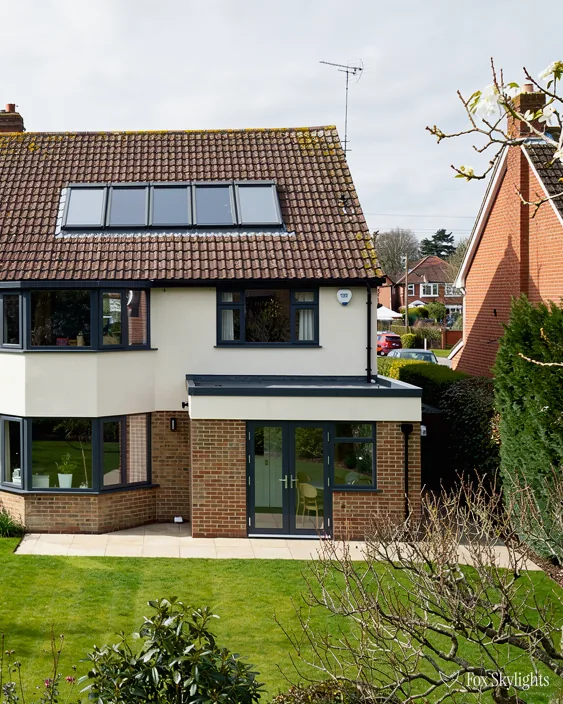
South-east of Leicester, 28.1 road miles on, with about three-quarters of an hour at the wheel
Skylights and rooflights in Kettering
Rooflights for a town the shoe trade built, where large owners' houses and worker terraces share one history and each wants a different answer from the sky.
Or call 0116 430 0516
What the shoe trade left overhead

Large homes on the Headlands and Rockingham Road were built for factory owners. A big house like that can carry a roof window or a lantern, since there is volume to light.

Terraced streets housed the workers, and a terrace loft can be narrow. A compact roof window fitted between the rafters turns that attic into a bedroom or a study.

Out in Avondale, The Grange, Brambleside and Ise Lodge, rear extensions are a common addition. A flat rooflight on a raised kerb brightens a kitchen without moving a wall.
Which products answer Kettering's housing
-
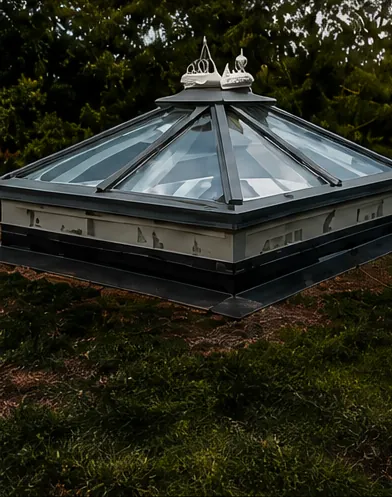
 Roof lanterns
For the owners' houses and large rear extensions, where the room is tall and wide enough to carry a proper glass lantern.
-
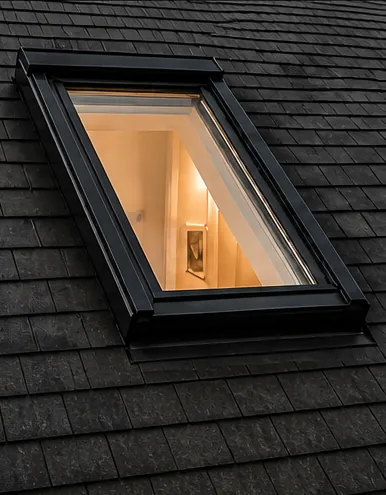 Roof windows
For terraced and semi-detached lofts, sized to the gap between the rafters once the insulation has been lifted.
-
 Conservation rooflights
For slopes in or beside the centre's conservation area, in a thin frame that lies flush with the slope.
-
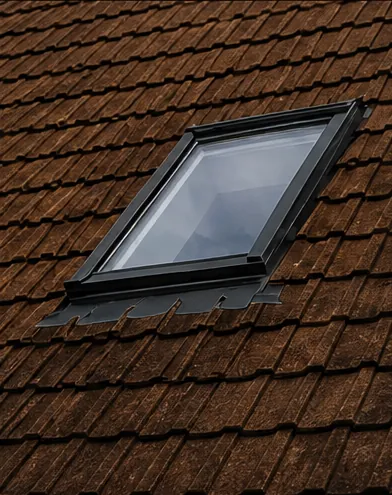 VELUX windows
For lofts that suit a familiar size code, supplied with the matching flashing kit for the tile or slate you have.
Nearby
Kettering sits in a chain of Northamptonshire towns and villages, and the six nearest each have their own page below.

THE FOX BROADSHEET · KETTERING
North Northamptonshire and the town centre record
Planning decisions for Kettering, a market town in the North Northamptonshire district, rest with North Northamptonshire Council. Most householders there can fit a rooflight with no application, because the national Class C rule covers it, provided the unit respects limits on projection, height and side-slope glazing. Those limits are spelled out in the guide linked in the box below.
The register has a conservation area called Kettering Town Centre, drawn round the centre point. Inside it stand 26 listed buildings: 23 at Grade II, two at II* and one at Grade I. No designation date is recorded, so we give none. Living near the boundary does not itself cancel the Class C allowance; an Article 4 direction might, and the council is the body that knows whether one covers your property.
A reader asks
Our house is in the Headlands. Do we need to check the register?
Yes, though it only takes a few minutes. The town centre record is drawn around the middle of town, and a Headlands address may or may not fall inside it. We look up the boundary and any listing before we visit, and if there is any doubt we say so and send you to the council for the answer before a quote is sent.
Planning is one set of rules and Building Regulations another, and cutting a roof opening is building work even where nothing needs applying for. If the job is notifiable, the notice goes in from us, to the council or to an approver on the register, so the paperwork travels with the work.
If an application is needed, it is modest for a rooflight: the slope drawn with the unit marked, its size and frame depth, and photographs of the roof as it stands. We note those at the survey. When no application is needed, the paperwork ends there and the installation can be booked, with the register entry kept on file for any future buyer who asks.
The Heritage Quarter, home to the Manor House Museum and the Alfred East Gallery, is the part of town where an old slope and a new product meet most visibly. For a roof anywhere near it, a conservation rooflight in a matching dark frame is the quiet option, and its low profile is also what helps an application. We can talk through the frame colour at the survey so it sits well against your roof.
Owners in big houses, workers in the rows
The present town grew in the 19th century on the boot and shoe industry, for which Northamptonshire became famous, and Kettering's economy was built on it. Footwear has declined markedly since the 1970s, with large manufacturers such as Dolcis, Freeman, Hardy and Willis, Frank Wright and Timpsons leaving the town or closing in the face of overseas competition. The houses outlasted the factories, and they are what we work on. Many large homes in the Headlands and Rockingham Road were built for factory owners, while terraced streets provided accommodation for the workers.
That split still decides how a rooflight goes in. A large owner's house suggests rooms with height and a roof space that may take a full-size window, so the question is how much glass the structure allows. A terrace has a shallow loft and walls shared with neighbours, so the question is how to fit a window that gives a person room to stand. Both can be answered, in different ways, and a photograph from the pavement will not tell us which way a particular roof falls.
The Heritage Quarter's museum and gallery are reminders that this is a town with a record of looking after what it has. Householders who care about their roofs tend to ask good questions at a survey: what is the flashing made of, how will the frame colour look from the road, can the unit open. We answer those with the drawing and the product in front of you, not with a brochure, because a rooflight is a small object that has to live with a big roof for a long time.
The terraced loft, measured properly
Across the two kinds of house, the sequence on the day is the same. We go into the loft first, because the structure there decides what is possible, then onto the roof to see the covering and the pitch, and last into the room below to look at where the light will fall. A rooflight that looks right on paper but lands over a wardrobe, a radiator or a stair head is a poor result, so we mark the position on the ceiling with you standing in the room and agree it before it goes into the quote.
In a terrace we measure from the party wall outwards. The width of the bay between rafters sets the largest roof window, the pitch sets how high on the slope the window sits, and the floor beneath sets whether there is space to stand in the light. Where a purlin crosses the position we want, we move the opening or split it into two windows, and tell you why in the quote.
The but
A terrace shares its roof line with the houses on either side, so a rooflight that sits proud of the slope draws the eye along the whole row.
The way in
We choose a flush-fitting frame in a colour that matches the tiles, and place it level with the neighbours' windows where a pair already exists.
| Roof | First question | Usual answer |
|---|---|---|
| Owner's house | Beam spans, roof space | Roof lantern |
| Workers' terrace | Width of the rafter bay | Compact roof window |
| Town centre roof | Listing and boundary | Conservation rooflight |
| Suburban extension | Fall of the flat roof | Flat unit on a kerb |
| Dark inner landing | Route up through the loft | Sun tunnel |
Where a rooflight is being replaced and not added, the standard for existing dwellings applies. For the roof window that means band B on the Window Energy Rating scale, or a U-value of 1.4; for the rooflight, a U-value of 2.2. Our VELUX window page explains the size codes with an example, MK04: the letters stand for the width and the digits for the height.
From the A14 to the suburbs
The town stands west of the River Ise, a tributary of the Nene, and the A14 skirts it to the west and south, joining the A45 and the motorway network. From Leicester it is a 28.1 road-mile run south-east, about 45 minutes. Six classified roads come within a kilometre of the middle, among them the A4300, alongside the A6003, and the railway station is 0.7 km from it. That road network lets a survey here share a day with other work along the A14.
The map shows several suburbs around the centre: Leisure Village and Avondale about 1.2 km out, The Grange at 1.7 km, Brambleside at 2.1 km and Ise Lodge at 2.4 km. We say nothing about their ages or builders because the data does not, and the survey is the place we find out. What we can say is that a suburb is where rear extensions and conservatories pile up, and that an old conservatory roof raises a fair question: should the polycarbonate sheet become a lantern or a flat glass rooflight?
Travel time is part of how we plan. At 45 minutes from Leicester, Kettering is a full visit rather than a drop-in, so we agree the time with you in advance. The survey takes as long as the roof needs, and you will not be rushed through a loft that has more to tell us than a quick look would show.
Kettering Ironworks once stood on the west side of the main railway, north of Rothwell Road. It began smelting iron in 1878 and closed in 1959, though ore quarrying carried on until 1961. We mention it because a town with a working past has houses that have been altered along the way. A previous owner's loft room, a bolted-on porch or a lean-to will each change what the roof can accept, and we survey what is actually there.
A flat-roofed rear extension is the other common case. Over a kitchen, a flat roof rooflight on a kerb built up to shed water gives the middle of the room its light. Where the extension is large, a lantern is worth pricing alongside, since it gives side light as well as top light and makes the ceiling feel taller than it is.
A reader asks
Our extension roof is a few years old and the rooflight has gone cloudy inside. Does the whole roof come off to swap it?
Not normally. The old unit lifts off the kerb and the sealed replacement goes in its place. We check the kerb first, and if it is sound the roof stays as it is. See replacing misted rooflights for how that works.
At the larger end of the town, a lantern on an extension needs the beams below to be right before the glass arrives, and we check the span and the support on the survey. The reason is simple: a lantern is heavier than a flat unit, and its upstand has to sit on a properly built kerb. Getting that right early keeps the install short, and it means the day the glass arrives is a lifting day, not a day of rethinking the roof.