People hear "conservation area" and assume the answer to a skylight is no. The truth is more interesting, and it is worth knowing before you book anyone to your roof. National planning rules say one thing about rooflights, a council can say another in certain places, and a listed building follows a separate regime altogether. This guide explains how the three fit together for a house in Leicester or elsewhere in Leicestershire. It names the conservation areas that the national planning dataset records around the county's towns, shows where to look yours up and sets out what a sympathetic rooflight looks like when the roof is in a historic street. It is general guidance, not a ruling on your property. The council that covers your address is the only body that can say what applies to it.
What a conservation area is
A conservation area is a place a council has designated because its character or appearance is worth keeping. It can be a market square, a Victorian suburb, a canal basin, a village green with the houses round it. It is not a single building. It is a zone, drawn on a map, and everything in it, from the street layout to the roofline, counts towards the character.
The law puts a duty on those who decide planning matters there. Section 72 of the 1990 Act on listed buildings and conservation areas says that special attention shall be paid to the desirability of preserving or enhancing the character or appearance of the area. That is the sentence behind most of the advice that follows. It does not forbid change. It asks the council to weigh the effect of change on the area.
A conservation area is a zone on a map. The law asks the council to weigh change in it, not to refuse it.
What national planning rules say about rooflights
Most skylight work on a house is covered by permitted development, which means you do not need to apply for planning permission. The roof rule is Class C, in Part 1 of the 2015 General Permitted Development Order, Schedule 2. It permits any other alteration to the roof of a dwellinghouse. Its limits are short. The alteration may not project more than 0.15 metres beyond the plane of the slope of the original roof. The top of it may not rise above the existing roof at its highest. On a side-facing slope, glass must be obscured and fixed shut unless the opening part sits over 1.7 metres up from the floor. There are further exclusions for flues, chimneys, soil pipes and solar equipment, and for dwellings created under certain change-of-use rules.
The point for this guide is what Class C does not say. Reading the text on legislation.gov.uk, Class C makes no mention of conservation areas, whereas Class A, which covers extensions, has separate restrictions for houses in them. So conservation area status alone does not take away the Class C right to fit a rooflight. That is a statement about the national order, and it is only the first layer. Flats and maisonettes do not have these householder rights at all, and a council can remove them, as the next section explains.
Article 4 directions: how a council takes the right away
An Article 4 direction is a council power to withdraw particular permitted development rights in a defined area. When a direction covers rooflights, the same rooflight that needs no application in the next street needs one in yours. Councils use them where roof alterations visible from the street are eroding the character of an area. Whether yours has done so is a fact you must check; it is never safe to assume either way.
The check is quick. Ask the council's planning department whether any Article 4 direction applies to your address and whether it covers roof alterations. The national planning data service publishes conservation area boundaries for England, and its pages, like the one for Market Harborough, show the area, the council that holds the record and a start date. The Article 4 dataset sits alongside it. The council's answer for your address is the one to rely on.
We do not name any Article 4 direction on this page, because we have not confirmed one on a council's own record. If you tell us your address, we look at the planning register for it as part of the survey, and the council will give a firm answer if you ask it. The wider rules, including the permitted development limits above, are in our guide to skylight planning permission and Building Regulations.
Listed buildings follow a different rule
A listed building does not rely on permitted development for its roof. Altering a listed building in any way that affects its character needs listed building consent, and a rooflight in a historic roof is that kind of alteration. A house can be listed and also sit in a conservation area, in which case both regimes apply. The National Heritage List for England, run by Historic England, is where you check whether a building is listed and at which grade.
Grade matters to the conversation with the conservation officer. In the planning dataset, the recorded listed buildings inside a conservation area range from none to Grade I. For instance, the Market Harborough entry records 71 listed buildings, of which two are Grade I and six Grade II*, and the Melton Mowbray entry records 95, including one Grade I. A street with many listed houses is a street where officers are used to detailed questions about roof alterations. The application itself has its own guide: listed building consent for a rooflight.
Conservation areas around Leicester and across the county
Leicester is a city, and it has its own conservation areas, which Leicester City Council holds and can confirm for any address. For the towns and villages in the county, the planning dataset records a conservation area at many of them. The table shows a sample, with the council that covers the town and the designation year as recorded. A blank in the dataset does not mean an area is new or old. It means no date was entered.
| Area | Council | Recorded date |
|---|---|---|
| Market Harborough | Harborough | 1969 |
| Lutterworth | Harborough | 1972 |
| Kibworth Harcourt | Harborough | 1982 |
| Scraptoft | Harborough | 1994 |
| Oadby Hill Top and Meadowcourt | Oadby and Wigston | 1987 |
| Burbage | Hinckley and Bosworth | 1973 |
| Ashby-de-la-Zouch | North West Leicestershire | 1972 |
| Glenfield | Blaby | 2014 |
Others are recorded without a date: Melton Mowbray (Melton Borough Council), Market Bosworth (Hinckley and Bosworth), and Quorn and Mountsorrel (both Charnwood Borough Council). The dataset also lists areas at Syston, Rothley, Blaby, Enderby and Loughborough, and Oadby has a second entry, Oadby Court, dated 1997. The point of listing them is not to say that your street is inside one. The boundary is what counts, and it can run down the middle of a road.
Sources for each entry are the planning data pages named in the sources list below, and the council that holds the record is the final word. Our own town pages say more about particular places; the main conservation rooflights page is the best starting point for the product itself.
What a sympathetic rooflight looks like
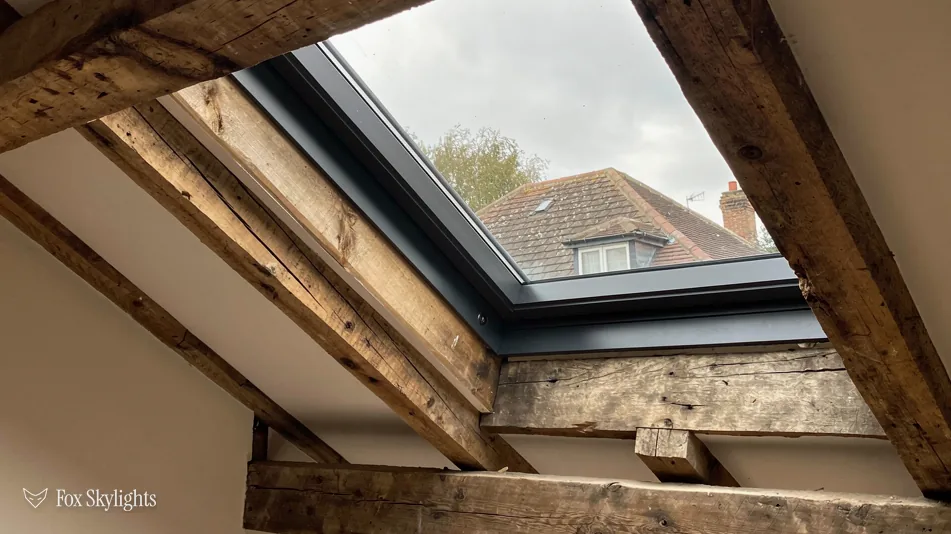
Where a council expects care with the roof, the rooflight itself is a design choice. A conservation rooflight is a trade name for one made to sit in a historic roof without announcing itself. The common features are a slim frame, a fit that sits low against the roof covering instead of standing proud, and a plain glazing layout, often with one central bar that echoes older cast-iron lights. The frame is usually dark so it blends with slate or tile. Frames are available in steel and in other materials; the choice affects the look and the weight.
Flush fitting is the feature people notice first. A standard roof window can stand a few centimetres above the tiles. A flush unit is set so its glass sits close to the line of the roof. On a street slope that is visible from the road, the difference in profile is clear from the pavement. The checklist for the term is in a short answer, what counts as a conservation rooflight, and another covers a slate roof.
Which slope, and how many
A roof slope that faces the street is read as part of the street. One that faces the back garden usually is not. Many conservation officers prefer rooflights on the rear slope, and fewer, smaller units to a row of large ones. Placing them to line up with the windows below gives the roof a logic that an irregular scatter lacks. These are design principles, not rules from the national order, and a local policy can differ, so ask.
Colour, glass and the view up the street
Two details give a rooflight away from the road more than its size does. The first is the frame colour: a pale frame on a dark slate roof draws the eye, a dark one recedes. The second is reflection. Plain clear glass gives a clean, quiet look. Heavy tints and mirrored coatings can flash in low sun. Both are matters of taste that a conservation officer may have a view on, and both are easy to settle at the survey, before anything is ordered.
Energy performance still applies. Under Part L 2021 an existing home needs a rooflight at 2.2 W/m²K or better, and a roof window at 1.4 W/m²K or at Window Energy Rating band B, so a slim historic-looking frame still has to hold a modern sealed unit. The two goals are not in conflict, but they are why the thin frame is a specification question and not just a styling one.
Matching what is there
If the roof already has old rooflights, replacements normally follow their size, shape and position. A new frame that matches the original often passes without comment, and a mismatched one does not. For a new opening on a historic roof, the spacing of the existing rafters helps decide where the opening can go without extra structure.
How to check before you commit
The order of checks saves time and avoids work that has to be undone. Most of them are phone calls or a few minutes on a map, and none of them costs anything. The one that catches people out is the boundary: a house on the edge of a conservation area can be inside it while its neighbour across the road is outside, so check the exact address and not the village name. Keep any reply from the council. If you sell, a buyer's solicitor will ask what was done to the roof and on what basis.
Check these in order
- Is the house listed? Look it up on the National Heritage List for England.
- Is it in a conservation area? Ask the council or check the boundary on the planning data map.
- Does an Article 4 direction cover roof alterations at your address? Ask the council in writing.
- Is it a flat or maisonette? Householder permitted development does not apply.
- Which roof slope is visible from the street? Plan the openings on the others first.
- Does the design keep to the Class C limits on projection, height and side-slope glass?
- Do you want the council's view in writing before work starts?
If the answer to the last question is yes, a written enquiry or a formal application gives you a record. That is useful for a later sale. When you want a second pair of eyes on a particular roof, ask for a free survey. We check the roof, the slope and the options with you, then give a fixed written quote. Photos by WhatsApp are a good first step. Where the work is notifiable under the Building Regulations, the notification is ours to handle.