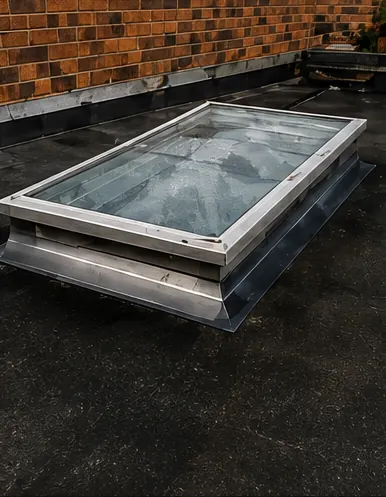
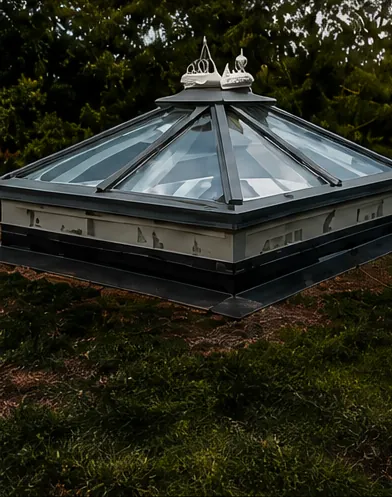
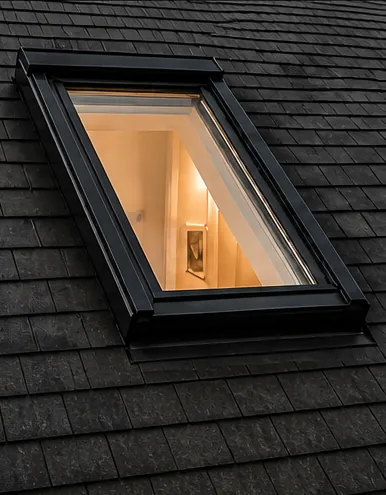
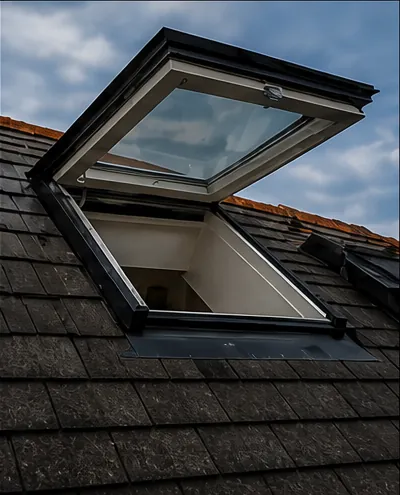
- 01Rooflight out of arm's reach
- 02Hot kitchen, sealed glass roof
- 03No socket within ten metres
- 04A hatch to the roof above
Electric opening rooflights in Leicester
A skylight that opens on a button, shuts when the rain arrives, and has its cable planned before anything is cut.
Or call 0116 430 0516
- Fixed written quote
- 10-year workmanship guarantee
THE FOX BROADSHEET · ELECTRIC AND OPENING ROOFLIGHTS
Rooflights that open: motors, sensors and the cable behind them
Which skylights are worth opening, what moves them, where the power comes from, and how the job runs from survey to sign-off.
Most rooflights are fixed. They let light in and nothing else. An opening rooflight adds the other half of a window: it lets the stale air out and the fresh air in, and in a room that gets hot under glass, that is the half you notice in July.
Opening and electric are two separate questions, and they are worth keeping apart. A rooflight can open by hand with a pole or a handle. It can open by motor, from a wall switch, a handset or a phone. It can be a roof window in a pitched slope, a hinged unit on a flat-roof kerb, or a sliding panel that clears the whole opening. What they share is a moving part on a roof, which is why the weatherproofing, the power supply and the sensors matter as much as the glass.
Our crew fits electric and opening skylights across Leicester and the towns and villages around it, out to 30 miles by road, in homes first and small commercial premises too. This read follows the job in order: why open one at all, which opening type suits which roof, the power and the cable, the rain sensor, the air and heat, roof access, then the fitting and the sign-off. The first visit is a free survey; a fixed written price comes after it. If you already know what you want, book the survey.
Why open a rooflight at all
Glass in a roof does two things at once. It collects natural light, and it collects heat. Warm air rises and a fixed rooflight gives it nowhere to go, so the top of a kitchen-diner or a loft bedroom turns into the warmest place in the house. An opening rooflight gives that air a way out. Open a window low down on the same day and you have a draught running through the room, with the rooflight acting as the chimney.
A reader asks
Is an opening rooflight the same thing as a roof window?
Nearly. Roof window is the name for an opening unit set into a pitched roof, flush with the tiles or slates. Rooflight is the trade word for glazing on a flat or low roof, usually on a raised kerb. Homeowners call both of them a skylight. An opening version of either is what this page covers. If your roof is pitched and you want a standard opening unit, the roof windows page goes into the pitched-roof side in more detail, and the VELUX windows page covers that maker's range.
The other reason to open one is reach. A rooflight sits high. On a room with a vaulted ceiling or a stairwell it can be well out of arm's length, and a pole is a poor answer in a house with children, or with someone who cannot lift their arms above the shoulder. That is where a motor earns its place.
Where an opening rooflight earns its keep
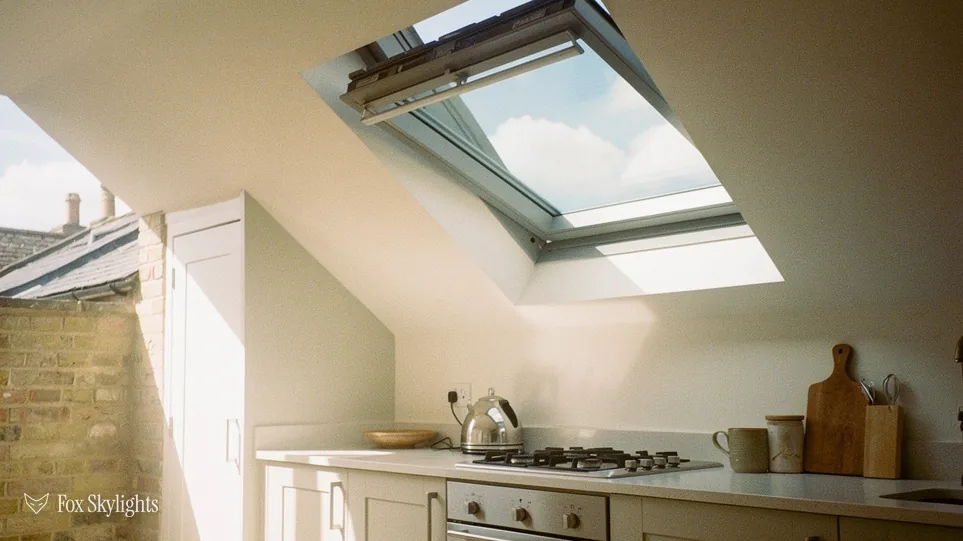
Kitchens come first, because cooking puts heat and steam into the air at exactly the point where a ceiling traps them. Bathrooms and shower rooms come next. Then the loft conversion, where a bedroom under the roof has the least air volume and the most sun. Then the extension with a lot of glass, where a flat-roofed room can behave like a greenhouse. Last, the stairwell and landing, where a single opening unit at the top ventilates every floor beneath it.
Each of these is a different job. A kitchen wants a big opening over the hob side of the room. A bedroom wants a small one it can open at night without a fuss. A stairwell wants one that opens by switch because nobody is going to reach it.
Hinged, sliding or electric: the opening types
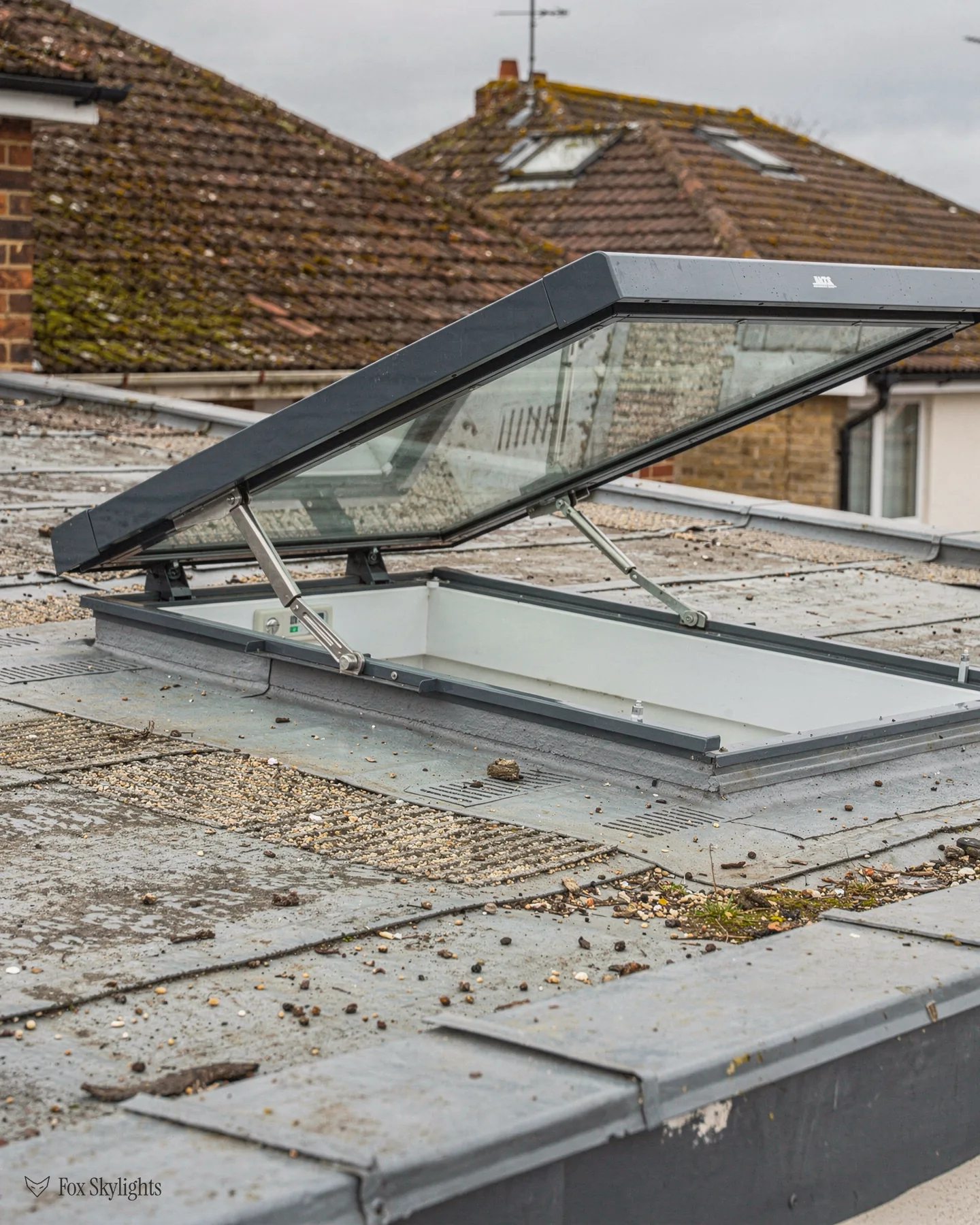
The first decision is the roof. A pitched roof takes a roof window, which tilts out or pivots, and the weather runs off it because the glass lies flush with the slope. A flat roof takes a rooflight on a kerb, the raised timber or GRP frame round the opening, which lifts the glass above the roof covering. A hinged flat rooflight lifts at one side, like a lid, and stays there at the angle the arm allows. A sliding one moves sideways instead, and gives you a big hole in the roof rather than a gap under a lid.
Hand-operated or motorised
A hand-operated unit has a handle, a pole or a crank. It costs less to fit and has less to go wrong, and it is the sensible choice when the rooflight is within easy reach and the household does not mind walking over to it. A motorised unit adds an actuator, which is the electric arm or chain that pushes the sash open, a controller, and a cable. You pay for those in the fitting as well as the parts. What you get back is a rooflight that opens with a switch, from a handset, or on a timer, in a room where nobody could otherwise touch it.
Motors come in two broad kinds. Low-voltage ones run from a small transformer on a plug or a spur. Mains ones run on the house supply direct. Either can be neat, and which one fits depends on the roof and where the power is. We come to that in the next chapter.
| Point | By hand | Electric |
|---|---|---|
| Reach | Within arm or pole | Any height |
| Power needed | None | Cable and supply |
| Rain response | You close it | Sensor can close it |
| Control | Handle or pole | Switch, remote, app |
| Best for | Low, near rooflights | High or hard-to-reach |
One more thing about frames, because it affects the opening. Aluminium frames are slim and stiff, so they carry a large opening sash without sagging, and they take a powder-coated finish. uPVC frames are broader and warmer to the touch and suit smaller units. On a glass-topped opening rooflight the frame mostly decides how wide a sash can go before it needs extra support. The survey settles that against the size of the hole.
Power, and the cable run behind it
The glass is the easy part to picture. The cable is the part nobody pictures until the plasterer asks where it goes. An electric rooflight needs power at the unit, and a way to get it there that does not leave a flex hanging down a finished wall. On a roof that has not been opened yet, you can plan that route. After the ceiling is boarded and painted, you chase it out or hide it in a boxing.
The but
The nearest socket is across the room, the ceiling is already plastered, and the rooflight is in the middle of it.
The way in
We route the cable through the roof structure or down a plaster-depth channel at the survey stage, agree the switch position with you, and bring in a qualified electrician where the supply needs altering. Nothing is left hanging.
The route depends on the build. In a new extension, the electrician can run a cable through the joists before the ceiling goes up. In a finished room, the cable usually comes down the reveal, the short return of lining around the opening, or along the edge of the ceiling to a switch plate. In a loft conversion, it runs inside the rafter void behind the plasterboard, if the void is deep enough.
Who does the electrics
Fixed electrical work in a dwelling falls under Part P of the Building Regulations, and some of it is notifiable. A new spur or an altered circuit is a job for a competent, registered electrician, who certifies it. Where a plug-in low-voltage transformer does the job, there may be no new circuit at all. We plan the supply with you at survey and say what is needed, and where the job is notifiable, the Building Control paperwork is ours to send in. Part P is set out in Approved Document P on gov.uk.
The wiring, the controllers and the rain sensor each have their own detail: which cable, where the sensor mounts, how the keypad pairs. That detail has its own read, electric rooflights: wiring, controls and rain sensors, so this page can stay on the roof.
Controls come in a few forms. A wall switch is the plainest and the hardest to lose. A handset works like a garage-door remote and can live in a drawer. Some controllers talk to a phone app, or sit in a smart-home system that opens the rooflight when the room gets warm. All of them do the same job. Pick the one the household will actually use, because an electric rooflight nobody can find the remote for is a fixed rooflight with extra wiring.
Rain, wind and the sensors that shut it
A rooflight left open and a shower arriving is the oldest worry in the trade, and the reason the rain sensor exists. It is a small unit on the roof, with a surface that detects moisture. When drops land on it, it tells the controller to close the rooflight. When it dries, some systems will reopen the unit and some wait for you to ask. We set up whichever you prefer.
What a rain sensor can and cannot sense
A sensor detects water on its own surface. It does not forecast. So it is placed where rain will reach it at the same moment it reaches the opening: on the same roof, in the same exposure, in the open. A sensor tucked under an overhang will not notice a shower that is wetting the rooflight. A sensor in direct sun dries fast and may reopen the rooflight while the glass is still damp. The position is a survey decision, and we check it against the roof.
A wind sensor does a similar job for gusts. An open sash catches the wind like a sail, and the arm and hinges take the load. Where a rooflight stands exposed, such as a top-floor roof or a terrace, a wind sensor closes the unit before the strain builds.
A reader asks
Will the rooflight close if I am out and it rains?
If it has a rain sensor and power, yes. The sensor signals the controller, and the controller drives the motor shut, whether you are in the house or not. It helps to know the limit: a unit with no power, because of a switched-off supply, will stay as it is. That is why we agree the supply with you and mark the isolator. The short answer page, do electric rooflights close when it rains?, goes through it plainly.
Seals matter as much as sensors. A closed opening rooflight is only as weatherproof as the gasket that meets the frame. Good ones are compressed evenly all the way round and are kept clean of grit. If the seal is clean and the sash lands true, a closed electric unit is as watertight as a fixed one. We test the closure on the day, with the roof wet where we can, and show you the result.
Heat, steam and fresh air
Ventilation is the whole point of an opening rooflight, so it is worth knowing how it works. Air moves because of two things. Warm air is lighter, so it climbs and leaves through the highest opening. Wind pushes air across the building, so a gap on one side draws air in from another. A rooflight at the top of a room gives the stack effect its exit. A window low down, on the other side, gives the air a way to come in. With both open, the room clears quickly.
Purge ventilation and everyday ventilation
Building regulations talk about two kinds. Background ventilation is the small, steady supply that keeps a home's air fresh all the time. Purge ventilation is the quick, large opening for moments when the air is bad: after cooking, after decorating, in a heatwave. An opening rooflight is a very good purge vent, because it is big, it is high, and it works with the stack effect rather than against it. Approved Document F sets out the ventilation rules for homes and is published on gov.uk. For the airflow in more depth, read opening rooflights for ventilation and purge air.
Energy efficiency is a fair worry, because an opening unit has a sash and a frame and a seal where a fixed one has a single sealed pane. Modern double-glazed opening units are made to current standards. Part L 2021 sets the targets for an existing home: 1.4 W/m²K for a roof window, with band B on the Window Energy Rating as the alternative, and 2.2 W/m²K for a kerb-mounted rooflight. The unit must hit its number whether it opens or not.
What about the bathroom? A rooflight above a shower can carry steam out before it settles on the ceiling and the paint. In a room with no external wall, such as a bathroom in the middle of a terrace, it can be the only opening to the outside. The sensor can be set to close it at night or when the temperature drops, so the room does not lose its warmth.
Roof access and safety
The but
Someone needs to get onto a flat roof for the gutters, the aerial or the solar panels, and the only way up is a ladder against an upstairs window.
The way in
A hinged or sliding access rooflight over the stairs gives a way through the roof itself. We agree where the opening sits, what stands under it, and what edge protection the roof needs once someone is outside.
An access rooflight is an opening rooflight made big enough to climb through. It sits above a stair, a ladder or a fixed set of treads, and opens to a flat roof. Hinged ones lift like a hatch. Sliding ones draw back and leave a wide, clear gap. Both can be powered. Choosing between them is a question of the roof edge, the headroom and the stair, and the short answer page, hinged or sliding access rooflight: which works for roof access?, compares them.
Fall protection and safety on the roof
A hole in the roof is a risk to anyone on the stair, and a roof is a risk to anyone who steps out onto it. Safety here is partly the product and partly the place. A good access unit locks open, so it cannot drop on a hand. It closes with a latch you can reach from the stair. Outside, a flat roof with an open edge needs a guardrail or a fixed anchor point before anyone works on it. Tell us who will go out there, how often, and what for, and we plan the edge with the opening.
On a house, the access rooflight is a convenience for the household and for a tradesperson, not a licence to treat the roof as a terrace. If you want to sit out, that is a different build, and a walk-on rooflight or a proper roof terrace is the right question.
Escape is a separate subject. Whether an opening roof window counts as a way out in a fire depends on how high it sits above the ground. That rule has its own answer page, can a roof window be a fire escape? Upstairs in a two-storey house, a loft bedroom turns into a question about the stair. We flag it at survey.
Security is part of safety. An opening rooflight is a gap in the roof, so it should lock when closed and not be an easy way in. A key-operated lock, a motor that holds the sash tight against its seal, and laminated glass in the inner pane all help. We note what the unit offers on the quote, so you can compare like with like.
The installation process, step by step
Every job starts the same way, whatever the roof. One of us comes out to see the roof and the room, takes the measurements, traces the power and checks the structure. The visit costs nothing. A fixed quote in writing follows, naming the unit, size, opening position, control and finish. There is nothing to sign at the visit.
On the day, the order runs the same way each time.
- The area below is covered, so dust from the roof does not land on your floor.
- The roof covering is lifted around the opening, and the roof is kept covered whenever it is open.
- The structure is trimmed: rafters or joists are cut where the opening needs it, and framed with a header and trimmers to carry the load they used to.
- The kerb or the roof window frame goes in, level and fixed.
- Flashings or upstands are formed and dressed to the roof finish, and the unit is lifted into place.
- The cable is connected, the sensor is mounted, and the controller is paired and set.
- The lining or finishing goes round the reveal inside.
- We open, close, and test it with you before we leave.
A reader asks
Can a fixed rooflight I already have be made to open?
Sometimes the glass can stay and sometimes the whole unit changes. A fixed pane is sealed into its frame, with no hinge, no arm and no gasket for an opening sash. So the usual answer is a new opening unit in the same opening, with the kerb or the flashings checked as it comes out. The answer page, can a fixed rooflight be made to open?, explains the options. Older opening domes are often polycarbonate, the plastic that yellows and turns brittle with age, while a modern unit is glass, and where the kerb is an odd size the new unit can be made to measure for it. An old dome that has gone yellow, brittle or cracked is a good candidate for the swap, and the page on replacing misted and failed rooflights goes through what comes out.
Structure, and the opening you can have
The size of the opening is limited by the structure. Between two rafters, a roof window drops in with little cutting. Wider, and a rafter is cut and a header added. In a trussed roof, we do not cut a truss without an engineer's say-so; the opening is planned around them or the design is checked first. On a flat roof, joists run one way, and a kerb is easiest to build across them, so the long side of the opening often follows the joists. The obstacles, as ever, set the way in. Our guide awkward roofs: where a skylight can go covers the usual ones.
Planning and regulations get their own treatment. In brief, planning permission is rarely the obstacle for a rooflight, listed buildings and flats being the exceptions, and the whole picture is in skylight planning permission and building regulations.
Jobs near Leicester, homes and small premises
Homes first
Most of this page has been about the house, because that is where an opening skylight does its best work. A Victorian terrace with a dark landing and a window nobody can reach. An interwar semi with a loft bedroom that bakes. A rear extension in Oadby or Wigston with a flat roof and a lot of glass. A bathroom in Birstall with no outside wall. Each job has a different roof and a different opening, and each is surveyed on its own roof, not from a catalogue. Roof lanterns are a taller glass roof for the same kind of flat-roofed room, and a lantern can open too; the roof lanterns page covers the shape. The simpler flat pane lives on the flat roof rooflights page.
Commercial and industrial premises
Small commercial jobs are welcome: a shop with a windowless back room, a workshop or an office in a unit on an industrial estate, a studio over a garage. The questions are the same, with a few additions. Who will use the roof access, and how often? What does the landlord allow? A powered unit used as a smoke vent is a fire-safety item, and it has to be a product tested and certified for the purpose and specified by whoever designs the fire strategy; an ordinary electric rooflight is not assumed to do that job. We work around opening hours, keep the roof covered whenever it is open, and book the work so the premises stay usable.
Areas covered
We cover Leicester and everything within 30 road miles of the city, across the county lines. The list of towns and villages is on the areas we cover page. If yours is on it, the survey costs nothing and the quote is fixed. If the job is borderline, ask on WhatsApp on 07880 284133 or by email at info@foxskylightsleicester.co.uk, and we will say.
Booking the free survey and quote
Before you ask for a quote, it helps to have three things: a photo of the roof, a photo of the room below, and a rough idea of the opening you want. Then book the free survey. Prices depend on the unit, the roof and the cable run, which is why we give them after the survey and not before. The costs page explains what moves them.
Further reading
Guides
-
Electric rooflights: wiring, controls and rain sensors
How an electric rooflight is wired, which controls suit which room, and where the rain sensor goes.
11 min read
-
Opening rooflights for ventilation and purge air
How an opening rooflight clears heat and steam, and what purge ventilation means in a home.
9 min read