- 01Brewery terraces on Alexandra Road
- 02Villas built for prosperous Burton
- 03A green on the east side of the hill
- 04Lofts above the Trent crossing

25.9 road miles from Leicester, west-north-west, about 48 minutes across the county line
Skylights and rooflights in Winshill
From the Victorian villas on the hill above Burton to the brewery workers' terraces below them, a village where Derbyshire and Staffordshire meet.
Or call 0116 430 0516
Villas above, terraces below

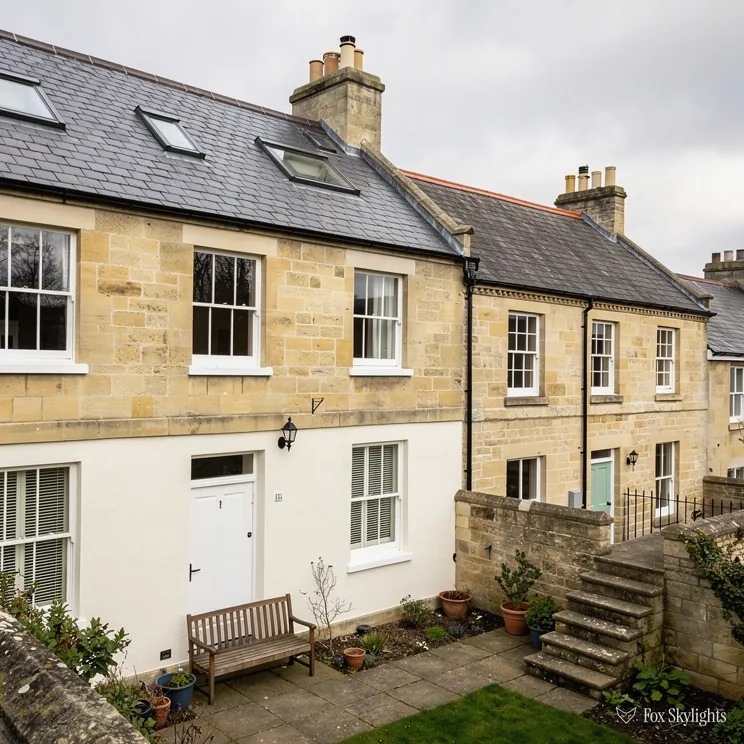
In the 19th century well-off Burton families built big houses on Winshill's higher ground, Bladon House and Moat Bank among them. Roofs that large leave generous loft space, and a roof window can turn it into a proper room.

Rows of houses for brewery workers went up on Bearwood Hill, Ashby Road and Alexandra Road. Terraces like these have narrow plots and shallow rooms, so light usually has to come from above and through a slim opening.
Winshill's riverside edge holds the listed Burton Flour Mill, on the site of Burton Abbey's medieval corn mill. For old industrial roofs the quiet answer is a flush conservation rooflight, with the listing checked first.
What the Winshill streets suit best
-
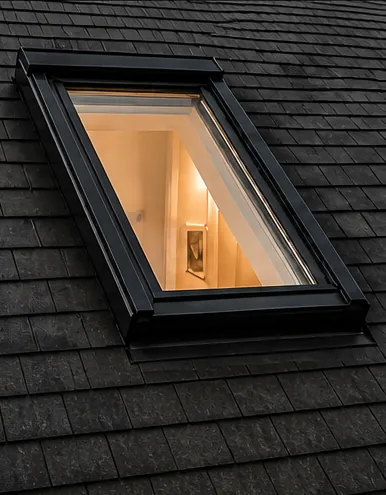 Roof windows
Spacious lofts under the big Victorian roofs, where a pair of windows can light a bedroom or a study properly.
-
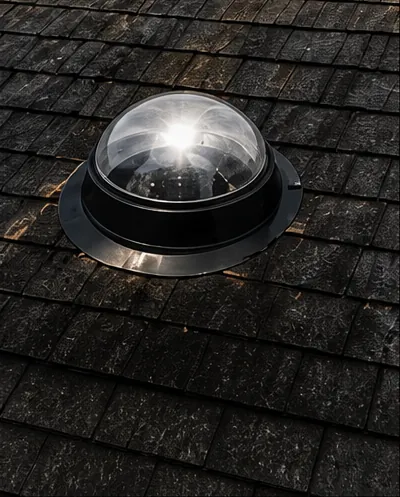 Sun tunnels
Narrow terraced houses whose landings and bathrooms sit under the roof with nothing overhead to hold a full window.
-
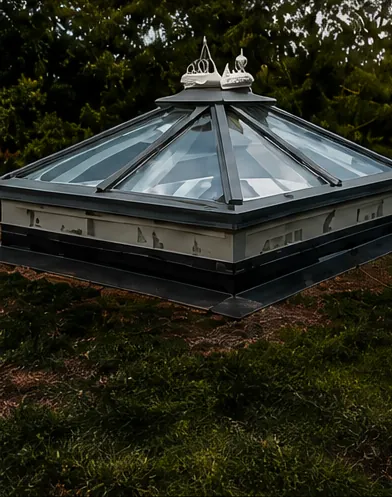 Conservation rooflights
Roofs that sit in view of listed buildings, glazed with a thin frame laid level with the slate or tile.
-
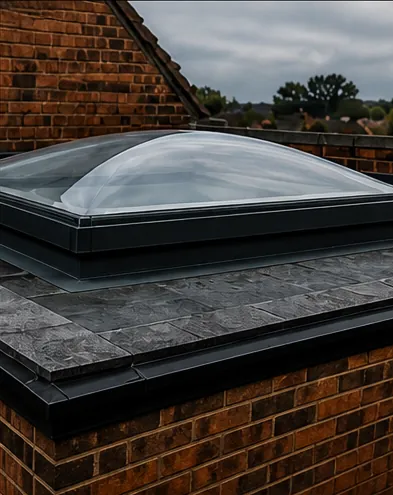 Flat roof rooflights
Rear kitchens and utility rooms with a flat roof, lit from above on a kerb that sheds water clear of the glass.
Nearby
Winshill sits among the Trent-side places around Burton, and the neighbouring pages describe the roofs in each of them, on both sides of the county boundary.

THE FOX BROADSHEET · WINSHILL
East Staffordshire, a county line and a listed town centre
Winshill is a village on the eastern side of Burton upon Trent, and East Staffordshire Borough Council is the authority for planning. The county boundary is a curiosity here. The parish always belonged to Derbyshire until it moved to Staffordshire, part of it in 1878 and the whole in 1894, and it is flanked to the north and east by the South Derbyshire border. A house on Winshill's edge can therefore sit a few metres from a different council. Our first job is working out which council covers the address, long before permission comes up.
No conservation area bears the name Winshill on the register, but two close neighbours matter. The Burton town-centre area, which the register labels No. 2 and 3, begins under a kilometre from where the village is plotted and has 70 listings: Grade I once, Grade II* four times, Grade II sixty-four times, plus a single entry with no grade given. No designation date is on file for it. The other, Newton Solney, was designated on 12 October 1978, stands roughly a kilometre and a half off, and has 15 listings, split two to thirteen between Grade II* and Grade II. Neither carries the Winshill name. A blank in the data means "none recorded", which is a smaller claim than "none".
The permitted development rule for rooflights, Class C, which lives in Part 1 of the 2015 order, comes down to a short list:
- 150mm of projection from the roof plane is the limit;
- no part may climb past the roof's top edge;
- a pane on a side-facing pitch is frosted and fixed, with one carve-out for an opening part whose lower edge clears 1.7m of height.
Living near a conservation area changes none of that. An Article 4 direction would, and so would a listing, after which consent for the work is needed on top. For flats and maisonettes the householder allowance never applies.
A reader asks
Our road backs onto the Trent side of Winshill. How would we learn which rules cover the roof?
Start with the postcode. We check the borough, the conservation boundaries and any listing before we come out, and the answer goes into the written quote. If the council needs to be asked about an Article 4 direction, we ask it. The wording behind all of this sits in our longer guide to the planning side and the Building Regulations side.
The boundary matters for a practical reason as well as an administrative one. A house on the Derbyshire side of the line reads like its Winshill neighbour from the pavement, and the same design of window can go in on either side. What changes is the council that answers the phone, the website you check and the officer who signs off. When a customer says "Winshill" we take the postcode and not the village name as the answer.
Even when no planning step is needed, the roof opening still counts as building work. Notifiable jobs carry a Building Control notice, which we send ourselves, to the borough or to an approver from the private register, as one of the job's own steps.
A hill of villas, a green and a brewery's workforce
By the end of the 18th century the village was grouped around a green on the east side of the hill. The shape of Winshill changed in the 19th century, when prosperous Burton citizens built large houses on the higher ground overlooking the town. Bladon House, The Woodlands, Highfield House and Moat Bank are the ones named in the record. At the same time rows of houses went up for brewery workers on Bearwood Hill, Ashby Road and Alexandra Road. One hill carried two kinds of roof, built for two kinds of household.
The two need different thinking, so here is how we approach each. A large Victorian roof usually has loft space that nobody is short of, and the work is about the quality of the room. The window goes where the ceiling height is best, and a second one on the same slope or across the ridge brings cross-ventilation in summer. In a worker's terrace the roof is small and the rooms beneath it are tight, so the work is about borrowing light from above without giving up what little height there is. Where the villa roof has been divided into several rooms, each slope gets its own look: some are best served by one tall window, others by two side by side. A narrow roof window can serve a back bedroom, and a sun tunnel can serve the landing or bathroom beneath the roof.
The but
A terraced roof is shared in effect: the party wall runs up beside the slope and leaves a strip too narrow for a standard window.
The way in
We take a narrower unit, set a little way from the wall, and flash it into the tiles so the neighbour's side of the roof is never touched.
Where an older roof carries a VELUX unit that has had its day, the size code on the frame is the useful clue. On a VELUX frame the code works as width then height, so a tag such as MK04 describes the opening before anyone is on the roof. A like-for-like replacement on the same code is a smaller job than a new opening, and an energy-efficient rooflight will usually lose less heat than whatever it replaces. Part L sets replacement glazing at 1.4 W/m²K for roof windows, where band B on the label also passes, and 2.2 W/m²K as the limit for rooflights.
| Roof | First question | Likely answer |
|---|---|---|
| Hillside villa | Ceiling height in the loft | Roof windows, perhaps a pair |
| Brewery terrace | Width beside party wall | Narrow window or sun tunnel |
| Rear flat roof | Fall and upstand height | Kerbed flat rooflight |
Turning a villa loft into a bedroom? In a house of two storeys, Approved Document B asks for a protected stair, because the escape-window allowance stops at 4.5m off the ground. Daylight and air are the roof window's job; the stair does the fire job.
Forty-eight minutes out, past the Trent bridge
Leicester to Winshill is 25.9 road miles, heading west-north-west, and it takes close to 48 minutes. Of everywhere we cover, this is among the furthest, so a Winshill visit is planned with every product type in the van. Winshill is ringed by roads: Ashby Road (A511), Newton Road (B5008) and the A444 each pass inside a kilometre. OSM shows no station within two kilometres either, so the road sets the pace.
Height matters in a village built on a hill. A loft on the high side of Winshill catches more sun and more wind than one down by the river, and that affects the choice of glazing. A south-facing slope on the hill can overheat a bedroom in July, so a coated pane that cuts solar gain, or a blind, is worth raising. A sheltered slope near the Trent has the opposite problem, and the better glazing there is the one that holds heat in. We note the aspect of the slope at the survey and recommend accordingly.
The roads tell part of the story. The A511, known locally as the Ashby Road, runs along the southern flank from Bretby Lane and Moat Bank, the highest point in Burton, to the eastern end of the Trent Bridge and the junction with the A444. Along the western flank lie the River Trent and the B5008 Newton Road, which runs on to Newton Solney and Repton in South Derbyshire. Brizlincote, a suburb about a kilometre off, sits close by. Wherever you are in the village you are within a short walk of a slope, and slopes mean views over roofs.
Water has shaped the place since the Middle Ages. A fulling mill stood on an island nearby in the 14th century and became a cotton mill in the late 18th. Burton Flour Mill, on the Winshill bank, is listed and descends from the corn mill of Burton Abbey. Mill roofs are the opposite of a suburban loft: large, plain and often low-pitched. They reward patience at the survey, because the span is long, the deck beneath may be unlike any house roof, and the load path decides where an opening can safely go. A flat roof rooflight is a natural companion to a flat or shallow roof of that kind, and where the building is listed, consent comes first.
A reader asks
We live near the river. Does the damp air shorten the life of a rooflight?
Not by itself. Good glazing is sealed at the factory, and the frame and flashings are built to shed rain, so a damp setting makes little difference when the installation is right. We still check the flashing detail and the lining twice on a riverside job. What does matter is condensation inside the house, which is a ventilation question. An electric opening rooflight helps with that as well as with summer heat, and it can be set to close itself when it rains.
Every Winshill job starts the same way. The free survey covers the roof and the room beneath it. After that comes a fixed written quote, listing the unit, its dimensions and its position. The quickest way to start is a message with a photo, and we turn up already knowing which of Winshill's two kinds of roof we are about to meet.