- 01The Buttercross's stone-slate roof
- 02Market Place frontages, quiet rear slopes
- 03Catmose, close to the centre
- 04Barleythorpe edges and newer extensions

Due east: 24.1 miles of tarmac, about 39 minutes at the wheel
Skylights and rooflights in Oakham
Rutland's county town, where a stone-slate Buttercross, 115 listed buildings and a good many hidden back roofs set the terms.
Or call 0116 430 0516
Listings, stone-slate and rear slopes

Near the Market Place the roofs show from the street and the register is thick with listings. The one that works is slim and flush-set, on the rear slope, chosen once the entry is read.

Out from the centre, toward Barleythorpe, a house is likelier to have a plain pitched roof. In those, a window set between the rafters is the plain way to a lighter room.
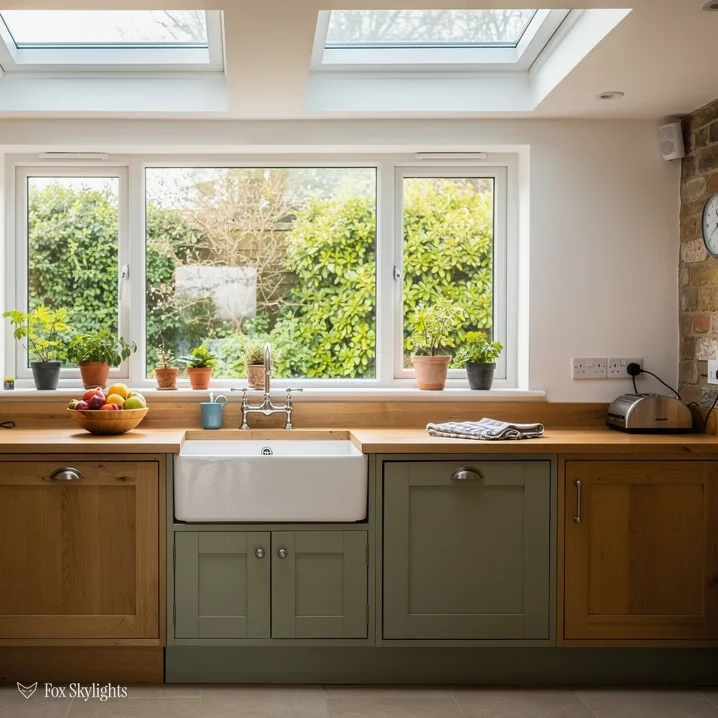
Add-ons at the rear of an older house may end in a flat roof above the kitchen. A flat rooflight on a properly raised kerb brings daylight into a room that had only one window wall.
Oakham's best-matched products
-
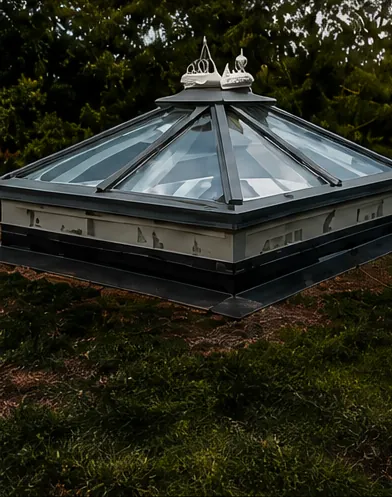 Conservation rooflights
For roofs inside the central designation, with a low frame and a bar that borrows an older pattern.
-
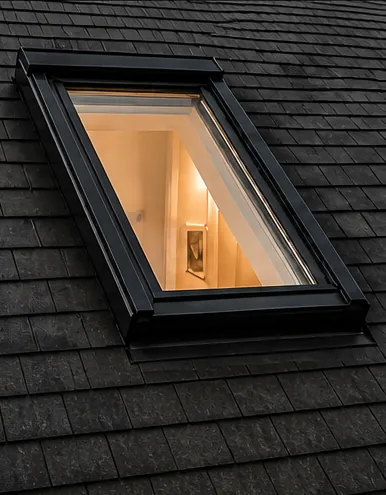 Roof windows
For loft rooms on ordinary pitched roofs, fitted between rafters once the timbers and the headroom have been read.
-
 Roof lanterns
For rear extensions with flat roofs, where a lantern gives height and daylight from every side to a dining area.
-
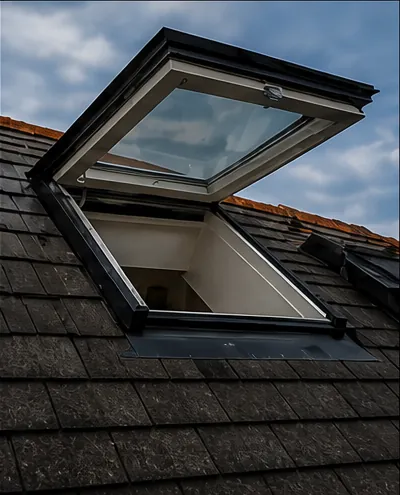 Electric and opening
For tall rooms and stairwells, where a switch is kinder than a pole and the glass can close itself when rain begins.

THE FOX BROADSHEET · OAKHAM
County town in the Vale of Catmose
Rutland's county town is Oakham, a market town in the East Midlands. Leicester is 24.1 road miles to the west, around 39 minutes by car, and the urban area holds about 12,000 people. The town stands in the Vale of Catmose, to the west of Rutland Water. Five classified roads (A606, A6003, B640, B641, B668) pass close to the middle, and the railway station, 0.6 kilometres from the centre, serves the Birmingham to Peterborough line.
Some of the town's character is plain to see. The open-air market runs in the Market Place every Wednesday and Saturday. Close by stand the Buttercross, with its octagonal stone-slate roof, and the wooden stocks, both Grade I listed. A museum nearby holds objects from local rural life, social history and archaeology. Any job near a roof like that starts with two questions: what is the building made of, and what is it allowed to become?
The town has also spread. The built-up area has spilled over into the neighbouring parish of Barleythorpe, north-west of the centre, and the map data names Catmose as a neighbourhood only 0.3 kilometres from the centre point. That growth means two types of survey inside one town: the historic core, with its constraints, and the newer roads where the work is mainly a question of timbers, headroom and daylight.
Green space is near. The map lists Brooke Hill Wood at 1.3 kilometres, Harris Grove and Ball's Meadow at 1.5, Gorse Field at 1.7 and The Seek at 2.8, all as named nature reserves. Trees close to a house bring shade, and shade changes the glazing question: a north-facing unit under a canopy collects leaf litter, while an open south slope may want solar-control glass. We assess both on the day.
It helps to know what a rooflight actually does to a room before choosing one. Daylight from above is brighter than daylight from a wall, because the sky overhead is the brightest part of it, and the light falls across floors and worktops instead of stopping at the nearest wall. Rooms that feel dull at noon often turn out to be rooms with windows in only one direction. A skylight, or a pair of them, can turn that around without moving a wall or changing the shape of the house.
A reader asks
Does the order of a survey change when the house is old and the street is protected?
Yes. We read the listing entry and the street first, then go into the loft, and only then choose the product. A rooflight on a protected street begins as a planning question and ends as a joinery one.
Whether you say skylight or rooflight, the visit is the same. We look at the room that needs the light, climb into the roof, measure the slope, and go outside to see how it reads from the road. A fixed written quote follows, with no charge for the survey. Oakham sits at the eastern reach of our working area, so we book the visit for a time that suits you and plan the day around it.
Stone-slate, old timbers and the rear slope
On an old building the front of the roof belongs to the street and the back belongs to the owner. That is not a rule so much as a habit of good judgement, and it guides almost every decision in a place like Oakham. A rooflight placed on a rear slope is out of sight from the road, easier to approve and kinder to the original design.
Covering decides the method
Natural stone slates are laid in diminishing courses, with the biggest at the eaves and the smallest near the ridge. To make an opening, individual slates are lifted and set aside, then relaid around the new frame. Careful stacking matters, because stone slate is hard to match. Where the covering is clay tile or modern concrete, the process is quicker, but the principle is the same: take only what the frame needs.
Timbers of unknown age
Old roof timbers are often generous in section and irregular in spacing. A rafter may have been replaced in one century, and a purlin added in another. We map what is up there before choosing the size code, and where a timber must be trimmed, we trim it with proper support above and below, so the roof stays as strong as it was.
The but
The slope you want to glaze is the one every passer-by can see.
The way in
We shift the unit to the rear slope, or choose a slim conservation pattern, so the street view stays as it was.
For a conservation rooflight, the frame is slim, the glass sits almost flush and a central bar divides the pane into a familiar pattern. Steel or dark-finished frames take the eye away from the glass, and the result reads from the road as a part of the roof, not an addition to it. Opening versions exist, although the bar and the hinge need to be chosen together.
Newer parts of town have simpler roofs. A house from recent decades often has factory trusses under concrete or clay tiles, and a loft kept for storage. The work there is to find a gap between trusses, or to have an engineer design an opening where the truss pattern leaves none. The outcome, a roof window with a plastered reveal, adds floor-to-ceiling daylight to a landing, a bedroom or a study.
Glass choice follows the slope. A south-facing pitch gets strong sun, so we talk about solar-control coatings that cut heat without darkening the room. A north-facing slope gets steady, cool light and needs no such coating. Laminated inner panes are a sensible choice wherever someone might stand beneath the glass, because they hold together if struck. And a blind is the simplest way to deal with a bright bedroom at five on a June morning.
For flat-roofed kitchens and extensions, a lantern is worth discussion. It rises above the roof, offers glazing on all sides and throws light into the heart of a room. The proportions matter: too tall and it overpowers the building, too squat and it gives little extra light. We sketch the options at the survey so you can see the scale before agreeing.
Rutland County Council and the register
Applications in Oakham go to Rutland County Council. For ordinary houses, much of the work falls under Class C of the General Permitted Development Order 2015: glass may rise no more than 150mm above the slope, may not top the ridge, and on a flank slope must be obscure and fixed, with a single exception for an opening part higher than 1.7m inside. Those limits are brief, and they are where a householder's plans most often come unstuck.
Oakham's central conservation area dates from 15 June 1971 and holds 115 listed buildings: five Grade I, five Grade II* and 105 Grade II. A second area, Egleton, designated in October 2004, lies 1.5 kilometres from the centre and records 17 listings, one of them Grade I. Neither designation takes Class C away by itself. The thing that does is an Article 4 direction, and Rutland can say, address by address, whether one exists.
A reader asks
My roof is stone-slate and the house is listed. What is the first step?
Consent for listed buildings comes first, in hand before a rooflight is ordered. It fixes the position, size and frame, and we can supply the product details for your application. The broader rules live in the longer explainer on permission and regulations.
For a flat or maisonette, householder permitted development is simply not available, and an application opens the process. In the centre that is worth checking for larger old houses, because a building that looks like one home can be several in law.
Building Regulations are a different gate. A roof opened up is building work, so we file the notice with Building Control where one is required, Rutland's team or a private approver, and the paperwork stays with your job. Loft rooms add an escape rule: a window serves as the way out only where the floor sits no higher than 4.5m up, and a second-floor loft therefore wants a protected stair.
Timing is worth a word. Roof work depends on weather, so we plan the opening for a dry spell where we can and keep the cover on until the unit is sealed. If rain arrives mid-job, the temporary cover does its work and the room stays dry. We tell you the plan for the day at the start, including how long the roof will be open, so nothing about the visit is a surprise to you or the household.
With the route clear, the job runs in a set order. Dust sheets and a temporary cover go on first, the opening is cut or the slates lifted, and the frame, flashings and lining follow before the glass goes in. The room is weathertight before we leave each day. Ten years of workmanship guarantee follow, and the figure in the written quote is the figure invoiced.
When you are ready for a survey in Oakham, the quote form is the quickest route, and WhatsApp suits anyone who would rather send photographs first.