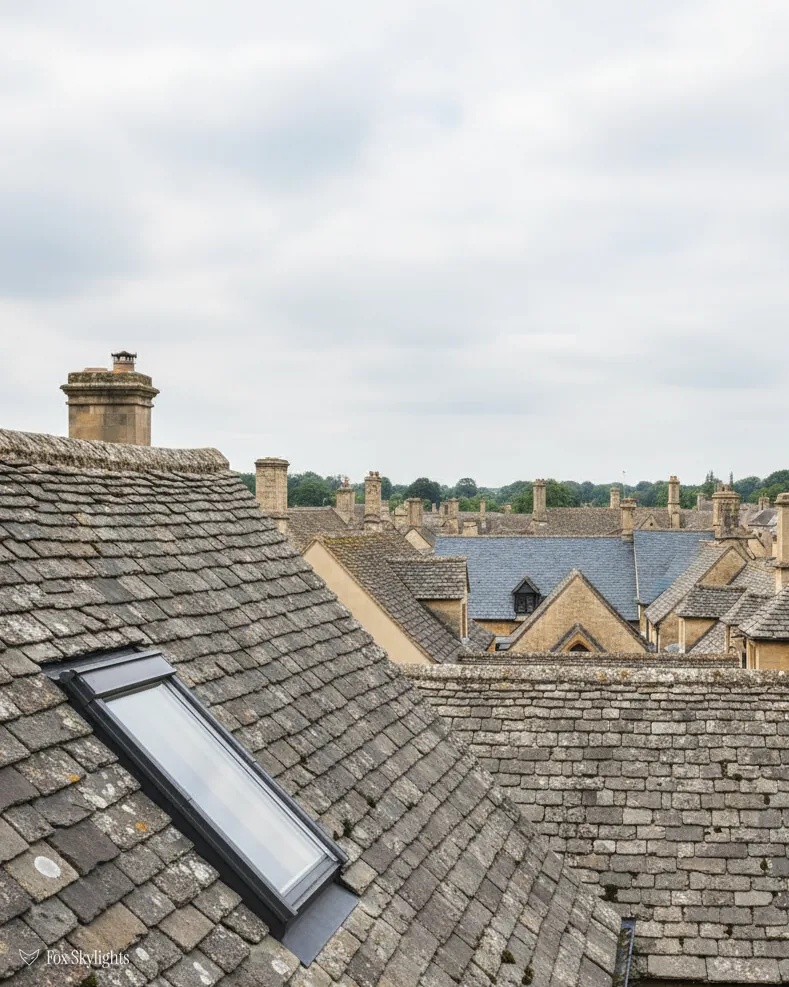
- 01Roofs along the Soar's east bank
- 02Listed fronts inside the village centre
- 03Extensions cut off from the garden light
- 04Lofts waiting on a roof window
Leicester to Barrow: 9.7 road miles heading north, 16 minutes door to door
Skylights and rooflights in Barrow upon Soar
Skylights fitted and replaced across a long river village, from houses near the Soar and the canal basin to the newer roads further back.
Or call 0116 430 0516
Built along water and rock
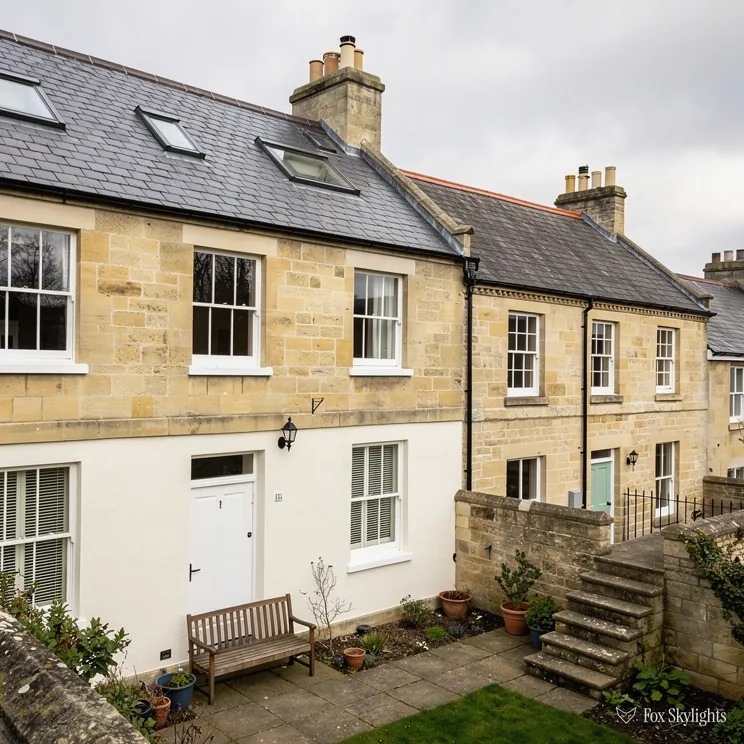
Barrow sits on the east bank of the Soar, with the Fishpool Brook running in beside it. Where a house near the water has a short slope, a slim rooflight set flush suits it.
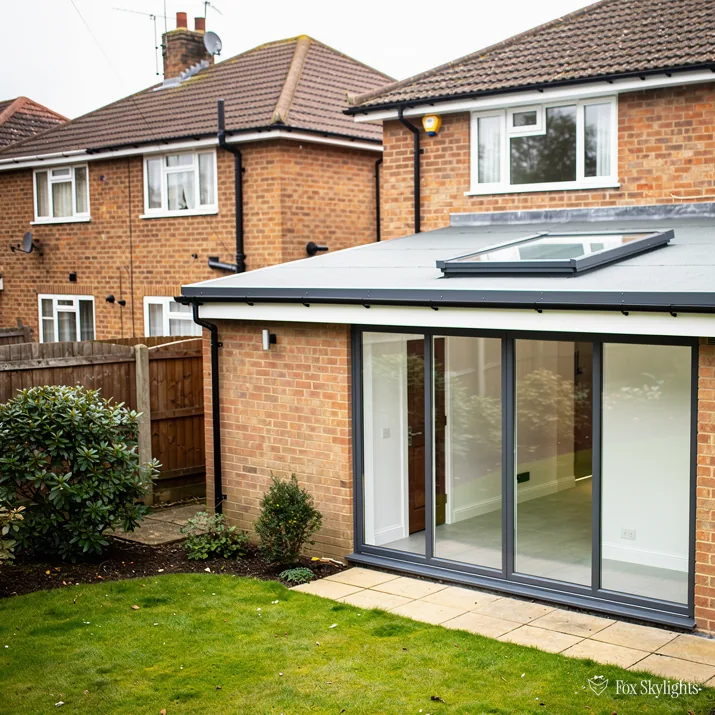
A large village collects rear extensions over the years: a kitchen pushed out, a utility added, a garden room tacked on. Each carries a low flat lid over a gloomy core, and a kerb-mounted rooflight lights it from directly above.

Behind the old centre the lofts are usually plain pitched voids with room to spare. Cutting a roof window into the slope gives that unused volume a job: a bedroom or study with sky overhead.
Skylights that suit Barrow houses
-
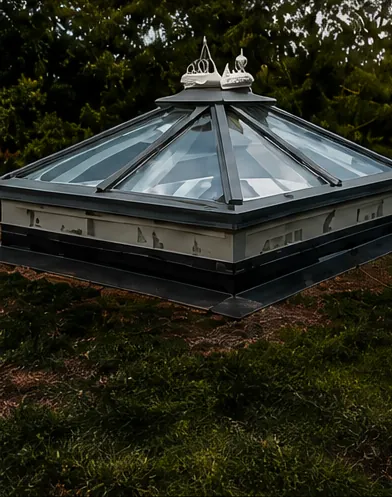 Conservation rooflights
For listed or older houses near the centre, where a low, slim frame settles into the slope and does not rise off it.
-
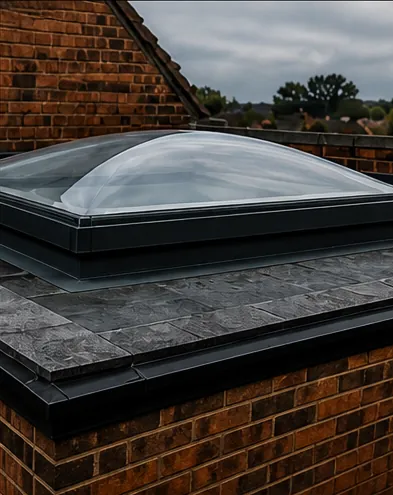 Flat roof rooflights
For the flat-roofed kitchens and garden rooms that a long-settled village has added to the back of its houses.
-
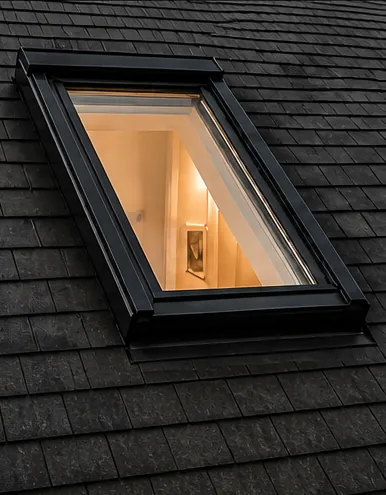 Roof windows
For spare lofts on the plainer pitched roofs, with the glass placed between rafters so the structure is left alone.
-
 Roof lanterns
For wider extensions that face the garden, where one tall pane of light over the table changes how the whole room feels.
Nearby
Barrow sits in a chain of Soar Valley villages and towns, and each neighbour below has its own page written around its own roofs.

THE FOX BROADSHEET · BARROW UPON SOAR
Charnwood's rules and the village centre
Charnwood Borough Council decides planning matters in Barrow. Class C of the 2015 GPDO lets a typical house take a new skylight with no application, provided three limits hold. Glass may project up to 150mm past the roof plane, never further. The top edge stays below the ridge line. Side-facing roof slopes need obscure glass and no opening, unless its opening section starts over 1.7m from the floor.
The national register has a conservation area named Barrow upon Soar at the village's core, and the register counts 24 listed buildings inside: 22 are Grade II, one is Grade II* and one has no grade logged. A second area, Quorn, starts a short walk away and holds another 31. Neither entry carries a designation date, so we quote none. For the roof the rule is short. Class C stays available in a conservation area. Nothing short of an Article 4 direction removes it; ask the council about your own street.
Full statutory detail: planning and Building Regulations guide. Here it is enough to say that the council is where the answer comes from, and that it is worth asking before work starts. A skylight that needs consent and has not got it is a bill nobody wants to open later.
In practice the council's answer comes in one of three shapes: no application needed, a lawful development certificate if you want it on paper for a future sale, or listed building consent where the house is listed, or an application where an Article 4 direction bites. We say which looks likely at the survey, and we write the position into the quote so it travels with the paperwork you keep.
A reader asks
Our house is close to the old centre but unlisted. Must we still ask the council?
It turns on a single point: whether your address falls under an Article 4 direction. If it does, Class C is switched off and an application is needed. If not, a unit inside the size and projection limits normally goes ahead without one. Charnwood can confirm that, and the fixed quote reflects the answer. For a conservation-area roof a conservation rooflight is usually the safest choice of product either way.
Planning permission and Building Regulations are different tests. The opening itself counts as building work. If a notification is required, we send it, either to Charnwood's building control or to a private approver, so the certificate comes with the job.
Brook, basin and quarry: what shaped the roofs
The records describe Barrow upon Soar as a large village in northern Leicestershire, in the Soar Valley between Leicester and Loughborough. A nineteenth-century directory entry quoted on its Wikipedia page says it has long been celebrated for its limestone, and sits on the east side of the navigable river. The Fishpool Brook meets the Soar at the village. A canal basin, the Barrow Canal Basin, is named on the map nearby, and the Grand Union Canal runs through the same stretch of valley.
The mineral story did not stop with the stone. The old Mountsorrel Railway carried granite from the Mountsorrel quarries to Barrow, and a conveyor now follows the same line so that quarry rock can be sorted here for distribution. British Gypsum also has a plant at Barrow. We mention it because working villages like this rarely end up with one kind of house. Houses of different kinds can end up side by side, and the roof over each needs reading separately.
Reading a roof before choosing a skylight
The records say little about which street belongs to which decade, and a house's age cannot be read off its postcode. We start in the loft. How far apart are the rafters? Is there a purlin, the heavy timber along the slope that props the rafters, and where does it cross? How much headroom is left under the ridge? Those answers decide the size and position of a roof window, not the age of the street. Then we go outside and look at the slope itself: the tile or slate, its condition at the edges of the opening, and what the neighbours can see.
Glazing choice follows the room below. A bedroom wants a unit that opens and a blind that darkens it; a study wants even light without glare on the screen; a stairwell wants as much daylight as the slope can give. Good glass keeps heat in as well as letting light through, and the figures behind that are on the energy efficient rooflights page.
The but
A rafter sits right where the middle of the new roof window should be, and moving the window sideways pushes it off the bed it is meant to light.
The way in
We trim and frame the opening so the load is carried round the cut, or pick a narrower unit that fits the gap between two rafters without disturbing either.
Wet ground matters too. A village with a brook and a river on its doorstep tends to have damp air in the valley bottom, and a roof window in a bathroom or kitchen should let that moisture out. An opening roof window on a centre pivot lets steam out, where a fixed pane would only collect it. A landing with no slope overhead can borrow light from a sun tunnel: a mirrored tube dropping from a small dome in the tiles. Tom Long's Nature Reserve lies about 2 km away, a reminder that open, damp ground is never far from the village.
| Roof | First check | Likely way in |
|---|---|---|
| Older house near centre | Listing and local limits | Slim conservation rooflight |
| Pitched roof, empty loft | Rafter spacing, purlins | Roof window between rafters |
| Flat-roofed extension | Falls and upstand height | Rooflight on a built kerb |
| Landing under the ridge | Clear run through loft | Sun tunnel |
Replacement units answer to Part L. Part L sets roof windows at 1.4 W/m²K (WER band B is the alternative) and rooflights at 2.2 W/m²K. A good modern unit clears both easily, which is more than the one it replaces will have done. Those figures apply to new and replacement fittings, and the fixed written quote names the unit proposed so you can compare its figures.
Sixteen minutes up the A6
Barrow lies between Leicester and Loughborough, 9.7 road miles from Leicester with the A6 running close to the village. Its railway station, 0.3 km from the centre point, is on the Midland Main Line. East Midlands Railway trains call from Monday to Saturday, with no Sunday service. For a survey that means a short drive in, a tape and a ladder, and a visit that does not eat the afternoon.
Commuters live here, and the Midland Main Line is on the doorstep, so we are used to arranging a survey around working hours or around a photo sent first. A couple of photos of the room, and of the roof from the garden, let us arrive knowing what to expect. Send them by WhatsApp or email, and we will say what we can already see before anyone climbs anything.
The ground around the village is green and wet in places. Tom Long's Nature Reserve is named on the map 2 km out, and the parish sits next to the Swithland Reservoir. Houses on that side of the village, with trees and open land close by, tend to cope with light of another character than those among the terraces: more leaf shade in summer, more weather coming straight across open ground. Glass with good solar control and a clean, simple frame is a sensible choice for a south-facing slope, and we say so at survey, not at installation.
A rear extension that opens onto a garden is the commonest brief we expect in a village of this size, and the answer is usually a flat rooflight or a small roof lantern: a glazed crown that lifts light well into the middle of the room. See the flat roof rooflight service for how kerb, glass and covering fit together so rain runs away from the frame.
Tell us when suits for the survey. Time on site is whatever the roof needs, and nobody is asked to hover on the landing holding a torch.
If the skylight you want is a roof lantern, the same visit settles the practical questions: the span of the opening, the height the lantern will reach above the flat roof, and how the structure round it is carried. A roof lantern is a bigger piece of joinery and glass than a flat rooflight, and it deserves a roof that has been measured, not estimated from the garden.
A reader asks
Can an existing flat-roofed extension in Barrow take a bigger rooflight than the one it has?
Often it can, after we have worked out the roof's make-up and what holds it up. A larger opening needs the joists around it trimmed and supported, and the kerb rebuilt to suit. Both are done at once, and both are written into the quote before you agree to anything. If a larger unit is not sensible, we say so and suggest a better arrangement.