- 01Knitters' cottages with long upper rooms
- 02Listed frontages near the village centre
- 03Low ground beside the River Soar
- 04Lofts that fill up the family house
Quorn: 8.7 road miles from Leicester, up the Soar valley, a 16 minute drive
Skylights and rooflights in Quorn
Rooflights for a Soar-side village of old knitters' cottages, listed frontages and the family houses that filled in around them.
Or call 0116 430 0516
Under Quorn's cottage eaves

Where the knitters worked, the upper rooms were built long and bright. A slim skylight laid low in the rear slope can give a bedroom or landing that same working daylight again.
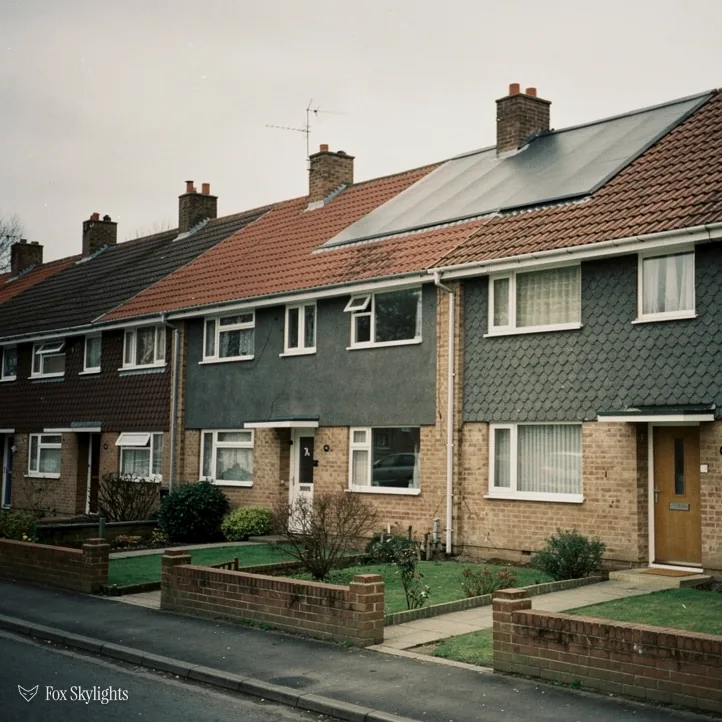
Thirty-one listed buildings are recorded inside the conservation area, so some slopes in Quorn are protected by law. Before a rooflight goes near one, we read the listing and ask what it covers.
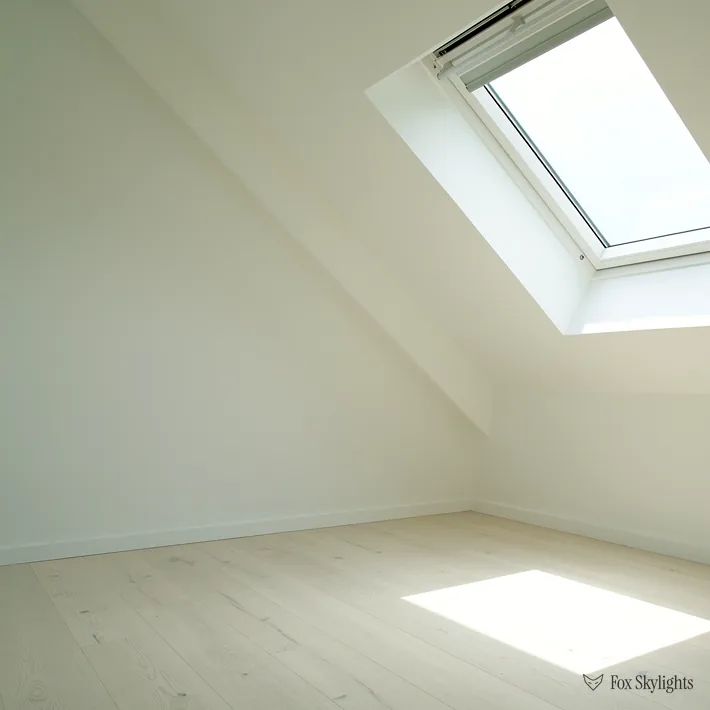
Family houses further out tend to have a loft used for boxes and not much else. Opening the slope with a roof window, framed between two rafters, can give it floor space you would happily use, once the timbers are checked.
Choosing for Quorn's mixed streets
-
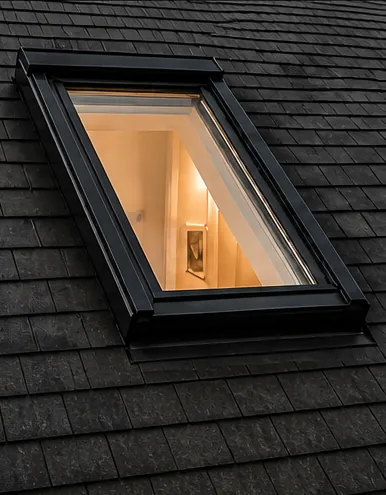
 Conservation rooflights
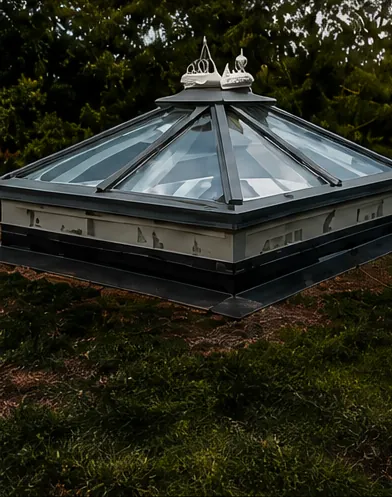
For the old cottage slopes near the centre, where a thin frame and a single central bar sit close to the roof covering and read quietly from the lane.
-
 Roof windows
For a family-house loft, placed once we have found where the purlin runs and how much of the floor has true headroom.
-
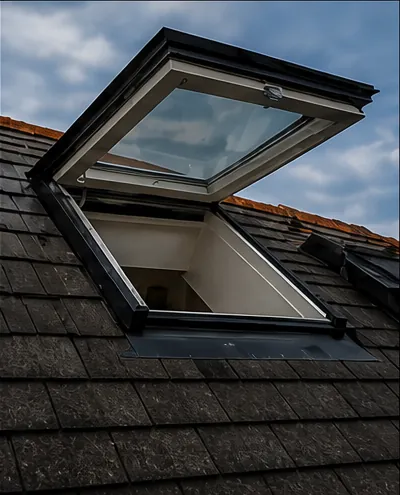 Electric and opening
For a high opening over a stairwell that nobody can reach, run by a wall switch or a handset instead of a hooked pole.
-
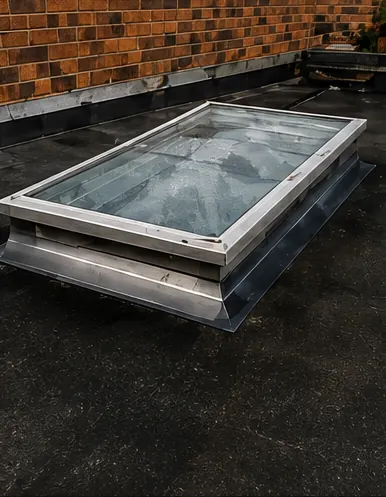 Misted rooflight replacement
For an older unit whose glass has clouded between the panes, swapped for a modern unit in the same opening so the ceiling below stays as it is.
Nearby
Around Quorn we also cover the Soar valley villages and the Charnwood towns beside it, and each has a page written about its own roofs.

THE FOX BROADSHEET · QUORN
Charnwood, the conservation area and the listing
Quorn belongs to Charnwood, so Charnwood Borough Council is who you would ask about a roof. A house owner normally needs no application at all, because the 2015 order grants a standing right for roof alterations and a skylight falls under it. The limits are physical ones: glazing may rise 150mm clear of the slope and no more, it cannot top the ridge, and a unit in a roof slope forming a side elevation needs frosted glass that cannot open, unless the sash that moves reaches above the 1.7m mark measured up from the floor beneath it.
The national planning register has a conservation area for Quorn that takes in the middle of the village. The date it was designated is blank in the record, but 31 listed buildings stand inside it: one Grade I and thirty Grade II. That is plenty of protected roof for a village this size. Being in a conservation area leaves that right standing. An Article 4 direction is what would take it away, and Charnwood can say whether your address is caught.
For a house in the old part of Quorn, the paperwork comes before the tape measure. We look up the listing, find out whether the street lies inside the boundary, and tell you when the position needs Charnwood to confirm. By the time anyone climbs a ladder, the open questions are down to a few, and the quote describes an opening that can lawfully be made.
A reader asks
Our Quorn cottage isn't listed. Must we apply to Charnwood before a skylight is cut into the back slope?
Usually no, so long as the unit keeps inside the size limits and no Article 4 direction has been placed on your property. If there is any doubt, Charnwood can confirm it before work starts, so no slate is lifted on a guess. The statute itself is set out in our long guide to planning permission and the Building Regulations.
Building Regulations are a different matter from planning, and a clear answer to either question settles nothing for its twin. A fresh hole in a roof counts as building work even with no application. Where the job is notifiable, the notice to Building Control comes from us, passed to the local authority or to a registered building control approver, so a completion certificate arrives without you chasing it.
Because so many of Quorn's older buildings are on record, the answer to "what kind of roof is this?" comes quickly. Listed, conservation area or plain, it sorts the job into order. A conservation rooflight is the natural product for the first two, and an ordinary roof window serves the third.
Knitters' cottages and a river that floods
Framework knitting was a major trade in Quorn until machines took over, and the cottages along one of the old roads still carry the features that suited it. A knitter needed light: the frame stood by the window and the stitching was judged by eye. That history is handy to us now. A room built for close work has generous glass at one end, and often a ceiling and roof pitch that would welcome more daylight from above.
The roofs on those cottages are modest. The slopes are short, the eaves are low, and the neighbours are close enough that a large opening would be seen from three windows at once. A small rooflight placed between a pair of rafters and laid flush gets daylight onto the stair or into a back bedroom, and the row looks the same from the road. We measure the framing first. Cottage roofs were framed by hand and follow no standard spacing, so a unit has to be cut to the timber actually there.
Quorn is a village, not a town, but it is a big one, and two houses on the same street need not share a roof. That is why we hesitate to talk about a typical Quorn roof. Two houses facing each other across a lane can differ in slope, in rafter size and in the way the loft was floored, and the survey is where those differences are written down. A rooflight that suits the cottage may be wrong for the villa opposite, and the quote follows whichever roof we are standing on.
A shallow river and a damp history
Quorn has flooded repeatedly down the years, and the record puts it on the shallow fall of the River Soar, which lets water spread instead of clearing. The river, with Pilling's Lock and part of the Grand Union Canal, makes up much of the eastern edge of the parish. A rooflight does nothing about floods, but older houses here have lived near damp for a long time. When an old unit comes out, we read the timber around the opening for past water before deciding what the new one will rest on.
The but
The old frame sits in a rough timber opening gone soft with age, and a modern unit needs something firm to bear on.
The way in
We cut back to sound timber, add a fresh trimmer across the opening if one is wanted, and size the new unit to what remains, so it sits square instead of wedged.
| Roof | First look | Usual way in |
|---|---|---|
| Knitter's cottage | Rafter spacing by hand | Slim flush rooflight |
| Listed frontage | The listing text | Consent, then conservation unit |
| Family house loft | Purlin and headroom | Roof window in the gap |
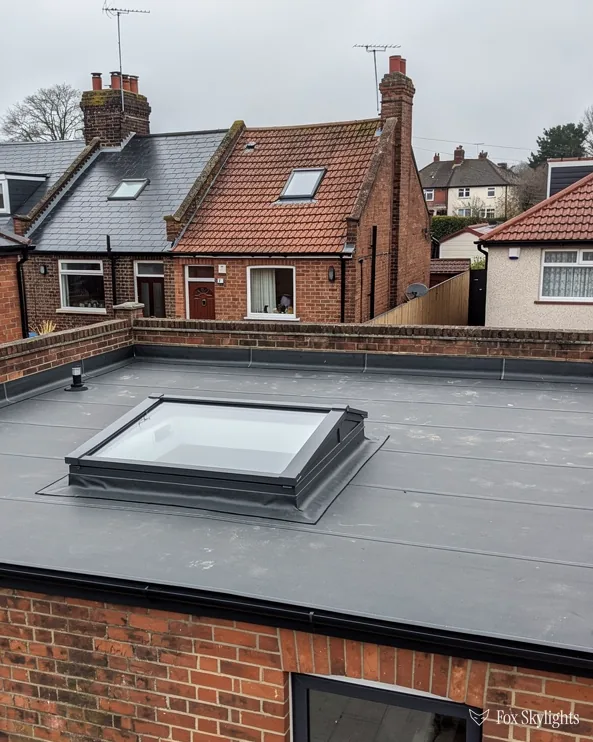
| Flat-roof extension | Fall of the deck, kerb height | Flat unit on a kerb |
Heat loss is set by Part L for work on existing homes. For a roof window Part L accepts either 1.4 W/m²K or Window Energy Rating band B, and a flat rooflight has to come in at 2.2 (both in W/m²K). Those figures are the floor, so at the survey we spend our time on glass type and frame depth instead.
Lofts raise one more point. For a bedroom in the roof of a two-storey house, the escape route is a separate question. Under Approved Document B a window counts as a fire exit only when the floor it serves is 4.5m or less from the ground. A loft room is above that mark, so the staircase does the escape work and the roof window just supplies daylight and fresh air.
The bypass, the heritage line and Buddon Wood
Quorn lies north-north-west of the city, 8.7 road miles on, and the van takes about 16 minutes. On 28 October 1991 a dual carriageway bypass opened and carried the A6 off to the north-eastern edge of the village. Only the A6 is classed as a main road near the middle of the village, and it is how we come in. A survey leaves most of the day free for drawing up the job.
The railway is part of how the village describes itself. The station is called Quorn and Woodhouse, shared with the hamlet of Woodhouse, and the section of the old Great Central Railway through Quorn is now preserved as a heritage line. The Midland Main Line also runs along the river boundary, and Barrow-upon-Soar station is a short way off. For a roof job it simply means Quorn is easy to reach, by rail or by road, and a survey does not have to be fitted round a long journey.
South of the village, the parish boundary with Mountsorrel, Rothley and Swithland takes in Buddon Wood, Mountsorrel Quarry and part of Swithland Reservoir. It makes for a green edge, and a house that backs on to any of it often has a roof with trees nearby. Leaf fall and shade change how a rooflight is placed. A south-facing slope under an oak will take less sun than the pitch suggests, so the glass choice is worth talking through at the survey.
The village still has working industry. A textile factory here began with fabrics for footwear and corsets and now makes high technology textiles for military, aerospace and leisure customers. It is a useful reminder that Quorn did not stop making things when the knitters did.
For homes with a high stairwell, an electric opening rooflight solves the problem of a window nobody can reach. It opens on a switch, lets warm air out of the top of the house, and can be wired to close on its own if rain is detected. Where an old unit has fogged and the seal has failed, replacing a misted rooflight in the same opening keeps the work small.
Water is part of the landscape in other ways too. Lake Sara and the River Soar are both mapped within 1.5 km of the village point, and Tom Long's Nature Reserve is about half a kilometre away. Anyone whose back garden looks that way has a view worth framing, and a rooflight over a kitchen table or a bedroom is one way to bring some of the sky indoors. We think about what is outside the glass as well as what the glass lets in, and we will say so if the best position for the view is not the best position for the roof.
A reader asks
We back on to the river side of the village. Does a rooflight need anything special there?
Nothing special in the product, but we look at the roof edge and the surrounding timber with more care, because a house with a long history of damp can hide softened wood. The Class C rules apply as they do elsewhere, and if your property is listed or in the conservation area, we check that first.