- 01Two greens, one old crossroads
- 02Listed roofs that need a light touch
- 03Lofts measured before a window
- 04Brook and rivers close by

North from Leicester for 6.8 miles, a drive of about 14 minutes
Skylights and rooflights in Rothley
Cross Green, the Town Green, two conservation areas and large houses with deep roofs: the roof decides which glass can go in, long before anyone talks about size.
Or call 0116 430 0516
Roofs around the greens
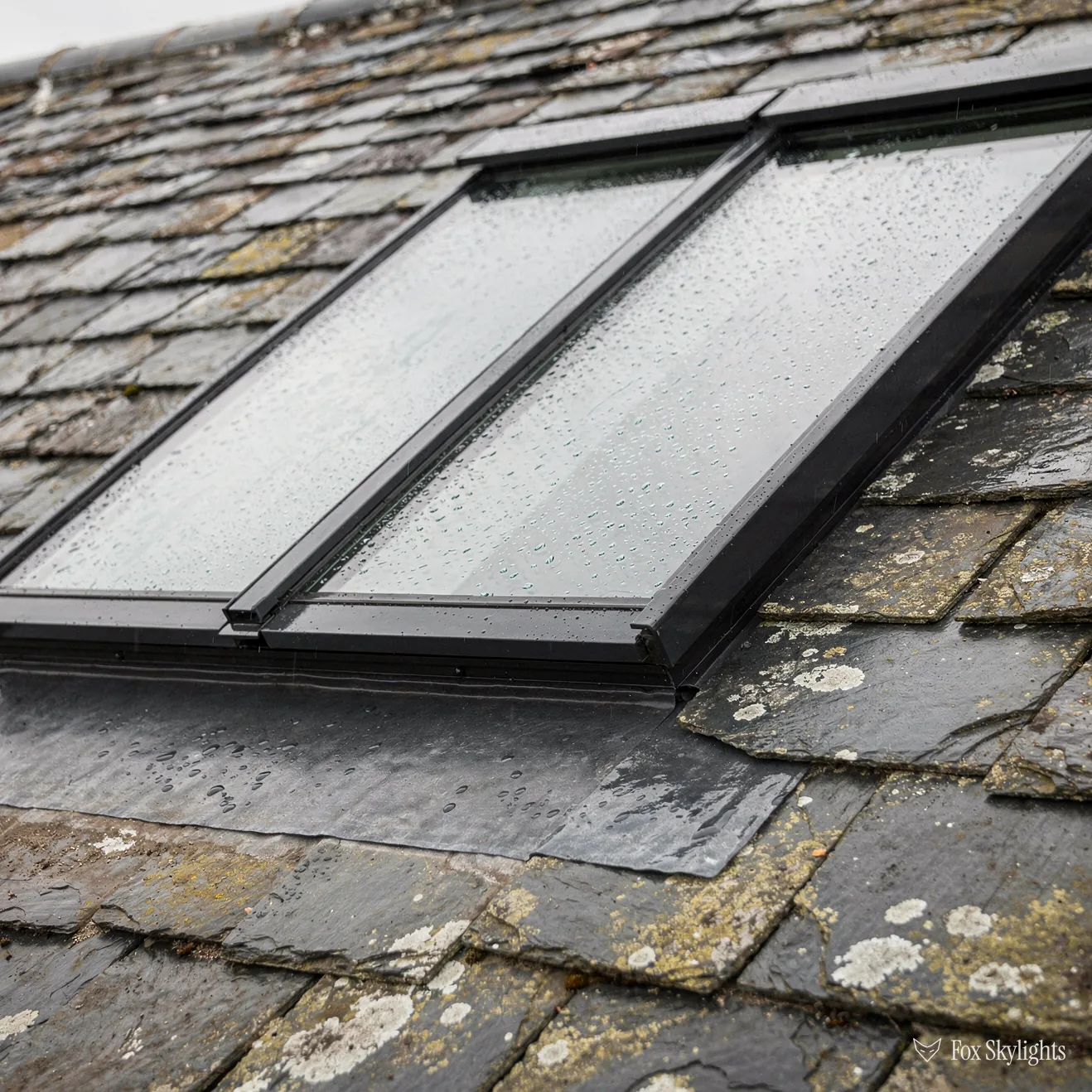
Cross Green and the Town Green sit inside a conservation area that holds twenty-four listed buildings on the planning register. A roof there is read from the street first, so the glass has to be low, slim and set at the same angle as the slope.

Houses on The Ridgeway and other sought-after roads are among the county's most valuable. That gives a roof window or a pair of them somewhere to go, once we have found the purlins and counted the headroom.

Behind the older frontages, kitchens and garden rooms are often flat-roofed additions. A rooflight on a proper kerb brings daylight deep into the plan, where a side window never reaches.
Which glass tends to suit Rothley
-
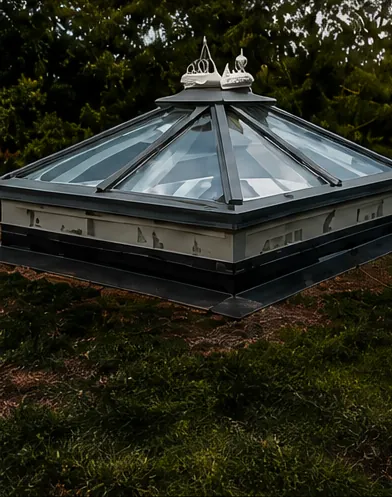 Conservation rooflights
For the listed and older roofs near the greens, where a thin frame lying flat to the slope draws the least notice from the road.
-
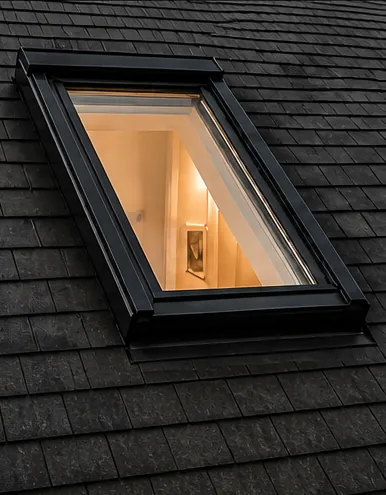 Roof windows
For the deep lofts of the larger village houses, fitted between rafters once the roof structure has been checked.
-
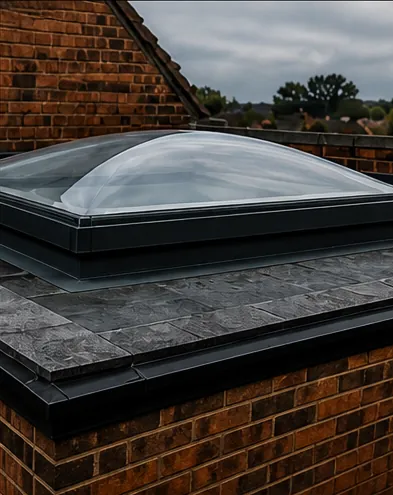 Flat roof rooflights
For the flat-roofed rooms built on at the back, raised on a kerb so rain runs off the glass.
-
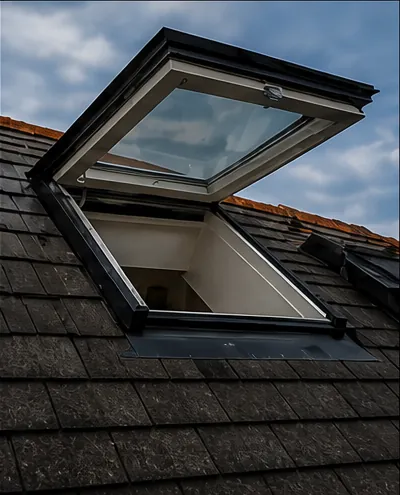 Electric and opening
For high ceilings and stairwells, where a handle would be out of reach and a remote does the job.
Nearby
Our work also runs through the Soar and Wreake valley villages and towns close to Rothley, and each of those places is listed below.

THE FOX BROADSHEET · ROTHLEY
Two conservation areas, one small village
The parish of Rothley, a village in Charnwood, has a population of about 6,000, and sits 6.8 miles up the road from Leicester. Planning questions about a new opening in a roof go to Charnwood Borough Council. The planning register holds two conservation areas in the village's name. The first, plain Rothley, has 24 listed buildings on record: one Grade II* and 23 Grade II. The second, Rothley Ridgeway, sits a few hundred metres off the centre point and holds 6: one Grade I, five Grade II.
The register does not give a designation date for either, and we do not guess at one. What matters for a roof is the practical meaning. A conservation area is a place where the council has decided the look of the street deserves care, and a rooflight on a slope that faces a green or a lane is the kind of change that gets noticed. A slope at the back of a house, behind a boundary wall, is a different conversation.
Most unlisted houses can take a rooflight without applying, because the 2015 permitted development order already grants the right, under Class C. Its conditions are physical. The glass may sit 150mm clear of the roof surface at most. It cannot climb above the ridge. A side slope needs obscure, fixed glass unless the openable part is over 1.7m up. A conservation area alone does not cancel those rights. What can is an Article 4 direction, and Charnwood is the body that knows whether your road has one. For the detail, read the full planning guide.
A reader asks
We live on the Ridgeway but the house isn't listed. Who do we ask before a roof window goes in?
Perhaps nobody, but confirm it. Class C stays available to your unlisted house unless a direction under Article 4 applies to it. We put that question to Charnwood during the survey, so the answer reaches you before the written quote does.
Building Regulations ask a different question from planning. Cut a hole in a roof and you have done building work, application or not. If it is notifiable, we submit the notice to Building Control, either the council's team or a private firm registered as a building control approver. The paperwork then closes out as the job does.
The data we work from also records two things about Rothley that bear on roofs, though they are not rules. The village centres on two greens, Cross Green and the Town Green, both reached by a road leading from the crossroads. And the crossroads itself lies on the old line of the A6, which now bypasses the village. Those slopes are the ones people see, which is why a conservation rooflight with a slim frame and a flat profile is where most conversations about the old core begin. You can read more about that product on our conservation rooflights page.
Large houses and what is under their slates
Rothley has a reputation for money. The village is described as one of Leicestershire's most affluent areas, judged by the number of houses worth more than a million pounds, and The Ridgeway was named by the Sunday Times as the most expensive place to live in the East Midlands. We read that as a clue about the housing stock: the homes on roads like these are valuable, and each roof is surveyed before anything is proposed. The Ridgeway figure says something about the price of houses, not about the roof over any one of them, so the survey starts from the timbers rather than the street name.
A deep loft is the easiest place to get a roof window in, and the hardest place to get the position right. There is usually space for two or three openings, and the temptation is to centre them on the slope for symmetry. The better order is the other way round. We start inside, mark where the purlins and the rafters run, check how much of the floor has full standing height, and only then decide which rafter bays take the glass. A roof window that is a good size for the roof and a bad position for the room is a poor trade. Where a house also has a front elevation that matters, the front slope usually stays plain and the glass goes to the rear.
The but
A tall house with a steep roof can leave the loft too high above the stair for anyone to reach a window handle.
The way in
An electric opening rooflight takes a wall switch or a handheld remote, so the window can be opened and closed from the landing below. See <a href="/services/electric-opening-rooflights/">electric opening rooflights</a>.
Extensions raise the other common question. When a kitchen or garden room has been added behind an older house, the new roof is usually flat or very shallow, and the rooms below it tend to be deep. A side window lights the first couple of metres. A flat-roof rooflight lights the whole of the floor beneath it, and a larger one can turn a long dark kitchen into a room that is bright at the cooker as well as at the doors. The glass sits on a kerb, which is the raised upstand that carries the unit and lifts it clear of standing water. If the existing flat roof has hardly any fall, we look at that first, because water that does not run off shortens the life of anything placed on top.
On higher-value houses, people often ask about the glass itself. Better glazing has become the usual expectation for existing dwellings. For a roof window, Part L (2021) is satisfied by band B (the Window Energy Rating grade) or 1.4 W/m²K. Rooflights are measured against 2.2 W/m²K. That is the minimum for work to an existing house, not a ceiling on what you can specify, and we are happy to quote higher where a room faces south and gets hot. Our page on energy-efficient rooflights goes through the options.
Because the glass is the visible part, finish matters. Frames come in dark and light colours, and in the conservation areas we are guided by the roof covering around the opening rather than by the owner's favourite shade. Slate wants dark; clay tile wants a frame that does not shout. We take samples to the roof when the question is close.
Brooks, the railway and a quiet kind of damp
The map around Rothley is wet. Rothley Brook runs close by, and the River Soar and River Wreake both lie inside roughly 1.5 km. Further out, a nature reserve known as Reedbed lies around 2.8 km away. None of this changes the planning position, but it shapes how roofs behave. A rooflight sits in the coldest, dampest plane of a house, whatever the ground around it. Condensation on the inside of a pane is usually a ventilation and glass question, not a sign that water is getting in. Our explanation of why rooflights get condensation is the place to start if you have seen it.
When a unit is already in the roof and the sealed glass has gone cloudy, the question becomes whether to replace the glass or the whole unit. That is a matter of size, frame condition and how the unit was fitted. We look at it on site, and the written quote says which it is. Details are on replacing misted rooflights.
A reader asks
We can see mist between the panes of our kitchen rooflight. Does that mean it needs replacing today?
Not urgently, usually. Mist between the panes means the seal around the double glazing has failed, so the unit insulates less well and looks tired. It is not the same as a leak. We would check the frame and the flashing at the survey and tell you plainly whether new glass will do or the whole unit has run its course.
Rothley's history gives the village an unusual set of roof ages to think about. It is listed in the Domesday Book as Rodolei, among the king's lands, with 37 acres of meadow, a mill and considerable woodland. The station opened in 1899 on the Great Central Railway, which now operates as a heritage line, and the poet and historian Thomas Babington Macaulay was born in the village in 1800 during a long visit by his parents. None of that tells us what is on any one roof. It does tell us that this is a place with deep roots, and that a lot of its building has been added to and altered across centuries, so the first hour of a survey is often spent working out which part of a house is which age.
That working-out matters because old and new parts of a roof behave differently. A Victorian slate slope has been through more weather than a modern tile one, and laths and battens may be at different spacing. A rooflight cut into the old part needs the surrounding slates lifted and relaid with new flashings around the frame. The same unit in a newer section can be fixed straight to the structure. Neither is harder; they are simply different, and the quote reflects whichever applies.
We fit survey visits around the household, and the survey itself is free. Once it is done, you receive a fixed written quote you can compare at your own pace. To begin, WhatsApp us or fill in the quote form and name the darkest rooms in the house.