- 01Georgian frontages off the Market Place
- 02Cook's cottages on the High Street
- 03A conservation area full of listings
- 04Newer roofs beyond the old core
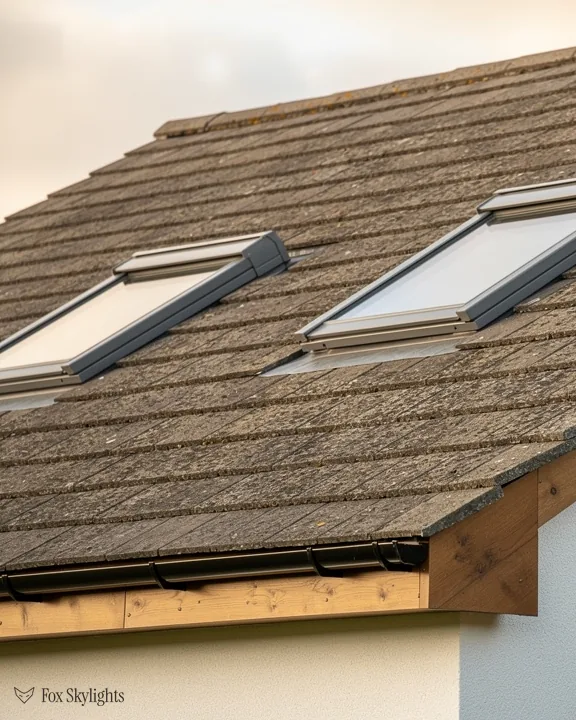
Across the county line in Derbyshire, 23.7 road miles from Leicester and about 36 minutes' drive away
Skylights and rooflights in Melbourne
Derbyshire market town, 104 listed buildings in its centre alone: the roof comes first, and the rooflight follows what the roof allows.
Or call 0116 430 0516
Georgian streets and Cook's cottages

The Thomas Cook Memorial Cottages on High Street went up in 1890 and 1891, fourteen cottages with a bakehouse, laundry and mission hall. A roof with that much recorded history is approached with great care.
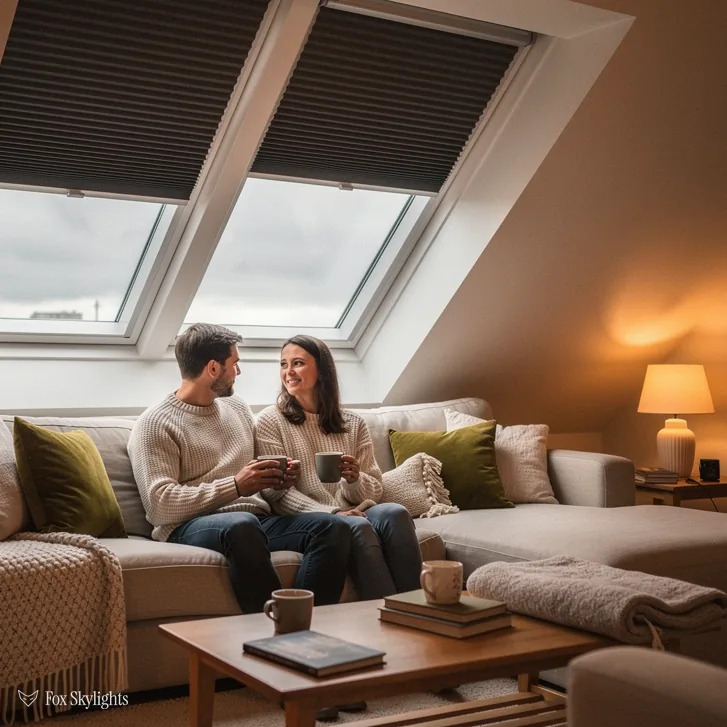
Melbourne has many Georgian buildings, and a Georgian roof tends to be deep and high-ridged. That gives a loft behind it real room, so a roof window can light a proper bedroom rather than a cupboard.
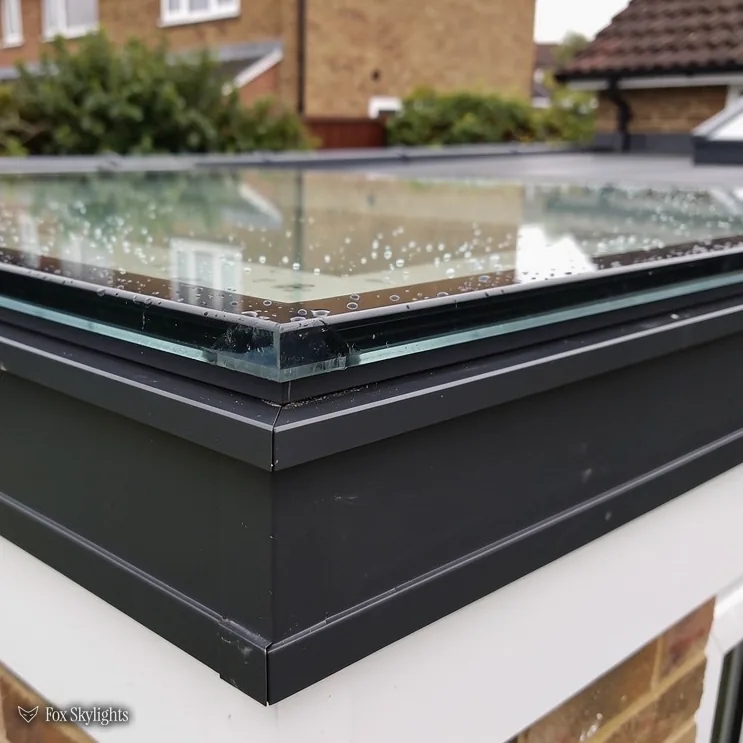
Behind a shop or house, a rear extension may have a flat roof. A flat rooflight on a kerb brings light down where a wall window cannot, and a slim frame stays out of the way.
What belongs on a Melbourne roof
-
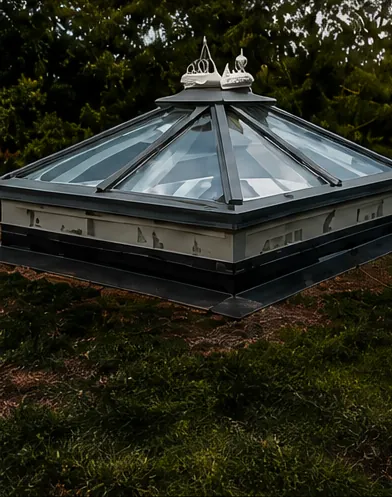 Conservation rooflights
For listed and historic roofs in the centre, with a slim bar and a flat finish that sits quietly in the slate or tile.
-
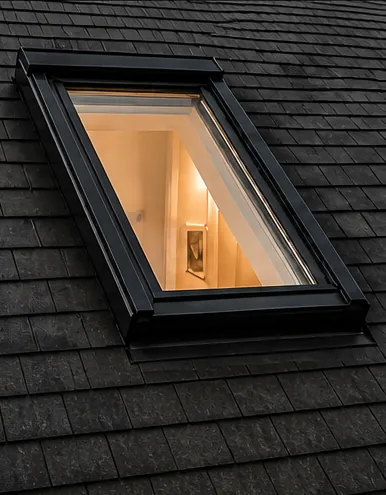 Roof windows
For the deep lofts of Georgian houses, where the headroom is generous and a window completes the room.
-
 Roof lanterns
For rear extensions and garden rooms, where a raised glazed crown fills a plain flat roof with sky.
-
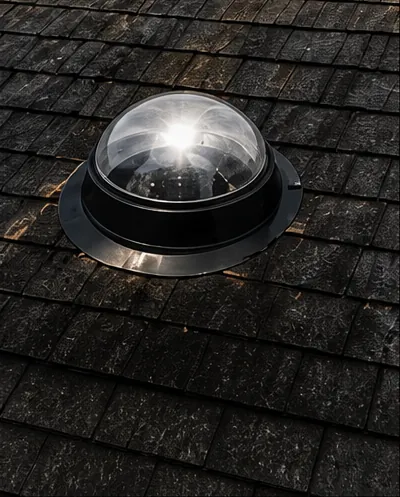 Sun tunnels
For small interior rooms, such as landings and bathrooms, where the roof above has no slope to cut into.
Nearby
The towns and villages around Melbourne are in our area too, and the six closest are shown below.

THE FOX BROADSHEET · MELBOURNE
The town built round a Market Place
Melbourne, a South Derbyshire market town and parish, sits 8 miles south of Derby and 2 miles from the River Trent; the drive from Leicester ends in a different county from our home ground. The Market Place holds the main shops, among them an ornate building that once housed the Co-op. The architecture matters because rooflights are judged against it: a flat, plain slope is one thing, and a roofscape that includes Georgian terraces is quite another.
The town contains many Georgian buildings, and in the 19th century it was a centre for framework knitting and footwear manufacture. Thomas Cook, who started popular travel in England, built the memorial cottages on High Street in 1890 and 1891. The group has fourteen cottages, a bakehouse, a laundry and a mission hall. A row of that kind reads as a single composition, so any change to one slope is seen against all the rest, and we plan accordingly.
The facts on file for Melbourne are generous about its buildings and thinner about what is up on their roofs, so we do not pretend to know a street from a list. The records tell us where the protected areas are and how many buildings in them are listed. They cannot tell us what is under a particular ridge, or whether a previous owner has already replaced the covering. Only a survey does that, which is why every Melbourne job starts with one.
In towns like this, what counts is the viewpoint. A slope seen from the High Street is judged harshly. A slope seen only from an upstairs window or the back garden is judged by almost nobody. We start every Melbourne survey by walking to the places from which the roof can be seen, and the answer decides whether you need a conservation rooflight or a standard unit.
A reader asks
Will a rooflight on the back of a Georgian house in Melbourne be visible from the street?
Sometimes it will, depending on the ridge height and the angle of the street. We walk to the pavement opposite and look up, then go back and compare the view from a ladder, before choosing a position. If there is a sightline, we lower the profile or move the opening so it drops out of it.
The dry reality of old towns is that the best position for light and the best position for looks seldom match. A rooflight high on the slope lights the middle of a room but may be seen from further away. A low one is hidden but throws the light on the floor. We lay both out in front of you, and the decision is yours.
South Derbyshire and the three conservation areas
South Derbyshire District Council decides planning matters in Melbourne. Three conservation areas are recorded close to the town centre. The main one, dated 12 February 1969, covers the centre itself and holds 104 listed buildings. Grade I accounts for 24 of them, Grade II* for seven, and Grade II for the remaining 73. A second, Woodhouses, dates from 16 January 1992 and records a single Grade II listing. A third, King's Newton, is dated 21 February 1979, includes 20 Grade II listings and sits just under a kilometre away, so it belongs to the neighbouring settlement rather than the town.
Melbourne is old, and old towns reward patience on a first visit. We take our time over the loft, the eaves and the view from the street before saying anything about glass. A survey that finds the one beam in the wrong place saves a good deal of arguing later, and the written quote that follows is fixed, so the figure you sign is the figure you pay.
It helps to know what the grades mean. Grade I is the highest, reserved for buildings of exceptional interest. Grade II* comes next and Grade II after that. All three need consent for work that affects a building's character, and a roof opening qualifies. The list entry for your house states the grade, and most entries can be found by searching the address with Historic England.
Twenty-four Grade I buildings in a single area is a remarkable concentration. Grade I marks buildings of exceptional interest, and listed building consent is demanded for work that affects their character, which includes a new opening in the roof. A consent application takes planning and a drawn proposal, so we establish the grade at the start, before any quote is prepared.
The but
A listed roof cannot take a rooflight until consent is granted; the decision rests with the council and not with us.
The way in
The product details the council asks for are supplied by us, and nothing is ordered until the decision arrives. The fixed quote follows the consent, so nothing changes on the day.
Houses outside the listed set have the general rule on their side. Class C permits a rooflight or roof window when it respects three allowances. It sits within 150mm of the roof surface. It stays below the ridge. If it looks sideways it must be obscure glass and shut, with one exception for an opener set higher than 1.7m up from the floor. A conservation area does not automatically withdraw that right, though an Article 4 direction can. Our planning and Building Regulations guide sets out the detail.
Owners of flats and maisonettes should note a further rule: householder rights simply do not apply to them, so a planning application is needed. If the address is a flat and you are unsure, tell us the street and we will look it up on the register before anyone books a survey.
Building Regulations are a separate matter. Part L asks for a heat-loss figure from glazing in an existing home. Rooflights are held to 2.2 W/m²K. Roof windows can qualify by earning band B in the Window Energy Rating scheme, or by reaching 1.4 W/m²K. Where notification is needed, it is sent by us to whichever inspector is checking the job: the authority's own building control team, or a private approver on the official register. On a historic building there is more room for judgement about thermal performance, and a chat with the conservation officer is sensible. We can bring the product data sheets to that conversation, so it is about numbers on paper and not impressions.
Beyond the centre: knitters, trains and newer roofs
Framework knitting and footwear manufacture are part of Melbourne's 19th-century past. Where an old workshop or warehouse has been turned into a home, a large roof span and few internal walls can suit rooflights well. Light from above reaches deep into a room that has windows on only one side, and an electric opening rooflight can clear stale air without anyone climbing a stair.
Newer streets round the old core hold the sort of family house a rooflight suits well: a hall and landing lit by a single small window, a bathroom with no daylight at all, a first-floor room with the loft above it going spare. These jobs are quick to scope and rarely complicated, and they change little except the daily feel of the house, which is the point. Daylight is the cheapest improvement you can make to a room, and the rooflight is how it gets in.
Melbourne once had a railway station, now recorded as closed, about 1.2 kilometres from the town centre point. The line operated during the Second World War as a military training railway, where engineers practised demolishing and rebuilding track and running a railway. The classified road through the area now is the B587.
What does this mean for a roof? It means the town has grown outward in stages. Beyond the Georgian centre you find houses of later decades, with simpler roofs, and for those the job is plain. Check the rafters, find the purlin if there is one, and choose between a roof window and a sun tunnel by the height of the room under it. Not every landing needs a window. Some only need a tube.
Garden rooms and extensions
A garden room or rear extension is a natural home for a rooflight, and Melbourne has the space for them. A roof lantern is a glazed crown raised above a flat roof, with its own sloped sides, and it lets light in from several directions as the sun moves. Its proportions matter: too tall and it dominates, too shallow and it looks like a lid. We work out the height from the room width, and the size from the span of the opening.
The countryside is close. Breedon Hill rises about 2.7 kilometres away and Spring Wood Nature Reserve is about 2.9 kilometres off, so there are views in every direction, and a rooflight can frame them as well as light the room. At night, the same glass lets you see the stars from bed, which a wall window on the ground floor will never manage. In winter a rooflight in a bedroom brings in the grey light of morning earlier, and a blind or a darker glass handles that.
A reader asks
How far is Melbourne for a survey, and does the distance change anything?
The journey is about 36 minutes by road, and it changes nothing about the survey or the quote. We cover Melbourne as part of our service area, the free survey is the same, and the fixed written quote is the same. Ask for a survey or write to us on WhatsApp, attaching the address and a photo of the roof.