- 01A commuter town of mixed roofs
- 02Two rivers close to the streets
- 03Thirty listed buildings on record
- 04Lofts that wait for daylight

Syston is 4.9 miles by road from Leicester, to the north-north-east: roughly a twelve-minute drive
Skylights and rooflights in Syston
Reading the roofs of a town that spreads from the Fosse Way towards the Soar and the Wreake: each house is read on its own, and every job starts with a survey.
Or call 0116 430 0516
Reading a roof in Syston
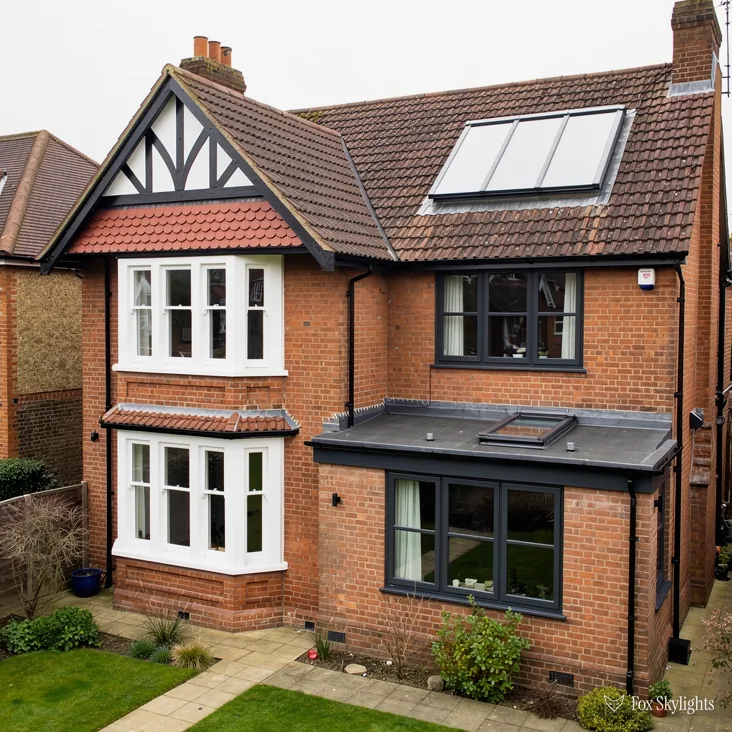
Syston is largely a commuter town for Leicester, so its houses can differ from one street to the next. We read the roof covering first, because tile, slate and felt each call for a different flashing and a different fixing.

A loft that has only ever held boxes usually has the headroom to take a roof window once the rafters are measured. The question is where the timbers allow the opening to sit, and that answer comes from the tape, not the drawing.
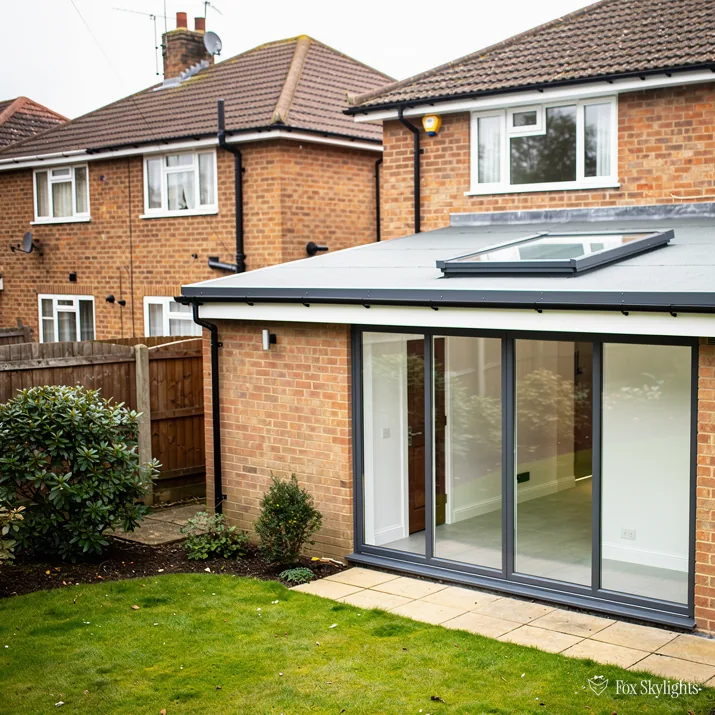
Back extensions under flat roofs are the quickest place to win daylight in a house this size. Set on a raised kerb, a rooflight lights the heart of the room, far past what wall windows reach.
What suits houses around Syston
-
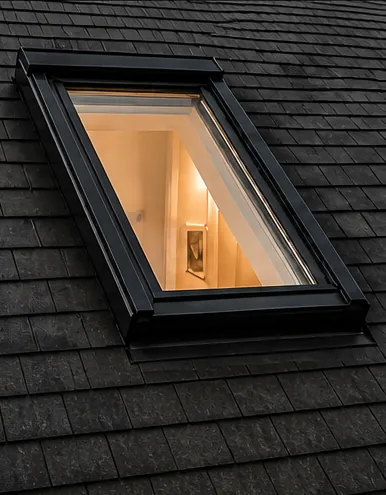 Roof windows
For a loft with a clear run of rafters, where a pivot window can sit between two timbers without any structural change.
-
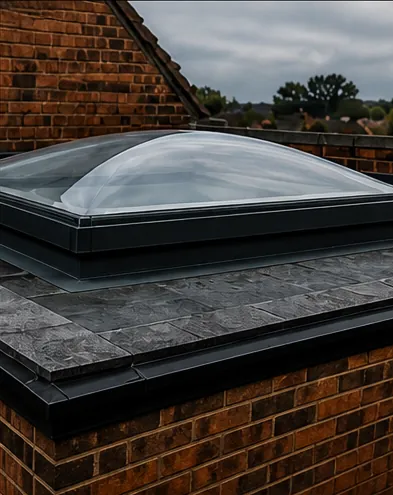 Flat roof rooflights
For flat-roofed kitchens and back extensions that stay shadowy at the table all afternoon.
-
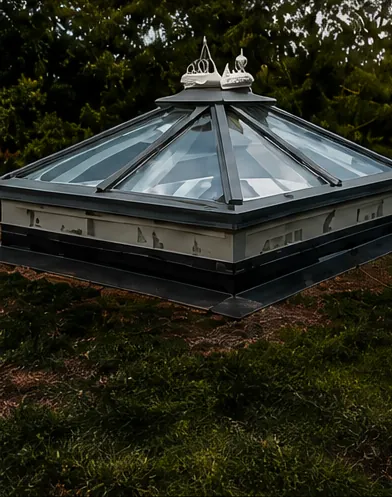 Conservation rooflights
For homes near the older, listed core of the town, where a slim frame lying close to the slope keeps the roofline quiet.
-
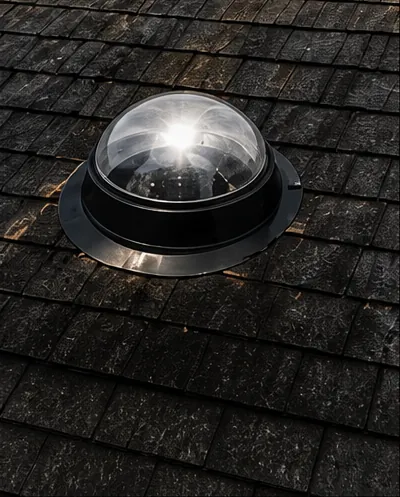 Sun tunnels
For landings and bathrooms with a roof directly above but no room to fit a full window.
Nearby
Out from Syston run the neighbouring Wreake and Soar villages, and each is covered separately, written for its own lanes and roofs.

THE FOX BROADSHEET · SYSTON
A Roman road and a commuter's roofline
The Fosse Way, the Roman road, passes through Syston, and the town today is largely a commuter town for Leicester. That single description tells you a good deal about the roofs. A place that people choose for its easy run into the city tends to keep growing, so a street here can hold homes from several building periods, sometimes within sight of each other. A map will not say which era your house belongs to. The loft will, and so will the roof covering, which is why we go up and look.
That mix is the reason a single stock rooflight would be the wrong answer. Older roofs may carry thicker timbers set wider apart. Later ones are often built from lighter trussed rafters, where the structure crosses the loft in a pattern that decides where a window can go. Flat roofs on rear extensions are their own category, with their own kerbs and their own drainage. Three roofs on one road can need three different plans, and the quote we write for you reflects only your roof.
Water shapes the town as well. The River Soar passes the western edge, just after it goes beneath the A46 near the Hobby Horse roundabout, and the River Wreake runs a short way from the centre. Syston Lake Nature Spot, the Reedbed Nature Reserve and Birstall Nature Reserve are all a few kilometres away. In a loft, that means sky. A room backing onto open ground can borrow plenty of it through a rooflight.
Syston has not always been quiet. Motorcycle speedway ran at the Syston Sports Stadium on Mostyn Avenue between 1930 and 1931, and greyhounds raced there from 1931 until the 1960s. Nobody has asked us for a skylight over a speedway stand, which is a shame. The jobs we are asked about are calmer: a dark landing, a boxed-in loft, a kitchen that gets its light from the garden end only.
Trains, roads and getting to you
Syston station is open, under a kilometre from the centre, which is part of why the commuter label fits. For us the useful fact is distance: Leicester sits 4.9 miles back down the road, about twelve minutes away. Survey visits are short trips, so we can come at an hour that suits you instead of building a whole day around the drive.
A reader asks
How do I know whether my Syston loft can take a roof window at all?
Two things decide it: the headroom under the ridge, and the spacing of the rafters. A window needs a clear opening between two timbers, and the room needs enough height beneath it to use the light. We measure both during the free survey and look at how the loft is used today, then give you a fixed written quote that says plainly whether the idea works. Our page on roof windows explains the sizes and how they are fitted.
If the loft is already a bedroom, the question shifts. The glass has to be within reach of the bed or the desk, and the room usually wants fresh air as well as light. We look at the room as it will be lived in, not only as a hole in the tiles. Tell us what you want the space to do, and the survey begins there.
Think about which way the slope faces, too. A south-facing slope fills a room with warm light and, in summer, with heat as well. A slope facing north gives a cooler, even brightness that suits a study or a bedroom. Glass can be specified to cut solar gain, and an opening rooflight lets warm air out. Such choices are best made with the roof in front of you, and the quote lays them out plainly so you can pick without a sales patter.
Charnwood Borough Council and thirty listed buildings
Charnwood Borough Council handles planning in Syston. For a house, the 2015 order's Class C householder rights normally let a skylight go in without an application, provided three limits are respected. The glazing stands no further than 150mm out from the slope. The ridge and the top of the roof stay the limit on height. Panes in a side-facing slope are obscured and fixed, bar one case: an opening part mounted higher than 1.7m.
The national planning register carries a Syston record for the town centre point. Thirty listed buildings sit inside it. Twenty-nine are Grade II, and the thirtieth carries the top grade, Grade I. No designation date is recorded against it. We therefore treat both the date and the exact boundary as open questions, and put them to Charnwood before the quote is written, in case your address is one of the thirty or stands beside them.
Class C survives a conservation area on its own. The thing that can strip it is an Article 4 direction, which a council aims at chosen streets or individual properties. The register gives no clear answer for Syston, so we ask instead of assuming. For the full statutory picture, read our longer account of planning and the Building Regulations. This chapter stays brief on purpose.
Think of planning and Building Regulations as two gates. Passing the first does not open the second, and a roof opening is building work whatever planning has said. Should the job be notifiable, the Building Control notice goes in from us, sent to the council or else a registered approver, and the paperwork stays with the job.
A reader asks
I live close to Syston's listed centre but not in it. Should I be concerned?
Not yet, and not alone. Send us the address on WhatsApp or by email and before the survey we compare it with the register and the council's maps. If the house is listed, consent comes first and nothing is ordered until it is in hand. If it is not listed and no Article 4 direction applies, Class C is usually all you need. Either way, you hear it from us in writing.
One practical thing about the larger listed buildings: they may carry old roof coverings that react badly to the wrong flashing. Such coverings suit a low-profile conservation rooflight, put in by someone who has handled that covering before. It is also a reason not to rush the order.
From the survey to the first morning of daylight
Our first visit is free and commits you to nothing. One of us climbs into the loft or out onto the flat roof, measures the rafters, studies the covering and asks what the room should do for you. Photographs go in the file, along with anything about the structure that shifts the window's position. The fixed written quote follows the survey, naming the product, the spot and the finish.
Syston has no single type of roof, so there is no single answer. A flat-roofed extension wants a kerb and a rooflight raised so water leaves it fast. A tiled loft wants a roof window with a flashing kit cut for that tile profile. A dark landing wants a sun tunnel: a small rooflight on a slim tube of reflective material that carries daylight down through the ceiling void. The survey chooses between them, not a brochure.
| Part of the roof | What it tells us |
|---|---|
| Covering | Which flashing kit fits |
| Rafter gap | How wide the window can be |
| Headroom | Whether the room can use it |
| Flat roof fall | How the kerb is built |
The quote itself is short and specific. It names the unit and its size, the position marked on the roof, the glazing, the finish inside the room and the total, fixed. Anything that affects where the unit can sit is raised at the survey, where we can see it, and the fixed figure is written with that in mind. If you want a second opinion on the position, we are happy to talk through the alternatives while you stand under the spot.
Fitting day
Fitting day follows a set order. Dust sheets go down, the roof is opened, the unit goes in, and flashings and inside lining are finished. A lone roof window or sun tunnel is over in a short visit. A lantern, or a flat rooflight over a new extension, takes longer, and you hear how long before we begin. The 10-year workmanship guarantee then covers what we fitted, and the paperwork arrives in one go.
A reader asks
Can you fit a rooflight if my Syston roof is flat and has no fall?
Yes. A flat roof without enough slope is a matter of building the kerb so that water drains away from the glass, not sitting against it. We measure the existing fall, and if the roof needs help, the kerb is built to correct it. Read more on flat roof rooflights, then ask for a survey and we will see the roof for ourselves.
When you want to begin, book the free survey and name the room that needs brightening. Or message us on WhatsApp on 07880 284133 with a photograph of the roof or the ceiling. We find the way in, and we say plainly if a roof cannot take what you hoped for, then offer the next best position.