- 01Three conservation areas in the town
- 02A lace mill turned into flats
- 03Motorway junction, quiet back slopes
- 04Lofts and extensions along the Erewash

Reached from Leicester in 36 minutes by road: 25.6 miles to the north-north-west
Skylights and rooflights in Sandiacre
Skylights for a Derbyshire canal town on the Nottinghamshire border, from the listed lockside to the lofts and extensions around it.
Or call 0116 430 0516
Canal, lock and lace mill

Three conservation areas are recorded in Sandiacre, all designated on 27 March 1984: Canal Side, Lock and Cloud Side. Roofs inside them suit a slim conservation rooflight, bedded low.
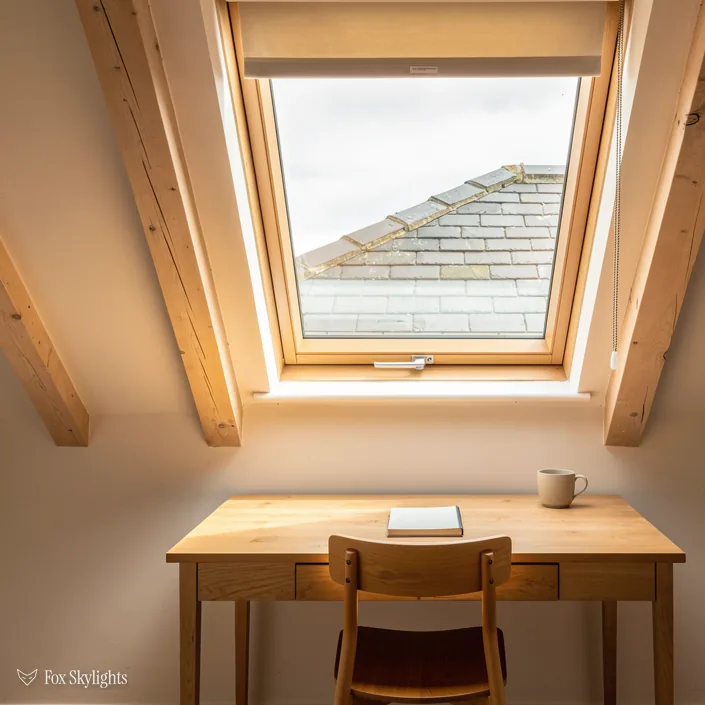
Springfield Mill was built beside the canal in 1888 as a lace mill and now holds apartments. A flat in a building like that sits outside householder rights, so the freeholder and the council come first.

Away from the canal, Sandiacre is a town of ordinary houses with ordinary lofts and rear extensions. Either a roof window set between rafters or a flat rooflight above the kitchen does the job.
Skylights for Sandiacre roofs
-
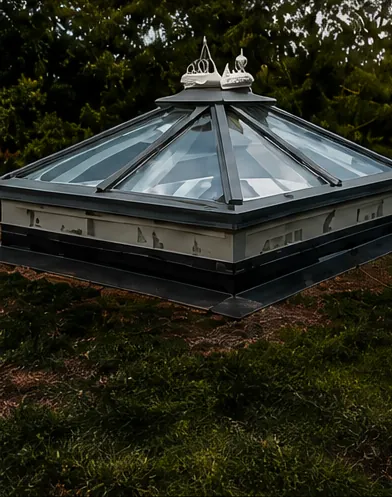 Conservation rooflights
For homes and buildings in the canal-side conservation areas, where a shallow frame and slender bar protect the look of the slope.
-
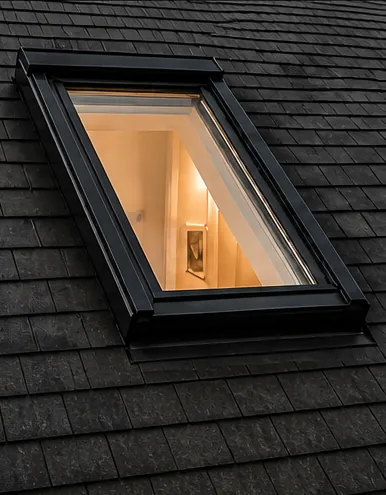 Roof windows
For spare lofts in the ordinary houses further out, with the unit set between rafters in the plane of the roof.
-
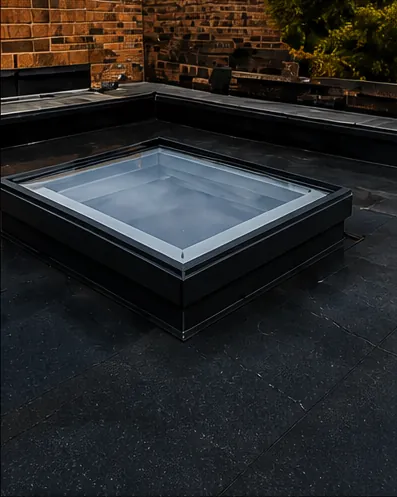
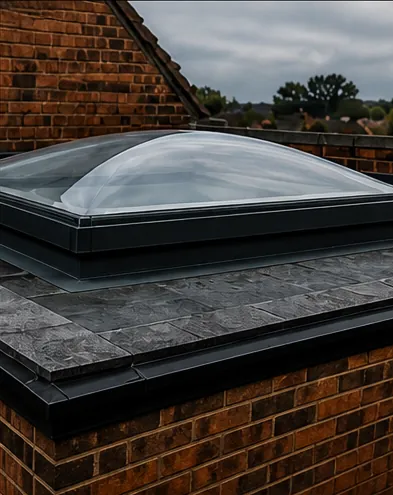 Flat roof rooflights
For single-storey extensions and conversions that have a flat roof and a dim kitchen underneath it.
-
 Energy efficient
For owners who want warm, quiet glass, which matters in a town sitting next to a motorway junction.
Nearby
Sandiacre shares a border with Nottinghamshire, and the neighbouring towns below each have a page written around their own roofs.

THE FOX BROADSHEET · SANDIACRE
Erewash Borough Council and three canalside areas
Sandiacre, a town and civil parish in Derbyshire, falls to Erewash Borough Council for planning, so skylight questions go there. A house with its own front door normally needs no application for a rooflight, thanks to Class C of the 2015 GPDO. That rule caps projection at 150mm, bars the glass from topping the roof's highest point, and wants obscure, fixed panes in side-facing slopes unless the part that opens sits higher than 1.7m inside.
The planning register records three conservation areas named after Sandiacre, each designated on 27 March 1984. Canal Side contains three listed buildings, all Grade II. Lock contains four, also Grade II. Cloud Side contains two, one Grade I and one Grade II. A fourth area, Stapleford Church Street, lies a little over a kilometre away and belongs to the neighbouring town, with three listed buildings of its own. Living inside one is not enough to lose Class C. That takes an Article 4 direction, and Erewash confirms whether you have one.
A reader asks
Our terrace backs onto the Erewash Canal. Can a rooflight go on the slope that faces the water?
Possibly. Being in view of the towpath does not stop you fitting one, but it changes what looks right, and an Article 4 direction can remove Class C. We check the register first. On a visible slope the usual answer is a slim-framed conservation rooflight. The rules in full: planning and Building Regulations guide.
Building Control sits apart from planning. Either way the opening is building work, and a required notification is something we make for you, through the council or an independent approver, with the completion certificate coming back with the job.
Dates in the register are worth reading with care. They tell you when an area was drawn on the map, not what stands inside it today, and they say nothing about the condition of a given roof. Two houses a few metres apart can sit under entirely different rules. That is why we ask for the full address before we send anyone to a survey, and why the answer arrives in writing alongside the quote.
What does a sensible order of work look like in a conservation area? First the address goes against the register. Second, a survey tells us which slope is visible from the street, the towpath or a neighbour's garden, and which is not. Third, we propose a position and a product that suit that slope, and put the planning position beside the price. Only then does anything get ordered. It sounds slow, but it stops the one mistake that cannot be undone, which is a hole in a roof that should not be there.
Ironstone, lace and the roofs left over
The records give Sandiacre a working past. The discovery of local ironstone led to the development of Stanton Ironworks in 1787, and the parish counted 8,889 residents in 2011. In the middle of town, next to the canal, stands Springfield Mill, built in 1888 as a lace mill and since converted into a modern apartment complex. It is the kind of building that explains the town: a big brick roof from one industry, now sheltering homes from a different age.
A flat in a converted mill is a special case for a skylight. Householder permitted development rights do not cover flats and maisonettes, so the first step for a rooflight is to apply for planning, and the freeholder or management company usually has to agree as well, because the roof is shared. Ask them early. Once they agree, the fixed quote then rests on a position already settled, not on a hope.
The ordinary roofs round the edge
The lace-mill years leave a second lesson about glass. A north-facing opening gives steady, shadowless daylight. A roof window on a north slope gives steady, even light for a study or a workroom without the glare and heat of a south-facing one, and a sun-facing slope suits a bedroom or a landing where you want warmth and brightness. Orientation of the slope comes first when we choose a specification.
Most of a town's roofs belong to houses, not mills, and for those the questions are practical. How much headroom is there in the loft? Where do the rafters sit, and does a purlin (the stout timber laid along the slope) cross the planned opening? Is the rear extension flat-roofed, and if so what is it made of? Records say nothing about those details, so we find them by looking. A short survey gives us what a long desk search cannot.
The but
The loft room needs light, but the slope that would suit the window faces the road and a conservation area is in play.
The way in
We move the opening to the back slope if the layout allows, or choose a conservation rooflight with a low frame for the front, and show you both on the quote.
| Building | First question | Usual choice |
|---|---|---|
| Listed or lockside house | Consent and boundary | Conservation rooflight |
| Converted mill flat | Freeholder and council | Application, then unit |
| Loft in a family house | Rafters and headroom | Roof window |
| Flat-roofed extension | Roof make-up and falls | Rooflight on a kerb |
Replacement skylights are tested against Part L. Part L sets a rooflight's limit at 2.2 in U-value terms, while a roof window passes with WER class B or a U-value of 1.4. Quiet comes with the territory: sealed double glazing takes the edge off traffic noise. Better glazing also helps with noise, which counts in a town with a motorway junction in it. Our energy efficient rooflights page has the detail.
A loft room above two storeys falls under Approved Document B, which stops a window counting as an escape route above 4.5m from the ground. Above that height escape means a protected staircase, while the roof window gives daylight and ventilation.
Mills and ironworks also remind us why survey comes before quote. Buildings that have been altered over a century and more seldom match their drawings. A loft may have been partly floored, a chimney may have been taken down, a beam may have been added. Reading what is there, rather than what ought to be there, is the whole job, and it is why every quote we give names the exact size and position of the opening.
Junction 25 and the towpath
Plan on roughly 36 minutes at the wheel from Leicester; Sandiacre is 25.6 road miles off, north-north-west. Junction 25 of the M1 lies in the town, where the motorway crosses the A52 Brian Clough Way, while the B5010 and the B6002 are close too. A railway station once served the town, Stapleford and Sandiacre, on the Erewash Valley line along the border with Stapleford. The map also shows a closed station at Stanton Gate, 1.9 km away. For surveys, the motorway is the practical fact: it brings us in quickly from the south.
The Erewash Canal passes through the centre of the town, and the small basin just above Sandiacre Lock was once the terminal link of the former Derby Canal. The map names the Erewash and Derby canals and the River Erewash within about 1.5 km. Waterside houses bring a particular concern: wet air. A bathroom or kitchen near a canal has to shed steam efficiently, and an opening roof window handles that better than a fixed pane.
Traffic noise is a fair question to put to anyone fitting glass into a roof near a junction. The honest answer has two halves. Sealed double glazing in a good frame softens the rumble, and the pitch of the slope helps because sound arrives at an angle. But a loose or gappy old unit lets noise in, which is one more reason to replace rather than leave it, and we can compare the options at the survey.
The green side of Sandiacre is close by. Stoney Clouds Local Nature Reserve lies 1.2 km out, Toton Washlands 1.8 km, and Stanton Gate Local Nature Reserve 1.9 km, and Stapleford Hill at 3 km. Houses near open ground are often overlooked by trees and not by neighbours, which gives more freedom to place glass where the room wants it. A roof lantern over a rear extension can then take full advantage of the sky.
For a landing or small bathroom with no slope above it, a sun tunnel channels light through a mirrored tube fed by a small dome on the tiles. It costs the loft only a narrow column of space, and we confirm the route is clear before we order.
A reader asks
Is it worth swapping an old flat rooflight on a Sandiacre extension for a new one?
If the old one has misted, leaks at the edges or is single glazed, yes: a new sealed unit on the existing kerb gives a drier, warmer room. If the kerb is sound, the job is short. If it is not, we flag it in the quote and rebuild it. Read more about replacing misted rooflights.
Noise deserves a line of its own. A town with a major junction in it hears traffic, and a roof window is a thinner barrier than a wall. Laminated or well-specified double glazing takes the edge off that sound, and a closed unit with a good seal is far quieter than an old one with a perished gasket. If you sleep in a loft room, tell us at the survey, because it changes what we recommend.