- 01Knitters' houses along Nottingham Road
- 02Church Street roofs under protection
- 03Modern homes near the park and ride
- 04Flat roofs behind the old frontages

Across 26.9 miles of road to the north-north-west, 38 minutes from Leicester
Skylights and rooflights in Stapleford
Rooflight work in a Nottinghamshire town with two conservation areas of its own and a hill with a famous rock on top.
Or call 0116 430 0516
Knitters, a hill and two designations

The original Stocking Knitters' Houses still stand on Nottingham Road beside newer homes and shops. Roofs in a street like that are read as a run, so a slim rooflight set into the rear slope is usually the safer proposal.

Around the park and ride at Toton Lane there are residential streets with ordinary family lofts. A roof window between the rafters is a simple job there, and a sun tunnel handles the dark upstairs landing.
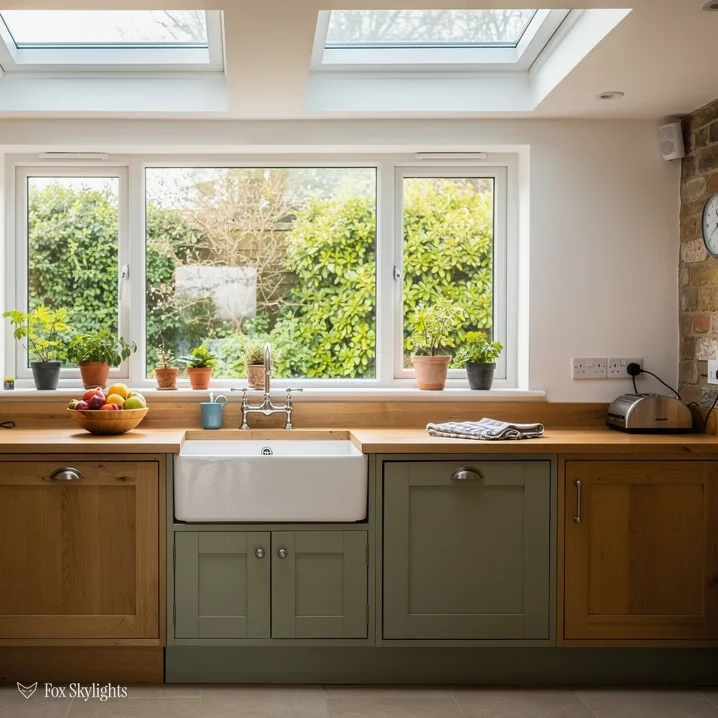
Flat-roofed extensions behind older frontages tend to leave kitchens deep and dim. A rooflight on a kerb gives them a source of daylight that the garden doors cannot reach.
Which services suit this town
-
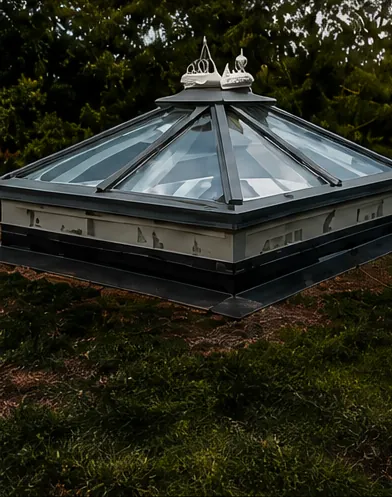 Conservation rooflights
For roofs on or near Church Street and Nottingham Road, where a low frame and a central bar keep the slope looking right.
-
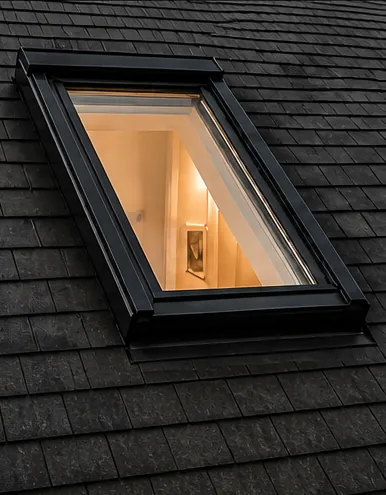 Roof windows
For the family lofts on the residential streets, fitted between existing rafters with a trimmed, lined opening.
-
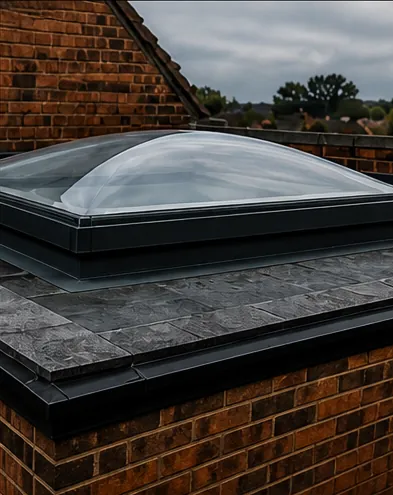 Flat roof rooflights
For flat-roofed additions at the back, where the kerb follows the true fall of the deck.
-
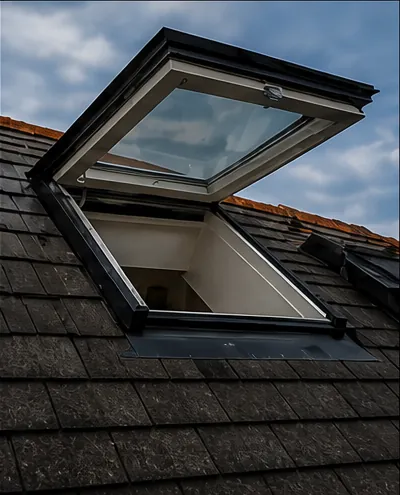 Electric and opening
For tall extension ceilings, where the unit is beyond arm's reach and ventilation matters as much as brightness.

THE FOX BROADSHEET · STAPLEFORD
Church Street, Nottingham Road and Broxtowe's rules
Stapleford sits in the Borough of Broxtowe in Nottinghamshire, a town with its own civil parish, about six miles west of Nottingham. Leicester to Stapleford is 26.9 miles by road, a drive of about 38 minutes, heading north-north-west. Planning questions go to Broxtowe Borough Council, and two separate conservation areas carry the town's name.
The first is Stapleford Church Street, a designation dating from 1 January 1978, with three listed buildings recorded inside it: one Grade I, one starred II* and one plain II. The second is Stapleford Nottingham Road, set up on 1 January 1986 and holding nine listed buildings, every one Grade II. Between them they cover Church Street and Nottingham Road, and a house on or close to either street needs a proper check before a rooflight is priced.
Church Street is where the town keeps its Grade I building, and a designation like that colours how a council reads everything near it. The officer looking at a rooflight application will ask what shows at street level, in the churchyard or along any public footpath, and the honest answer is sometimes more than the owner thought. We walk the surroundings before we survey the roof, and we photograph the view the council would see.
Other designations lie beside the town and may catch an address on the border. Sandiacre Cloud Side, Sandiacre Canal Side, Sandiacre Lock and Bramcote are all recorded near the town centre. They carry other names and belong to neighbouring places, but the maps overlap, and an address near the boundary is worth looking up.
For a house inside a conservation area but not listed, the standard permitted development allowance for a rooflight generally holds, unless Broxtowe has made an Article 4 direction that withdraws it. The limits are brief: 150mm of projection at most beyond the slope, and nothing standing taller than the top of the roof. Our planning guide sets out the steps and links the official wording.
A reader asks
My house backs onto Nottingham Road. Is the rear slope safe to use?
The back pitch, hidden from any public road, is the best candidate, but position alone does not decide the question. If the building is listed, consent is required for any elevation. If it is merely inside the area, a rear rooflight is generally within permitted development. The address goes through the council record first, and you get the result on paper.
Where an application does turn out to be necessary, we supply the survey measurements and product details the application needs.
There is a practical point about timing. A householder application takes a statutory period to decide, and listed building consent can take longer. If you are planning a loft room for a particular date, tell us early, so the paperwork starts before the order does and the glass is not sitting in a hallway waiting for an answer.
Staple town, stocking trade and the roofs they left
The town owes some of its growth to its closeness to the River Trent and the River Erewash, which made it a point of trade. The name has a trade meaning too: the antiquary John Weever defined a staple town as a place where wool, hides, wine, corn and other goods were brought to be sold. The area expanded again in the late eighteenth century, when the stocking hose trade thrived in the Midlands.
That trade left physical evidence. The original Stocking Knitters' Houses still stand on Nottingham Road, alongside more modern properties and shops. The record does not say how any one of them is built, so we do not assume. We look at the timbers and the covering before we propose anything.
The but
An older upper room can be dark at the centre, and the street side may be off limits.
The way in
A pair of small conservation rooflights on the rear slope, spaced to the rafters, bring light to the middle of the room and stay out of view.
Hosiery towns grew in bursts, and the housing that followed was added street by street. That means a single neighbourhood can hold several roof types, and a rooflight that works on one side of a road may not suit the other. Our habit is to survey each roof separately and never to quote one house from the look of its neighbour.
A conservation rooflight has a slim metal frame, usually with a vertical bar through the glass in the style of a Victorian cast-iron rooflight. It sits close to the covering, so on a pitched roof it reads as a line, not a box. That is the look this part of the town calls for.
Away from the old frontages, the planning data is silent about when and how the streets were built, and we will not make something up. There is a park and ride at Toton Lane, about a mile south of the town centre, built next to some residential parts of the town, and the sources record a neighbourhood called New Stapleford, 1.3 km out. Houses in places like these are survey jobs: we take the roof as we find it.
Flat roofs deserve a closer look than they usually get. Behind older frontages, extensions have often been added over the years, and their roofs may be felt, asphalt or single-ply membrane, each with a different way of forming the kerb. We identify the covering, check the deck beneath for sound timber, and tell you whether it will carry a kerb and glass or needs attention first. A rooflight is only as good as the roof it sits on.
A roof window brings an attic bedroom or study to life, and a sun tunnel gets light into the hall below it. Both are quick to fit, and we protect the rooms beneath with dust sheets while we work.
If a photograph of the front and back of the house is all you have to hand, send that. It is enough to start the conversation about what might fit. Measurements help too, even rough ones: the width of the ceiling joists, how far the rafters are apart, and the height from the floor to the underside of the ridge. None of this replaces the survey, but it lets us say early on whether a roof window, a rooflight or a sun tunnel is likely to suit the room, and what the fixed written quote will need to cover.
The Hemlock Stone, the Erewash and the A52
Stapleford Hill, 1.9 km from the town centre, is home to the Hemlock Stone, a rock about 200 million years old that dates to the Triassic Period. The hill is the high point on the town's skyline, and roofs on its slopes face wind and long views. A rooflight there needs flashings and fixings that cope with exposure, and its glass needs to suit a view worth having.
Across the River Erewash to the west lies Sandiacre, and to the south Toton. The Erewash Canal and the Derby Canal are also within about 1.5 km. Near water, roofs pick up damp and moss, so a steeper pitch and a coating that helps rain wash the glass are both worth having.
The hill is also a reminder that Stapleford is not flat. Roofs step up and down with the land, and some gardens are well above or below their neighbours. That affects scaffolding and access, and it changes what a neighbour can see of a new rooflight. We look at these things on the visit and plan the delivery to suit, whether the glass is carried up through the house or hoisted at the back.
The town is surrounded by green space: Stoney Clouds, Stanton Gate and Pit Lane local nature reserves, Stapleford Hill Woodland, Bramcote Hills Park Woodland and Toton Washlands all lie within a few kilometres. Trees close to a house cast shade and drop leaves, and the survey notes which slopes get the sun. The A52 links the town to Nottingham, Derby and the M1, and B-class roads feed the streets close in. Stanton Gate station, 1.3 km away, is recorded as closed.
A reader asks
Can a rooflight cope with a windy hillside?
Yes, when it is fixed and flashed for the position. We check the exposure, use fixings rated for the load and form the flashings generously. A well-fitted unit stays put and stays dry, and our workmanship carries a ten-year guarantee.
For a flat-roofed extension, a flat roof rooflight on a built-up kerb is the reliable choice, and a motorised opening rooflight works from a handset when the glass is out of reach. Part L holds older homes to 1.4 W/m²K at a roof window and 2.2 at a rooflight; we check both at quote stage, and a decent unit clears both.
Where winter light is low, the position of a rooflight matters more than its size. A north-facing unit gives a soft, steady light all day, and one facing south gives more but brings heat in summer. Neither is wrong, and the choice depends on how the room is used. A study wants steady light, a bedroom may want less of it, and a kitchen can take plenty. We talk this through at the survey and draw the options on a photograph.
Book a free survey and the fixed written quote follows. Start with the quote form, or send a photograph on WhatsApp.