- 01Village cottages with stone behind them
- 02A knitting and quarrying village
- 03Lofts that stop short of a window
- 04Back-kitchen extensions in the dark

Twenty minutes by road, 12.9 miles south-west from Leicester
Skylights and rooflights in Sapcote
Rooflights for a small south-west Leicestershire village, where a roof can be a century old or a few years new and the survey decides which.
Or call 0116 430 0516
Small village, mixed roofs
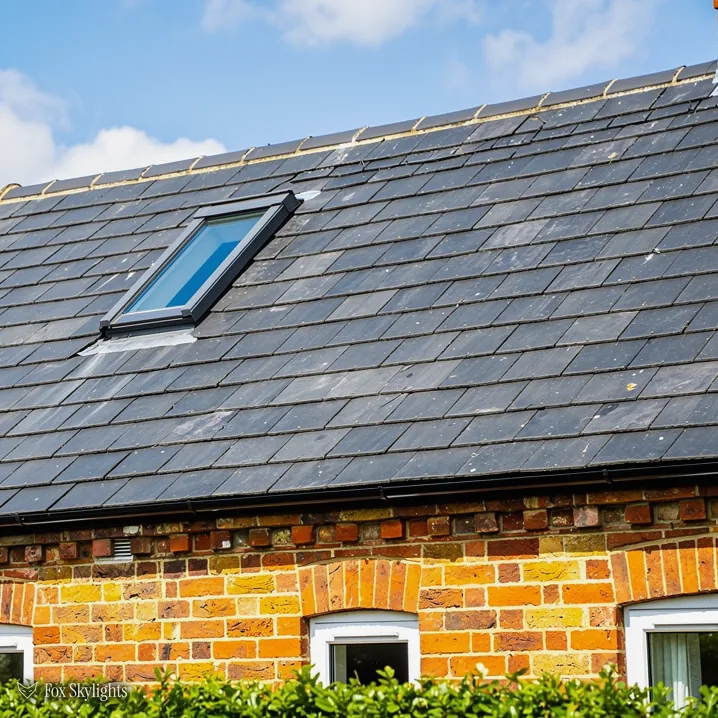
In the 19th century most Sapcote villagers knitted hosiery on frames or quarried stone. A roof of that age has usually been patched and recovered, so the timbers get inspected before any position is promised.
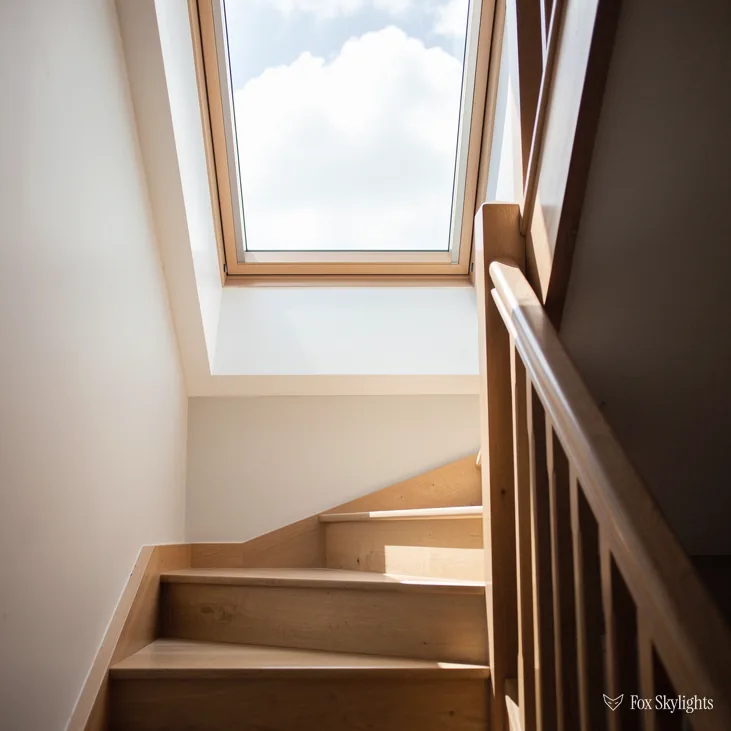
Plenty of loft space in a village house stays unused because the room under it is dark. A roof window between two rafters gives a bedroom, a study or a landing its first proper daylight.
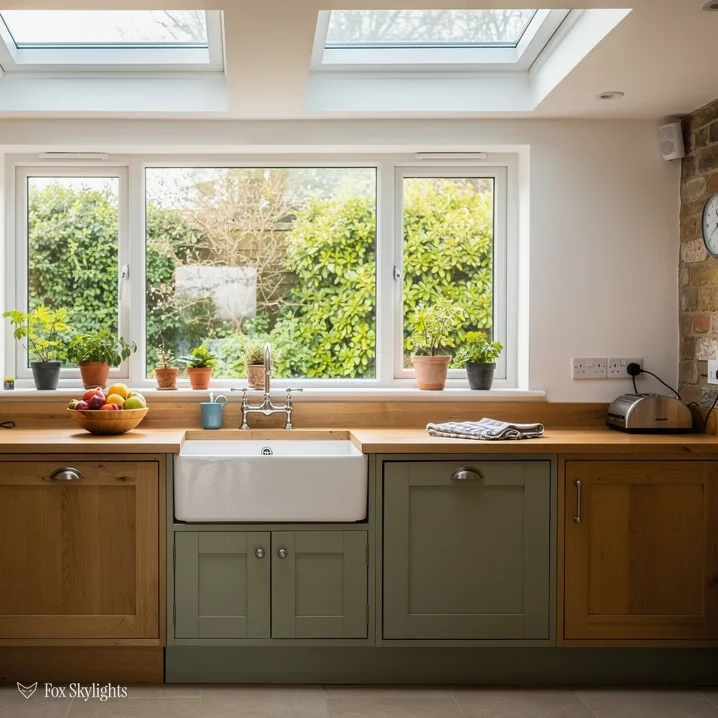
A back extension with a flat roof is the common cure for a cramped kitchen, and the common cause of a gloomy one. Put a rooflight on a raised kerb over the table, and the dining end gets a window of its own at last.
Choosing glass for village roofs
-
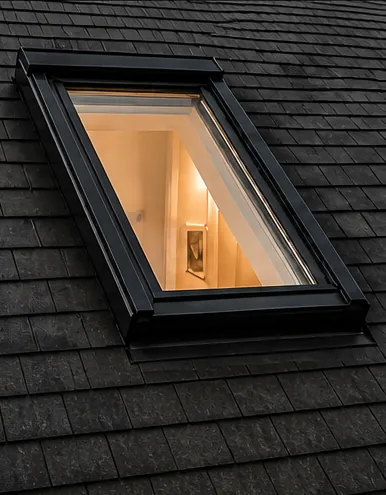 Roof windows
For lofts under pitched village roofs, fitted into the gap between rafters once we have checked headroom and the rafter spacing from inside.
-
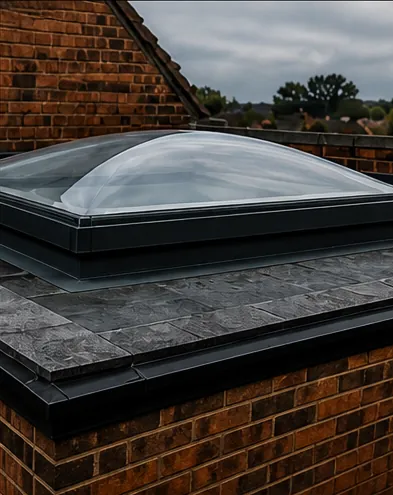 Flat roof rooflights
For back rooms built out from older cottages, where a deep kitchen gets nothing from the side walls and needs its daylight from above.
-
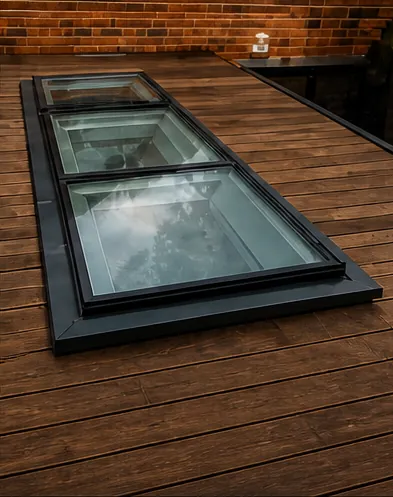 Walk-on rooflights
For a garden path, patio or terrace laid over a basement room or utility space, strong enough to be crossed in shoes.
-
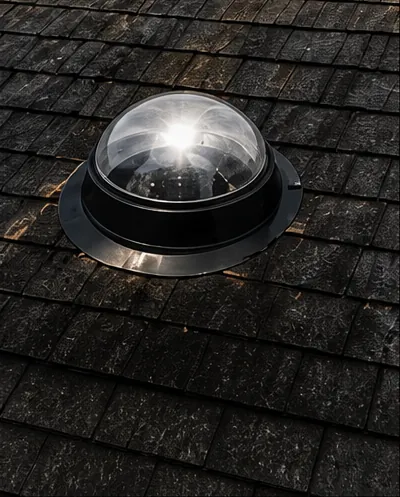 Sun tunnels
For a landing or bathroom with a loft or a roof pitch above it too tight for a window, a small round tube carries the daylight down.
Nearby
Sapcote's neighbours in this corner of Leicestershire are on our rounds as well, and each has a page to itself.

THE FOX BROADSHEET · SAPCOTE
What Blaby will want to know
Sapcote is a small village in south-west Leicestershire, in the old Sparkenhoe Hundred, and its planning authority is Blaby District Council. Any application, any question about a listed building, and any query about whether a direction applies to your road goes to Blaby. We check those points when we price a job, so you know where you stand before a date is fixed.
For a typical house, the planning answer comes fast. Under the 2015 permitted development order a householder can add a roof window or rooflight with no application, provided no part rises beyond 150mm above the slope and it stays beneath the ridge. Glass facing the side of the house must be frosted, and fixed shut unless the opening part is over 1.7m up. We run those three measures against every roof. Our planning rules guide quotes the order word for word.
A reader asks
The church here is old. Does that put my house under special rules?
A neighbouring landmark does not do that by itself. Rules attach to your own building: is it listed, is it in a designated area, does a direction cover your road. A square stone church went up in 1902, and it is still counted among the best buildings in the village, but that tells us about the church, not about your roof. We look up your address, not the skyline.
The Building Regulations side is its own matter. A new opening alters the roof structure, so a job that needs notifying is notified by us, and the body receiving it is either Blaby or a private approver registered for the purpose.
One habit worth having: keep the paperwork. Whoever buys the house from you will ask what was done to the roof, and a tidy file of the quote, the notification and the guarantee answers that before it becomes a negotiation.
Knitters, quarrymen and the roofs they left
Local history, as recorded on Wikipedia, gives a plain picture. In the 19th century the main occupations in Sapcote were frame-work knitting, which means hosiery, and quarrying. The 1902 church was built of stone quarried by its own congregation, and the story goes that they made such a good job of it that it still ranks among the best buildings in the village. A village that earned its living that way built, and rebuilt, in whatever material the work and the pay allowed.
We do not assume a particular house is a knitter's cottage or a quarryman's. A tape and a torch answer that, not a history book. What the history does tell us is that roofs here are unlikely to be uniform. A row may share a ridge line and still differ in the covering, the pitch and the age of the timbers underneath. That is why our first visit is for looking, with no sales pitch.
The but
An old pitched roof has been recovered at least once, and nobody can say what is beneath the tiles until a few are lifted.
The way in
The survey looks at the rafters and battens from inside the loft where there is one, and the price reflects what we can see there rather than what we hope is there.
For a pitched roof, a roof window is the usual answer, and the choices are about where, not whether. Put it too low and it shows you the garden fence; too high and it lights the ceiling and little else. We stand in the room, mark where your eyes will be at the desk or the bed, and work out from there. A second window on the opposite slope, where the roof allows it, gives you light at both ends of the day and a draught that carries warm air out when the sun has been on the tiles.
Think about the room before the roof. A bedroom wants light that does not wake you at five in June, so a blind or a position out of the bed's line matters as much as the glass. A study wants steady light that does not glare on a screen, which usually means a north-facing slope or a position to one side of the desk. A landing wants whatever it can get. The same roof gives three different answers because the rooms are asking three different questions, and we would rather ask than assume.
Size is the next decision. A VELUX window goes by a short code: a letter for the width, then digits for the height, so MK04 points to one frame only. If you already have a window in the roof and want the same size, the code on its label is the easiest route to a match. If you are cutting a new opening, we choose the size that fits between the rafters you already have, because a window that needs a rafter cut costs more labour and more structure.
Where a room is under a very shallow pitch, or a landing has a loft above it that you cannot open up, a sun tunnel is the quieter route. A little dome up top gathers daylight and a reflective tube sends it down to a ceiling diffuser. The roof opening is small, so the disruption is small too, and a sun tunnel can often go in without lifting out a rafter.
Sapcote also has the gardens and paths that come with village plots. Where a basement, a cellar or a low utility room sits under a patio, a walk-on rooflight lets daylight drop through the ground and still carries your weight. The glass is thick and laminated, and the frame sits on a built-up upstand, so water has somewhere to go.
Fresh air is the other half of the choice. A fixed rooflight lights a room; an opening one lets the air move. Under a sloping ceiling in summer, warm air collects at the top, and a window you can open at the high point releases it. In a bathroom, the same window clears steam without a fan. We ask which job you want done, since the answer changes the frame, the handle position and sometimes the price.
Where a stairwell or a tall extension puts the glass beyond arm's length, an electric opening rooflight has a motor and a wall switch, and some close on their own when rain is detected. That is a decision to make before the ceiling is plastered, so the cable can be routed cleanly.
Twenty minutes out, between two B-roads
Sapcote lies towards the south-west, a 12.9 mile run out of Leicester, and the drive takes about twenty minutes. Two classified roads serve the village: B4114 and B4669. No station stands within 2 km, so travel here is by road. Water is part of the picture too: the River Soar is recorded within about 1.5 km, along with a lake at Fortway Farm Leisure.
Fosse Meadows Nature Area lies 2.3 km from the village in OpenStreetMap's data. Open land and a long view across it change what a rooflight is for. In a room with a view of field and sky, a roof window set at the right height puts a slice of that sky on the ceiling, which is a different thing from letting light into a cupboard.
In a village this size, a neighbour notices when a roof window goes in. We would like the finish to hold up to being looked at: a clean opening, flashings that lie tight to the covering and a neat reveal inside the room, so the work reads as if the roof had always been made that way.
A reader asks
What does the covering change?
Tell us the covering in your first message. Concrete tile, clay tile and natural slate each need a differently cut flashing, so the covering shapes the whole job. If the survey shows a spot that should be left alone, we say so and suggest where else the light could come from.
Starting is easy. Photograph the room and the roof from outside, then send them to us on WhatsApp, 07880 284133, or fill in the quote form. We reply with a few questions and fix a visit. Looking costs nothing, and the figure you receive afterwards is a set price on paper.
The day itself is shorter than people expect. Scaffold or a roof ladder goes up, the covering is lifted around the marked opening, the new frame is fixed to the rafters and the flashing is dressed over the tiles. Inside, we frame the lining and leave the room clean. The slowest stage is usually the lining, because it is the bit you will see every day, and a rough one never stops looking rough.
A rooflight does change how a room feels in winter, which is worth saying plainly. Glass loses heat faster than a solid roof, so we choose the glazing with that in mind, and the figures required for an existing home under the heat-loss rules are part of what we specify. Over a bed or a desk we would lean towards a better-insulated unit than the cheapest, and we explain why on the quote.