- 01Roofs older than the enclosure maps
- 02Ten listings in the conservation area
- 03Lofts for Leicester and Hinckley commuters
- 04Brascote and Newbold Heath at the edges
Due west of Leicester: 10.2 road miles, roughly 22 minutes
Skylights and rooflights in Newbold Verdon
Cob Cottage dates from 1650, one listing is Grade I, and the rest of the village commutes along the B582.
Or call 0116 430 0516
Cob, coal money and commuters

Cob Cottage is probably the oldest remaining home in the village, dating from 1650. Anything of that age is looked up in the listing record first, and any opening is planned around the age of the building and a roof that has had a long time to settle.

Six cottages were built in 1794 for the poor of the parish. Cottages of that kind are usually modest buildings with little roof to spare, which makes a single slim rooflight or a sun tunnel the careful choice.

When the coal worked out, the village became a place to live while working in Leicester or Hinckley. Houses built to serve that life often have a loft that was never finished, and a roof window turns it into a room.
What suits a village this old and this mixed
-
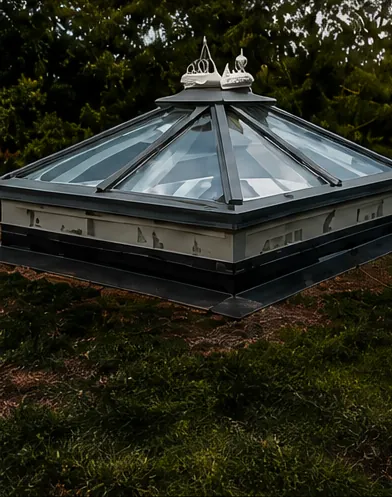 Conservation rooflights
For the old core inside the conservation area, where a low profile and a thin central bar keep the slope looking as it has for years.
-
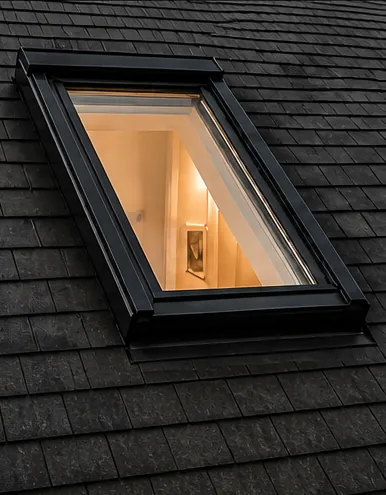 Roof windows
For the commuter-era houses with an empty loft, placed once the timbers are mapped and where the stairs will arrive.
-
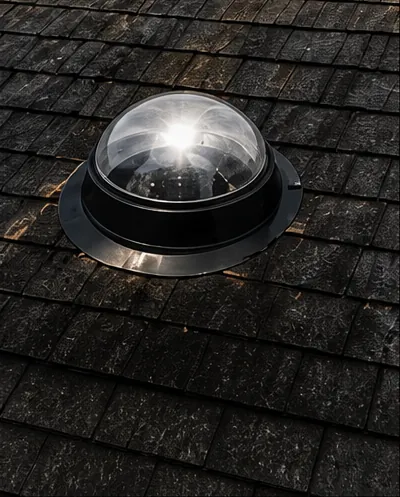 Sun tunnels
For small cottages and dark inner landings, where a tube of daylight does what a window cannot reach.
-
 Roof lanterns
For extensions behind older houses, where a lantern over the new kitchen gives height and light without touching the old roofline.
Nearby
Barlestone, Desford and Market Bosworth are our closest neighbours on this side of the county, and a short page on each follows.

THE FOX BROADSHEET · NEWBOLD VERDON
Cottages, cob, and a village older than its streets
Newbold Verdon is a Leicestershire village and a civil parish too. The parish takes in Newbold Heath to the north and Brascote to the south. In the itinerary of 1280, Newbold, Brascote, Naneby and Barlestone answered collectively as one village, with 80 acres of woodland and a vineyard between them. That is a long way back, and it is a reminder that a house here may stand on a plot that has been lived on for centuries, even if the building itself is younger.
Cob Cottage is probably the oldest remaining home in the village, dating from 1650. If its walls are true cob, of earth, clay and straw, a house made that way has its own demands. The walls move gently, they dislike being wet, and a new opening in the roof above them has to be fixed to what is solid rather than what is merely there. We say so at the first visit, and we say it plainly: some of these houses suit a rooflight beautifully, and some want a more careful answer first.
In 1794 six cottages were built for the poor of the parish, paid for by benefaction money, and their occupants were allocated the use of ten acres of land at the time of the enclosure. The record does not say what roofs those cottages wear today, so we read each one on the day. Houses of that type tend to be small, with short slopes and not much roof to spare, and in terms of daylight that points towards modest answers. A single narrow roof window, or a sun tunnel sending light down a tube to an inner landing, leaves most of the slope as it was.
Why a short slope changes the sums
On a long roof you can put the window almost anywhere. On a short one the choices narrow quickly: the frame cannot overlap the ridge, the flashing needs room above and below, and the opening has to leave rafters either side. A VELUX size code gives the width first (the letter) and then the height (the digits), so the code on a small window already tells you its proportions. Choosing the size is the work of the survey, not a catalogue decision.
Age also changes how we protect what is already there. Before the first cut, dust sheets go down inside and the loft contents are lifted clear. Slates or tiles come off in the order they went on and are stacked so they go back in the same pattern. On an old roof, the tidy way of working matters as much as the glass, because an old house tends to hold on to the marks of every visitor.
The but
A low cottage slope leaves no room for a standard window and its flashing.
The way in
We shrink the unit to fit the rafters, fit a flashing kit designed for that opening, and look at a sun tunnel where the slope will not take glass at all.
A reader asks
Will a rooflight work in a roof that has sagged a little with age?
Often it can, but the frame has to be set square to the opening, not to the dip. We look at the line of the rafters from inside the loft and from the lane, and where the slope has moved we pack and trim so the glass sits true and the flashing follows the real surface. Where the timbers cannot carry a new opening, we say so at the survey, before a quote exists.
The council, the 1989 boundary and the Grade I listing
Planning matters here are handled by Hinckley and Bosworth Borough Council. Usually a house here can go ahead with a rooflight and no application, because Class C, a 2015 permitted-development allowance, applies. It asks that the glass stands within 150mm of the slope, stays below the roof's top edge, and, on a slope facing sideways, is obscured and fixed unless anything that opens is above 1.7m. Flats and maisonettes never had those householder rights.
The planning register shows a conservation area called Newbold Verdon, designated on 14 November 1989 and whose boundary lies only 40 metres from the village centre point. It records ten listed buildings inside: one at Grade I, which is the top tier and reserved for buildings of exceptional interest, and nine at Grade II. Class C survives inside the boundary unless the council has withdrawn it through an Article 4 direction, and the council keeps the record of where those apply. Listed buildings are firmer still: consent under the listing regime has to come before any rooflight, however small.
We run a simple routine. Before we quote, we check your address against the register, then ask the council whether any Article 4 direction touches the property. Where the house is listed, we tell you up front and explain what consent involves, and the choice is yours. If it is not listed and not restricted, we carry on to the survey with a clear conscience.
The second hurdle is Building Regulations, which any new roof opening meets. A notifiable job has its notice sent by us to council building control or to a registered approver. For energy, Part L expects an existing home's roof window to achieve 1.4 W/m²K, with WER band B also accepted, and a rooflight 2.2. Our specification follows those numbers, so the product and the paperwork agree.
Fitted in a conservation area, a conservation rooflight is the choice most likely to be welcomed. It sits flush with a slim frame, typically carrying one central bar, and seen from the lane it is a detail in the roof, not a feature of it. Not every house in the area needs one. A rear slope that no street sees can take an ordinary unit, provided the house is not listed.
From the coalfield to the commute
Newbold Verdon began as an agricultural centre and grew in size during the 1850s with the expansion of coal mining in the area. That industry has now ceased, leaving the village as a commuter place serving Leicester, 9.5 miles to the east, and Hinckley, 8.5 miles to the south. It sits on the B582 between Barlestone and Desford, and 4 miles east of the small market town of Market Bosworth. The map records no station inside 2km, so road and bus make the village what it is.
A mill stood in Mill Lane, a windmill brought from Syston in 1812 was put up near what is now the Windmill Inn, and a third mill stood in Desford Road. Those buildings tell you something useful about the village: it has been rebuilt, extended and rearranged more than once, so the roofs you meet on a single road may come from three or four different centuries. We treat each one on its merits.
Where people commute, the house often becomes a place to do other things too. A back bedroom turns into an office, a loft into a spare room, a garage into a utility space with no window at all. These are the jobs where a skylight earns its keep. A bright office needs a roof window with the right glass for the aspect, so that a monitor does not fight a low sun. A loft guest room needs a window that opens and that is reachable from the floor. A windowless utility room, with a roof above it, can take a flat rooflight set into a proper kerb, which is the raised frame the glass sits on.
| Space | Usual starting point |
|---|---|
| Home office | Roof window, right glass |
| Spare loft room | Opening roof window |
| Windowless utility | Flat rooflight on kerb |
| Dark inner landing | Sun tunnel |
The edges of the parish deserve a mention too. Newbold Heath lies to the north and Brascote to the south, and a house out at either end may stand on a bigger plot than one in the middle of the village. A larger plot can mean more scope for a single-storey extension, and with an extension comes a flat roof that wants a rooflight. We are as happy to survey a house at Brascote as one on the main road.
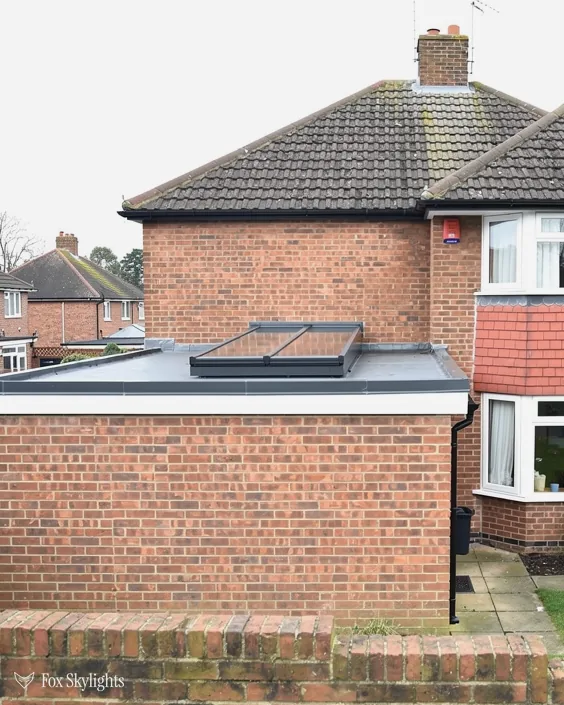
Behind older houses, a rear extension is another place the daylight runs thin. A roof lantern lifts the ceiling and lets light drop in from all four sides, which suits a kitchen that has grown beyond what one window can serve. We look at the junction with the old wall first, because that is where a lantern either looks right or looks added on.
A reader asks
Is a roof lantern too much for a village house?
It depends on the extension and on who can see it. A lantern on a modest flat roof at the back is usually in proportion; one on a small single-storey room may be better replaced by a flat rooflight. We talk through both against your actual roof so you can judge, and you can start that conversation by sending us the address through the quote form.
Surveys cost nothing, and what you get afterwards is a fixed quote on paper, with the workmanship guaranteed for a decade. With two B-roads, the 582 and the 585, crossing the parish, getting to Newbold Verdon from Leicester is straightforward, and a photo sent to us on WhatsApp helps us arrive with the right questions.