- 01Red-brick lace warehouses, up to seven floors
- 02Streets inside The Park and Mapperley Park
- 03Suburbs that swallowed old villages
- 04Older streets round the Arboretum

Twenty-eight miles of road north from Leicester, 42 minutes if the ring road behaves
Skylights and rooflights in Nottingham
Warehouse brick in the Lace Market, protected streets around the Castle and Park, and suburbs that swallowed old villages.
Or call 0116 430 0516
Lace warehouses to suburban lofts

The Lace Market has streets of four- to seven-storey red-brick warehouses, restored and put to new uses. Roofs above flats and offices there are high, overlooked and in a conservation area, so a slim conservation rooflight is the sensible start.
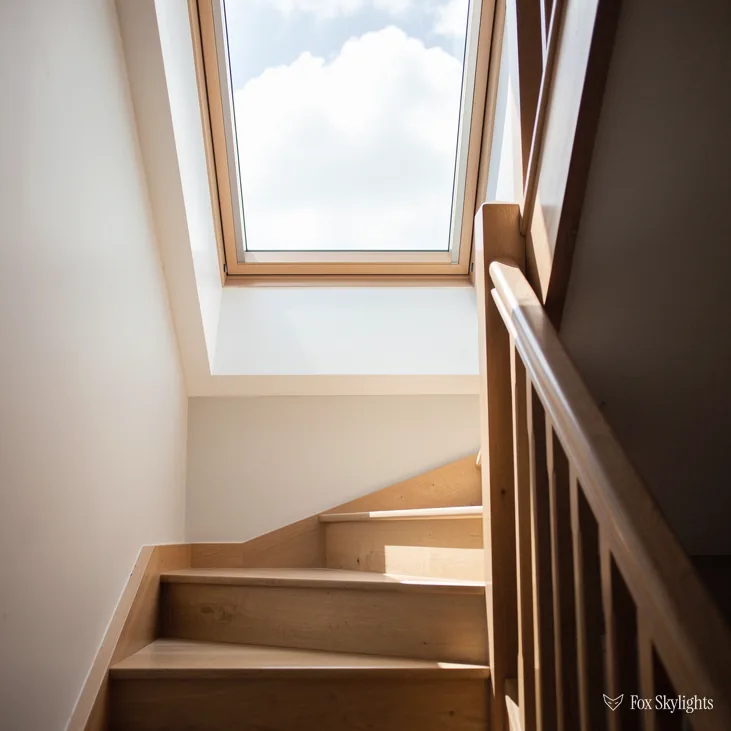
Bilborough, Wollaton, Gedling and Bramcote were once villages, until later twentieth-century housing spread over them. The estates have lofts of the right size and the wrong light, which a roof window between the rafters sorts out.
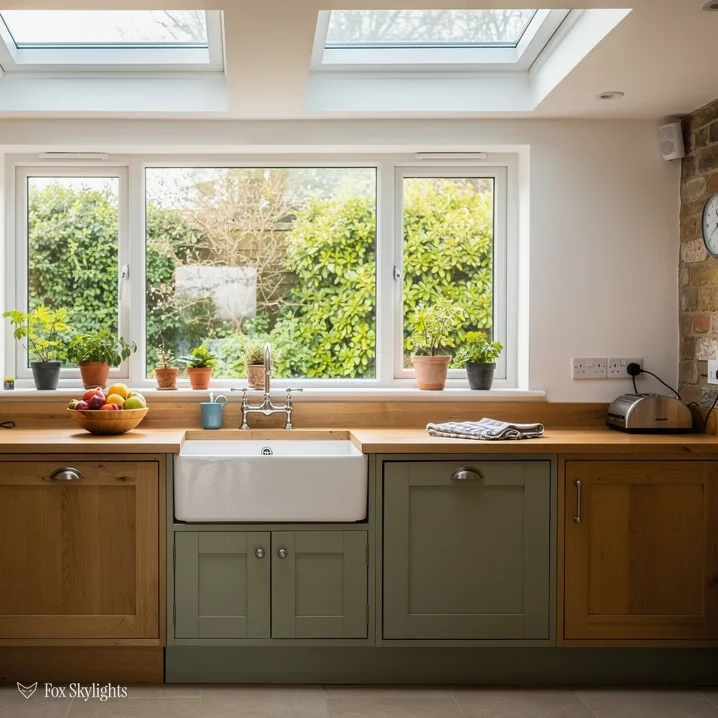
Older houses near the Arboretum and The Park often gain a back extension or a flat-roofed kitchen long after they were built. A flat rooflight over the middle of those rooms lights the part the sash windows never reached.
What a city of three eras needs
-
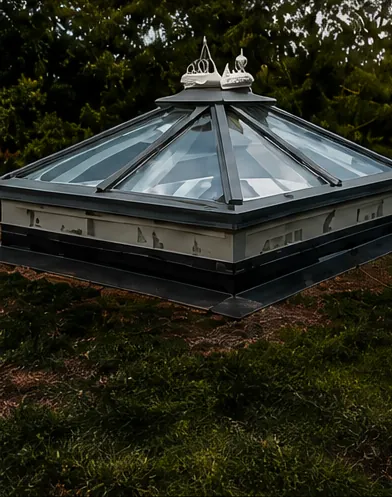 Conservation rooflights
For the Lace Market warehouses, The Park and the streets around the Castle, where the council's eye is on every new opening.
-
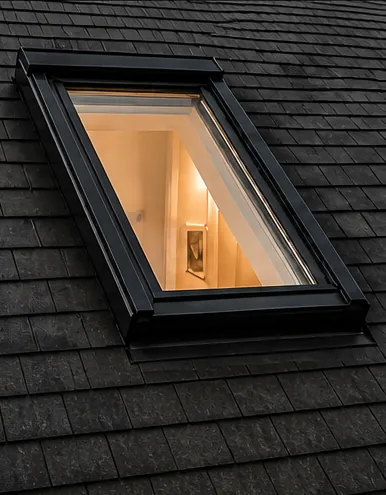 Roof windows
For the outer estates on the old village sites, with lofts framed tall enough to take a proper room.
-
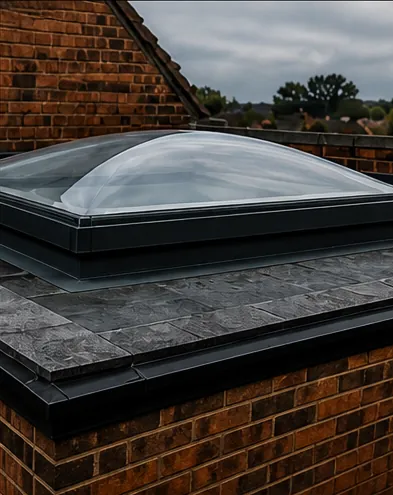 Flat roof rooflights
For back extensions on older houses, where a kitchen ran out into the yard and lost its daylight on the way.
-
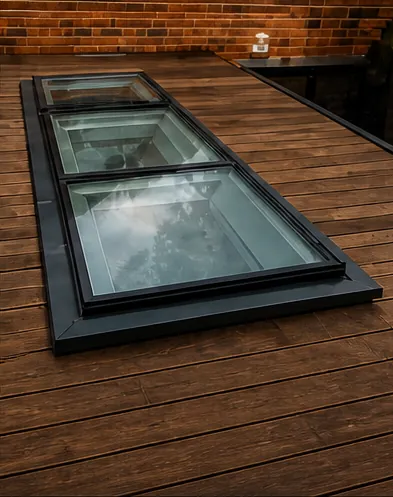 Walk-on rooflights
For the tight yards and roof terraces of converted buildings, where glass has to light a room below and take a footstep above.

THE FOX BROADSHEET · NOTTINGHAM
Seven storeys of red brick, and the sky above them
Nottingham is a city and unitary authority area in Nottinghamshire, 42 miles south-east of Sheffield and 54 miles north-east of Birmingham. It lies on low hills along the lower valley of the River Trent, with Sherwood Forest to the north and the Trent and Belvoir Vales to the east and south. During the Industrial Revolution much of its prosperity came from textiles, and the city became an internationally important centre of lace manufacture. Little textile manufacture happens now, but the buildings stayed.
The Lace Market, just south of Hockley, still has streets of four- to seven-storey red-brick warehouses, iron railings and red phone boxes, and former industrial buildings there have been restored and given new uses. In the planning register its conservation area holds 120 listed buildings: 113 of them Grade II, five Grade II*, one Grade I, and one whose grade was never recorded. Putting a skylight into a building like that is not a routine job. The roofs are high, the neighbours are close, and everything shows from the street or from the windows opposite.
A conservation rooflight is made for this setting. Its profile is low, its frame slim, and often a single central bar splits the glass, so the unit settles into the slope instead of announcing itself. In a converted warehouse the roof may be a modern covering over an old structure, so before we choose a position we look at what the roof is really made of and where the loads run. A flat in such a building is also a different legal case from a house: no householder rights apply to it, and the freeholder usually has to agree as well.
A reader asks
We own a flat in a converted lace warehouse. Where do we start?
With two questions: who owns the roof, and what does the council say? The freehold usually decides the first, and Nottingham City Council the second. We can describe what we would fit, in writing, so both can respond to something specific.
Inside a tall building the roof space often turns out different from the room beneath it. There may be a void between the ceiling and the covering, steel or heavy timber where a modern house would have rafters, and a service run that nobody drew. We open up as far as we safely can on the survey, photograph what is there, and write down which part of the structure the new unit will rest on. If the design needs an engineer's view, we say so at the quote stage and not halfway up the scaffold.
Daylight has a practical value in these conversions. In a deep floor plan the middle of a flat can stay dim all day. A rooflight over a hallway, a bathroom or a kitchen island, where the roof allows one, borrows light from the one direction the street cannot take away. A sun tunnel is the quiet option where there is little roof directly overhead.
Listed buildings, of which the Lace Market has plenty, add a gate: consent under the listing rules, needed for any new opening whatever its size. Applications that succeed tend to keep the frame thin, the glass flat to the slope and the position tidy against the existing roofline. We say which frame suits the slope, and nothing is ordered until the decision is in your hand.
Protected streets and the villages the estates ate
Away from the warehouses, the city is a patchwork of conservation areas. The register gives The Park 58 listed buildings, all Grade II, and the Arboretum 38, again all Grade II. Canning Circus has 25 and Wellington Circus 21. Mapperley Park and Alexandra Park together hold 16, and Sneinton Market, designated on 20 October 2004, holds 9. The Castle area has 66, among them four Grade I, and Old Market Square 125. A good slice of central Nottingham is under some kind of protection, so a house there needs checking before anyone orders glass.
An unlisted house keeps its Class C right to a rooflight even where the street falls within a conservation boundary, unless an Article 4 order was made for it, and its planning team holds the map of those. The central suburbs, among them The Meadows, Radford and Lenton, are recorded as separate neighbourhoods, and in older houses of a terraced layout the shape is familiar: a main block at the front and a narrower back addition behind. The back addition is where a rooflight earns its place, because that is where a kitchen loses its daylight.
The but
A back addition on an older house has a shallow, mono-pitched roof with a party wall on one side and a neighbour's window overlooking the other.
The way in
A flat rooflight laid on a low kerb keeps clear of the party wall line, and a fixed or obscure pane takes care of anyone looking in.
| Area | Roof | First choice |
|---|---|---|
| Lace Market | Tall warehouse | Conservation rooflight |
| The Park, Mapperley | Roof slope | Conservation or roof window |
| Terrace suburbs | Back addition | Flat rooflight |
| Outer estates | Plain loft | Roof window |
Out on the outer ring, the picture changes. In the second half of the twentieth century Nottingham grew with new public and private housing estates and new urban centres, which engulfed former rural villages such as Bilborough, Wollaton, Gedling and Bramcote. Those estates were built for family living, and the lofts above them are the largest unused rooms in the city. A roof window let into the slope between two rafters, its flashing lapped into the tiles, turns one into a bedroom or an office.
The outer ring raises one more question, which is how many windows. A long loft can carry two or three roof windows in a row, each between a different pair of rafters, and the spacing decides how evenly the room is lit. We mark the positions on the survey, stand in the loft with you if you like, and adjust them until the room makes sense.
A terrace-shaped back addition, meanwhile, may suit a walk-on rooflight where it meets a small yard or roof terrace. Walk-on glass is laminated and built to take a person's weight, which is a different product from the ordinary rooflight, and we choose it when a space above is meant to be used as well as looked through.
If the old window is a Velux then the quickest swap is often like for like, with the same size code. The code reads simply once you have the key: letter first for width, then digits for height. Replacements in an existing dwelling are held to Part L: roof windows at 1.4 W/m²K or Window Energy Rating B, and flat-roof rooflights at 2.2 W/m²K. Escape from a converted loft over a two-storey house is by protected stair; an escape window only counts on floors up to 4.5m above ground.
Trent, canal and the city council's desk
Nottingham City Council handles planning in the city. On an ordinary house, a rooflight normally falls inside Class C, the householder rule in the 2015 national order. The conditions: no more than 150mm of projection, no part higher than the existing ridge, and frosted, fixed glass on any side slope unless the opening sash hangs at head-and-a-bit height, 1.7m up. Flats and maisonettes sit outside householder rights, and a listed building needs listed building consent. The full position, exceptions included, is in our detailed planning guide.
The size of Nottingham means we plan visits by area. A day around the Park and Mapperley Park is a different day from one on the outer ring. When you message, give us your postcode and the best days for loft access, and we will offer you the nearest available date. Photographs of the loft hatch and the roof help us prepare for the visit.
Cutting into a roof is building work as well as a planning matter. Where the job is notifiable we lodge it with Building Control ourselves, via the council or a registered private approver, so the paperwork stays with the job.
A reader asks
Is a rooflight in a conservation area treated differently from one outside it?
On an unlisted house, not automatically. Class C still applies unless an Article 4 order covers your street. What changes is how the glass reads from the street, and a low, slim unit suits that setting best. We check the direction status of your address first.
From Leicester the city is 28 road miles north, about 42 minutes by van. Eleven classified A and B roads cross the area within a kilometre of the centre. Nottingham station sits 0.7 km from the centre point, and two closed stations, Victoria and London Road Low Level, are still marked on the map. The Nottingham Canal and Borough Hill are in the records too, and so are nature reserves such as Lenton Triangle, King's Meadow, Iremonger Pond and Colwick Woods.
Houses close to the canal or the green edges of the city meet the weather more directly than those in the middle of town, so we pay extra attention to the flashing and seals on exposed slopes. Nearby places each have their own page and their own roofs: Wilford · West Bridgford · Colwick · Edwalton · Beeston