- 01Frameshops built for the knitters
- 02Estates named Elms and Wheatley
- 03A conservation area down the A60
- 04Nineteen Grade II roofs inside it

Twenty-three road miles due north of Leicester, about 33 minutes behind the wheel
Skylights and rooflights in Ruddington
Built on the knitting frame, this Nottinghamshire village keeps its workshop roofs, estate lofts and a designated centre, each wanting a different rooflight.
Or call 0116 430 0516
Frameshop roofs and estate lofts

The knitters' workshops and cottages that give Ruddington its character were built to hold frames and families. Their roofs deserve a careful, low-profile rooflight set where the street cannot see it.
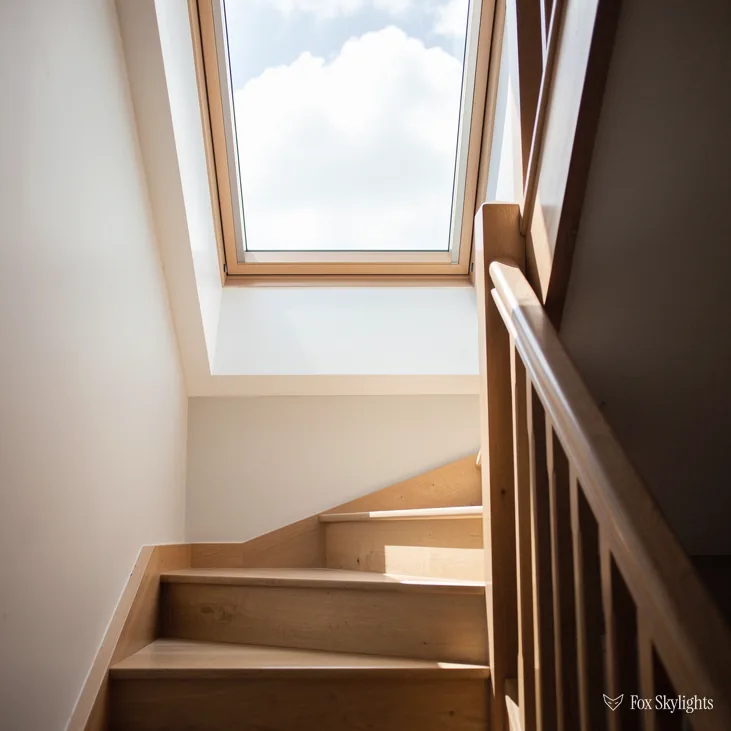
Estates such as Elms Park and the newer Wheatley Fields hold family houses from later periods. Their lofts are the natural home for roof windows, and the rafters decide the size.
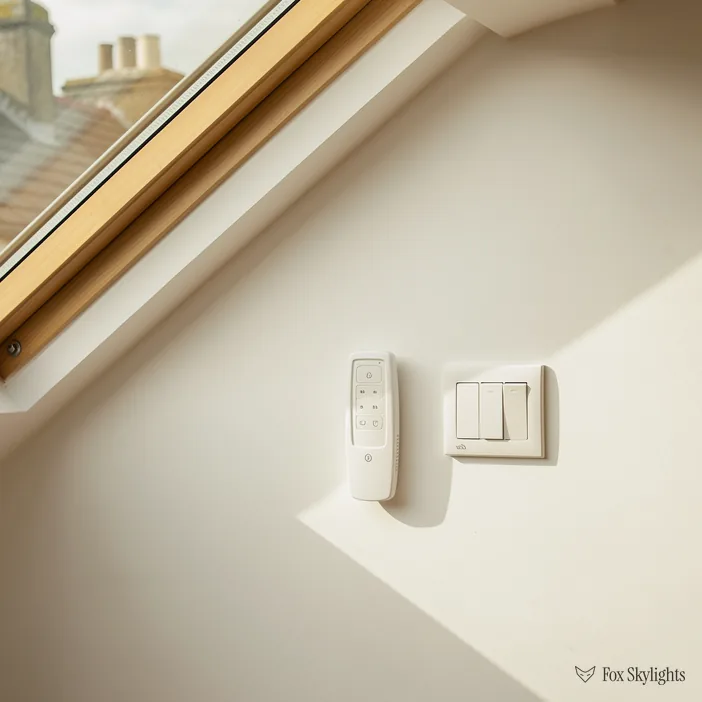
Where a house gained an extension under a flat roof, a rooflight on a kerb brings daylight down from above. A deep kitchen gets a bright middle that way.
Matching rooflight to Ruddington roof
-
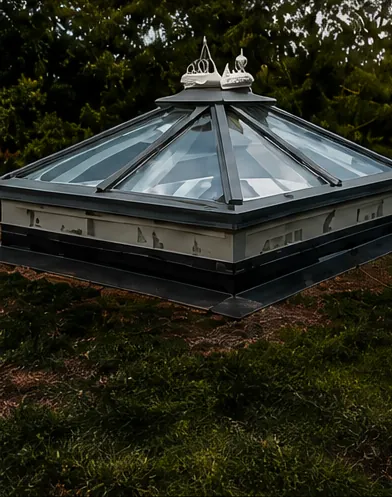 Conservation rooflights
For frameshops, cottages and anything within the conservation area, where a slim low frame leaves the slope looking as it always has.
-
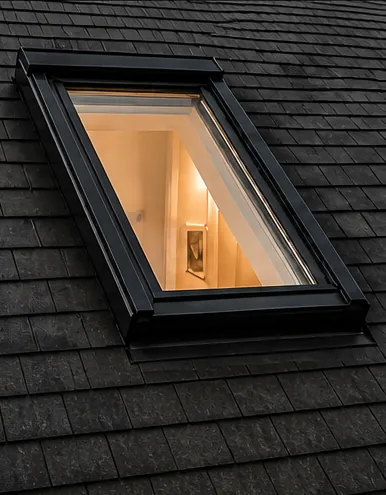 Roof windows
For loft conversions on the estates, fitted between rafters once headroom and timber spacing have been measured.
-
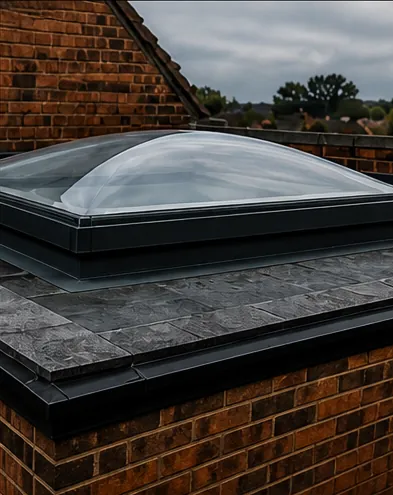 Flat roof rooflights
For extensions under flat roofs, where the glass sits on a kerb that sends rain away instead of holding it.
-
 Roof lanterns
For larger extensions with a big flat roof, where a lantern can make a dining space tall and bright.

THE FOX BROADSHEET · RUDDINGTON
A village the knitting frame built
Five miles south of Nottingham and eleven north-west of Loughborough, Ruddington is a large village of the Rushcliffe borough, in Nottinghamshire. The knitting trade reached it by the start of the nineteenth century, after the knitting frame was invented in Nottinghamshire. Newcomers followed the work, and the population climbed to 2,500 as the trade stretched into lace manufacture. Homes and frameshops went up for the knitters, including the plot now occupied by the Ruddington Framework Knitters Museum.
That history sits in the roofs. Frameshops were built to provide homes and workspace for the knitters and their families. Several Grade II listed buildings in the village are period knitters' workshops and cottages, along with St Peter's Church and, rather surprisingly, a phone kiosk.
Later Ruddington is another story. The residential areas include the Elms Park estate, Manor Park and the newer Wheatley Fields estate, plus Brook Hill, a thin line of ribbon development that almost touches Clifton. The contents of those lofts are something we learn by climbing in. A large village holds plenty of ordinary family houses with loft space nobody has considered for years, and roof windows are how that space becomes a room.
A reader asks
Will a rooflight on a knitter's cottage look wrong from the road?
Not if it is chosen and placed with the street in mind. A conservation-style frame lies close to the slope, with a thin central bar that echoes an old cast-iron light. Position it on the rear slope and the front stays as the knitters left it. Our page on conservation rooflights shows the detail.
Light was the whole point of a frameshop, and a good rooflight keeps that logic alive. The old workers wanted brightness at the bench, and a modern household wants it at the table, the desk or the stair. The details differ, but the instinct is the same: put the glass where the work happens. On a pitched slope that usually means a roof window. Over a stairwell it can mean a fixed rooflight, high up, that lights every flight below.
There are two further things to keep in mind on older workshop buildings. The upper floor may have a taller ceiling than modern houses and a long window wall, so one rooflight can seem small by comparison. And the roof timbers may be bigger and wider apart, which can allow a larger opening if the structure is sound. The survey tells us which way it goes, and the answer is written into the quote with the opening size marked.
Rushcliffe, a boundary and nineteen listed roofs
For planning, Ruddington answers to Rushcliffe Borough Council. A householder usually files nothing for a skylight: the householder order of 2015 grants it under its Class C, within set limits. Think of them as height, projection and privacy. The glass can project 150mm from the slope but no further. It cannot climb past the top of the roof. And glass on a side slope has to be frosted and kept shut, unless the lowest edge of the opening section is more than 1.7m above floor level.
The conservation area deserves a closer look. The planning register names Ruddington Conservation Area across the village centre, designated on 5 November 2002, with nineteen listed buildings recorded inside, every one of them Grade II. A separate account describes an area of 20.5 hectares first designated in 1970, running from Manor Park through the historic centre to newer buildings on the A60 Loughborough Road. Since the two accounts disagree on dates, we leave the boundary to the council and put your address to them.
It helps to keep three ideas apart. Listing protects a building for its own sake. A conservation area protects the character of a place. An Article 4 direction removes named rights from named properties. A Ruddington house can be under one, two, all three or none, and each answer alters the quote. All of it is settled before the survey ends.
A house outside the boundary has an easier road, though never an automatic one. Flats and maisonettes sit outside householder permitted development, which makes a planning application their opening move. If you live in a converted workshop or a divided house, say so at once, because the ownership and the status of the building change the first step.
A reader asks
Does a conservation area stop me choosing a modern roof window?
Not automatically. The deciding factors are your Article 4 position, whether the house is listed, and what the slope looks like from public view. On a rear slope hidden from the street, a standard roof window is often possible where the rules allow. We would still lean towards a slimmer frame inside the boundary. The rules are set out in full in our longer planning guide.
Building Regulations apply on top. A hole cut in a roof is building work. For notifiable jobs we send the Building Control notice ourselves, either to Rushcliffe itself or via a registered approver. The glazing must also meet the standard for existing dwellings: a roof window is capped at 1.4 W/m²K of heat loss, or must earn band B, while a rooflight is capped at 2.2. No rule in England demands daylight in a house, so a bright room is something you choose.
| Situation | Where it starts |
|---|---|
| Unlisted house | Class C |
| Listed workshop | Listed building consent |
| Flat | Planning application |
| Article 4 area | Planning application |
Hills, railway ghosts and the loft survey
The land around Ruddington rises and falls enough to have names. Fowemer Hill lies just over a kilometre away, with Wilford Hill and Spinny Hill a little further, and Mickleborough Hill stands close to the wider Grange area, home to Ruddington Hall. Fairham Brook, Sharphill Wood and Glapton Wood are among the nature reserves within three kilometres. For a house on a rise, the sky is generous. A rooflight in a bedroom there can show treetops and cloud instead of a neighbour's wall.
Ruddington once had a mainline connection. The village station was on the Great Central Railway, the last main line to be built from the north of England to London, opened on 15 March 1899. The station is now closed.
What happens at a survey
The visit costs nothing. We climb into the loft or step out onto the flat roof, take the rafter spacing, read the covering and ask what use the room will get. Pitched roofs get a note of the tile profile, because the flashing kit must match it. Flat roofs get a note of the fall, because the kerb has to correct it. Photographs go in the file, and the fixed written quote follows.
A reader asks
How long do I wait between the survey and the work?
The fixed written quote follows the survey, and the fitting date is agreed with you after you accept. A single roof window is a short job, while a lantern or a large flat rooflight takes longer, and we tell you the timing at the quote stage. For more on process, our page on roof windows sets out what goes into the fit.
Give the glass a thought before the survey. Double glazing is the normal start for a roof window, and a better specification keeps a bright room comfortable in winter. Solar-control coatings help a south slope in summer, and an opening unit lets out the warm air that gathers at the top of the house. Choices like these appear in the quote in plain terms, with the product named and the finish shown.
From Leicester, Ruddington is a longer run than our nearest towns, and still well within reach. Visits are planned so that survey and fitting waste none of your day. To start with a message, send WhatsApp a photo on 07880 284133, or request a free survey through the form. A 10-year workmanship guarantee backs the fit, and the quote is fixed before work begins.
A last word on timing. Weather matters to roof work, and so does the state of the loft. In a village with a mix of old and new roofs, one visit can show you both, and we use that: the neighbour's loft often hints at what yours holds. If you have stored things up there, a short clear-out before the visit helps us measure, and we protect the room below during the work. A clear route to the hatch and a cleared patch of floor are all we ask for. Everything else we bring: dust sheets, ladders, boards and the glass itself. When the unit is in, we tidy the loft edge, check the inside lining and show you how any opening mechanism works.
Ruddington is a large village five miles south of Nottingham, and among its homes are Grade II listed buildings, including period knitters workshops and cottages. A listed building needs listed building consent for any work that changes it, whatever the grade, so the planning position is checked before anything is ordered. Elsewhere a house may be older or newer, and the survey simply records what is there.
Residential areas include the Elms Park estate, Manor Park, the newer Wheatley Fields estate and Brook Hill, and the roof construction can differ between them. Whichever you live in, installation or replacement of the window you choose carries our 10-year workmanship guarantee.